

Christian Art | Jesus | Lord’s Prayer | Crucifixion
Office Of Readings | Week 11, Monday, Ordinary Time | A Reading From The Treatise Of Saint Cyprian On The Lord’s Prayer | Our Prayer Is Public And For All
‘Our prayer is public and communal.’
In this portion of his treatise, Saint Cyprian of Carthage underscores the profoundly communal nature of Christian prayer, especially as it is expressed in the Our Father. Writing in the mid-third century amidst persecution and internal divisions, Cyprian offers not only theological reflection but also pastoral guidance on the meaning and practice of unity in prayer.
The Communal ‘Our’ Of Christian Prayer
At the heart of Cyprian’s teaching is the reminder that the prayer Christ taught us begins not with ‘My Father’, but ‘Our Father’. This small word bears enormous theological weight. It reminds the believer that prayer is never a solitary act. Even when one prays alone, one prays as a member of Christ’s Body, the Church.
Cyprian’s words resonate with the Pauline understanding of the Church as one body with many members (1 Corinthians 12:12–27). For him, the unity expressed in shared prayer is not mere courtesy or formality; it is an expression of the unity brought about by baptism and maintained by charity. In praying, ‘Give us this day our daily bread,’ we acknowledge the shared needs of all God’s children, not only our own.
The Peaceful Prayer Of The Whole People Of God
Cyprian anchors his teaching in biblical examples, particularly the prayer of the three young men in the furnace (Daniel 3). Though they lived before Christ, their prayer was ‘as with one mouth’. This unity of spirit in the midst of trial prefigures the unity Christ would explicitly establish in the Church.
Similarly, the early Church is depicted in Acts as praying ‘with one accord’ after the Ascension. Cyprian sees this unanimity not as incidental but essential: it is a prerequisite for being received into the eternal dwelling of God. His pastoral message is urgent—unity in prayer must be more than outward form; it must reflect true interior communion.
The Lord’s Prayer As A Summary Of The Christian Life
Cyprian describes the Our Father as a ‘compendium of heavenly doctrine’. It is striking that such a concise prayer is said to contain ‘nothing at all that is not to be found’ in our prayers and petitions. For Cyprian, this is not rhetorical flourish—it is a statement of theological depth. The Lord’s Prayer offers praise (Our Father, hallowed be Thy name), hope (Thy Kingdom come), dependence (Give us today our daily bread), mercy (Forgive us our trespasses), and protection (Deliver us from evil).
He links this prayer not merely with routine devotion but with the identity of the Christian: only the one reborn in Christ can truly say ‘Father’. Here Cyprian echoes the Johannine teaching: ‘To those who believed in his name, he gave power to become children of God.’ (John 1:12) This is not a title of sentiment, but a recognition of our adopted sonship through grace.

A Reading From The Treatise Of Saint Cyprian On The Lord’s Prayer | Our Prayer Is Public And For All
Above all, the Teacher of peace and Master of unity did not want prayer to be made singly and privately, so that whoever prayed would pray for himself alone. We do not say My Father, who art in heaven or Give me this day my daily bread; nor does each one ask that only his own debt should be forgiven him; nor does he request for himself alone that he may not be led into temptation but delivered from evil. Our prayer is public and common, and when we pray, we pray not for one person but for the whole people, since we, the whole people, are one.
The God of peace and the Master of concord, who taught unity, willed that one should pray for all, just as he himself, being one, carried us all. The three children observed this law when they were shut into the fiery furnace, praying with one voice and with one heart: thus our faith in divine Scripture teaches us, and, as it teaches us how such people prayed, gives us an example that we should follow in our own prayers, so that we may become like them: Then these three sang a hymn as if with one mouth, and blessed the Lord. They spoke as if with one mouth, even though Christ had not yet taught them how to pray.
And therefore, as they prayed, their prayers were heard and were fruitful, because a peaceful, sincere, and spiritual prayer deserved well from the Lord. Thus, too, we find the Apostles and the disciples praying after the ascension of the Lord: They all continued with one accord in prayer, with the women and with Mary who was the mother of Jesus, and his brothers. They continued with one accord in prayer, showing, by the urgency and the unanimity of their praying, that God, who makes the inhabitants of a house to be of one mind, only admits to his divine and eternal home those among whom prayer is unanimous.
But, dear brethren – what deep blessings are contained in the Lord’s prayer! How many they are, and how great, collected in so few words but so rich in spiritual power! There is nothing at all that is not to be found in these our prayers and petitions, as it were a compendium of heavenly doctrine. Thus, he said, you must pray: Our Father, who art in heaven.
The new man, re-born and brought back to God by his grace, says Father at the very beginning, for he has just begun to be God’s son. He came to his own, and his own did not accept him. But to those who did accept him he gave power to become children of God, to those who believe in his name. Whoever believes in God’s name and has become his son, should start here so that he can give thanks and profess himself to be God’s son, by calling God his Father in heaven.
Prayer With Jesus
Heavenly Father,
who through your Son taught us to pray not for ourselves alone but for all your people,
grant that our hearts may be united with the Body of Christ,
that our prayers may rise as one voice, pleasing to you.
Teach us to seek not our own will but yours,
to forgive as we have been forgiven,
and to live in harmony with one another,
that we may be counted among your children in your heavenly household.
Through Christ our Lord. Amen.
Glossary Of Christian Terms
- Communal Prayer: Prayer offered not just as an individual but as part of the whole Church, reflecting our shared identity in Christ.
- Our Father: The Lord’s Prayer, taught by Christ to his disciples as the model of all prayer (Matthew 6:9–13).
- Cyprian of Carthage: Third-century bishop and martyr known for his teachings on Church unity, sacraments, and prayer.
- Catechumen: A person receiving instruction in the Christian faith in preparation for baptism.
- Unanimity in Prayer: The spiritual and ecclesial unity expressed when the faithful pray in one spirit and intention.
- Three Young Men in the Furnace: Biblical figures (from Daniel 3) who prayed in unity amidst persecution, prefiguring Christian communion.
- Adoption in Christ: The theological doctrine that believers become sons and daughters of God through faith and baptism.
- Acts 1:14: A scriptural reference to the Apostles praying in unity after Christ’s Ascension, foundational to Cyprian’s argument.




Artificial Intelligence (AI) has raised questions concerning the nature and value of the human person, and the future of humanity, to the forefront of public discussion. Possible consequences of the growth and development of AI include unemployment, the replacement of human labour by artificial systems, a concentration of wealth and economic power away from local communities and towards large technology corporations, civilizational collapse and, at the extreme, catastrophic extinction of humanity. Such possibilities have themselves produced an apocalyptic language around AI. In the light of the book The Revelation Of Saint John The Divine, or Apocalypse, we may interrogate modern technology and AI through the lens of Christian faith, and through an awakened sense of our humanity. In doing so, we follow here and draw upon the encyclical of Pope Leo XIV, Magnifica Humanitas. We consider what the real capabilities and dangers of AI amount to, what Revelation actually says about power and deception, and how a Christian account of the end of history judges both technological fear and technological hope [ … ]
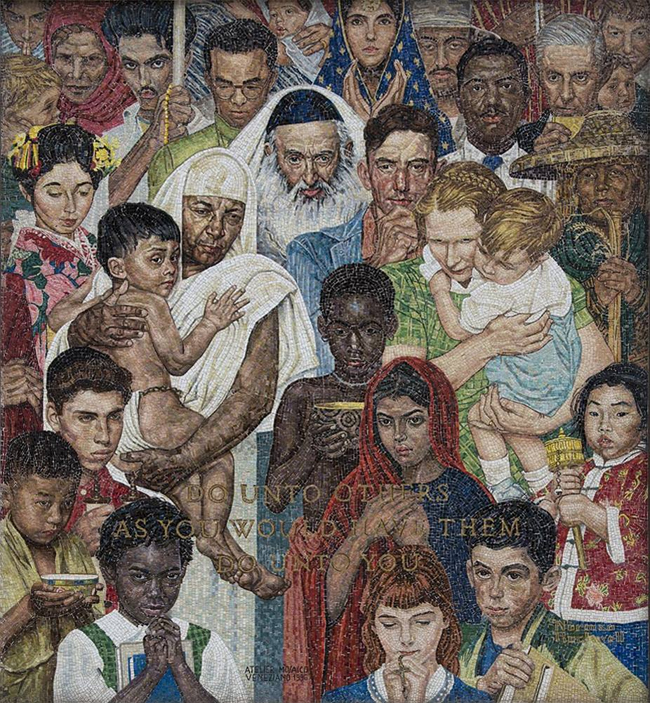
Jesus has discussed the resurrection of the dead with those who question him. He has spoken truly and in accordance with the Old Testament teachings of the Bible. The scribe who now asks Jesus his question is clearly a just man; he is not seeking to test Jesus but rather to learn from him and discover the truth. Jesus sees this and makes time to speak to the scribe quite plainly. The scribe accepts what Jesus has to say and we hear of Jesus’ message sinking into his heart [ … ]
Psalm 63 offers solace and inspiration to those who seek God’s presence, even in the midst of life’s trials. It serves as a reminder that our pursuit of the Divine should be unwavering, prioritizing our connection with God above all else. It acknowledges profound joy and spiritual fulfilment that come from seeking and experiencing God’s love and protection [ … ]
