

Christian Art | Jesus’ Miracles | Prayer And Healing
Office Of Readings | Week 12, Tuesday, Ordinary Time | A Reading From The Treatise Of Saint Gregory Of Nyssa On Christian Perfection | We Must Show Jesus Christ In Our Whole Life
‘Jesus Christ should be manifest in our whole life.’
The Christian Life As Theosis
Saint Gregory’s theology is deeply shaped by the Eastern Christian doctrine of theosis, or divinisation. For Gregory, salvation is not merely juridical or moral but ontological: to be saved is to become by grace what Christ is by nature. When Gregory writes that Christians must examine their thoughts, words, and deeds to see whether they are ‘directed toward Christ’, he is describing a dynamic process of transformation. This process, which begins in baptism and continues throughout life, involves increasing conformity to the divine image. In this sense, Christian perfection is not a static achievement but an unending ascent towards God, as expressed in his Life of Moses.
Philosophical Background | Thought, Word, And Deed
Saint Gregory inherits the classical triad of thought, word, and deed from Greek philosophical traditions, especially Stoicism and Platonism. For Plato, the harmony of the soul’s faculties (reason, spirit, and appetite) is the foundation of virtue. Gregory Christianises this structure: the mind (or nous) must be aligned with the divine Logos, so that the soul’s activities (speech and action) manifest the purity of its source. By stating that the life of the Christian must reflect Christ in all three domains, Gregory presents a coherent anthropology where the inner and outer life are seamlessly united in the image of Christ.
Passions And The Purity Of Heart
Gregory’s distinction between actions that stem from passion and those that reflect Christ draws on early Christian and monastic traditions that treat the ‘passions’ (such as pride, lust, and anger) as distortions of the soul’s natural energies. Influenced by thinkers like Evagrius Ponticus, Gregory sees the spiritual life as one of purification and restoration. The heart, as the seat of intention and desire, must be cleansed and brought into harmony with divine truth. Only then can the ‘pearl’ of the soul reflect the light of Jesus Christ without distortion.
Baptismal And Catechetical Echoes
Gregory’s vision is likely grounded in the catechetical practices of the early Church. Baptism was understood not merely as a rite of initiation but as the beginning of a lifelong process of transformation. His insistence that we must ‘show a likeness to Christ’ in our words and deeds echoes the baptismal liturgy, in which the newly baptised are clothed with Jesus Christ and anointed with chrism. The metaphor of the flowing water, drawn from a pure source, evokes both baptism and the Eucharist as sacraments of purification and union.
Biblical Imagery And Theology
Gregory’s metaphors are richly scriptural. The pearl recalls the parable of the pearl of great price (Matthew 13:45–46), suggesting the soul’s infinite worth and the need for purity. The image of water drawn from a pure stream evokes Jesus’ words in John 4 about the living water he offers. The ‘gleaming water in a jar’ mirroring its source underscores the idea that Christians are not autonomous but derive their beauty and life from Christ. Finally, the call to manifest Christ in thought, word, and deed parallels Jesus’ own life and the teaching of Paul: ‘Let the same mind be in you that was in Christ Jesus.’ (Philippians 2:5)

A Reading From The Treatise Of Saint Gregory Of Nyssa On Christian Perfection | We Must Show Jesus Christ In Our Whole Life
The life of the Christian has three distinguishing aspects: deeds, words and thought. Thought comes first, then words, since our words express openly the interior conclusions of the mind. Finally, after thoughts and words, comes action, for our deeds carry out what the mind has conceived. So when one of these results in our acting or speaking or thinking, we must make sure that all our thoughts, words and deeds are controlled by the divine ideal, the revelation of Christ. For then our thoughts, words and deeds will not fall short of the nobility of their implications.
What then must we do, we who have been found worthy of the name of Christ? Each of us must examine his thoughts, words and deeds, to see whether they are directed toward Christ or are turned away from him. This examination is carried out in various ways. Our deeds or our thoughts or our words are not in harmony with Christ if they issue from passion. They then bear the mark of the enemy who smears the pearl of the heart with the slime of passion, dimming and even destroying the lustre of the precious stone.
On the other hand, if they are free from and untainted by every passionate inclination, they are directed toward Christ, the author and source of peace. He is like a pure, untainted stream. If you draw from him the thoughts in your mind and the inclinations of your heart, you will show a likeness to Christ, your source and origin, as the gleaming water in a jar resembles the flowing water from which it was obtained.
For the purity of Christ and the purity that is manifest in our hearts are identical. Christ’s purity, however, is the fountainhead; ours has its source in him and flows out of him. Our life is stamped with the beauty of his thought. The inner and the outer man are harmonised in a kind of music. The mind of Christ is the controlling influence that inspires us to moderation and goodness in our behaviour. As I see it, Christian perfection consists in this: sharing the titles which express the meaning of Christ’s name, we bring out this meaning in our minds, our prayers and our way of life.
Prayer With Jesus
Lord Jesus Christ, You are the source of all purity, the image of the invisible God, Grant that our thoughts, words, and actions May mirror your holiness. Cleanse our hearts of passion, Strengthen our minds with your wisdom, And fill our lives with your peace. That we who are called by your name May truly reflect your likeness in the world. Amen.
Glossary Of Christian Terms
- Theosis: The process by which a Christian becomes more like God through grace.
- Nous: A Greek term meaning ‘mind’ or ‘intellect’, often seen as the highest part of the soul.
- Passions: Disordered affections that draw the soul away from God; to be transformed, not merely suppressed.
- Logos: The Word of God; in Christian theology, identified with Christ as the rational principle of all creation.
- Catechesis: Religious instruction given to prepare individuals for baptism and full entry into the Church.
- Pearl of great price: A biblical image (Matthew 13) for the Kingdom of God or the soul’s value.



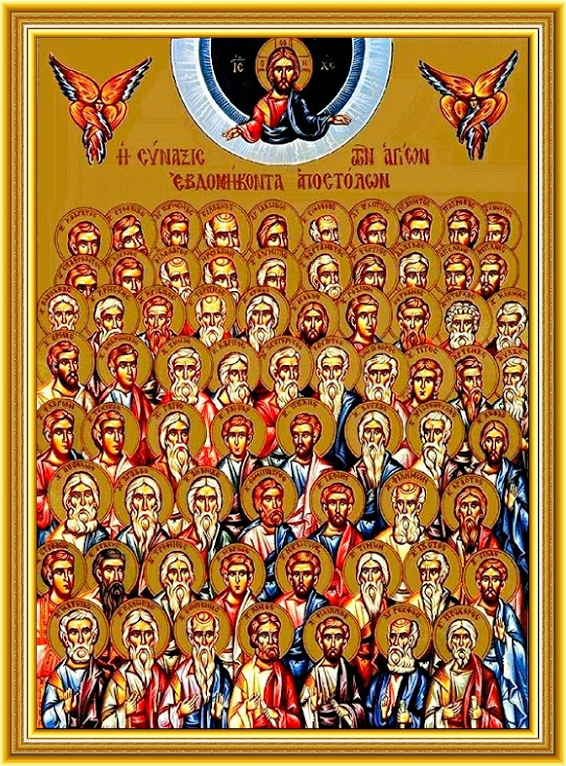
The seventy disciples, or as some authorities state: the seventy two, are symbolic of the sending to all nations, and supplementary to the Twelve. There is a numerical symbolism here, the meaning of which we may with confidence say concerns a sending of the Gospel to all nations [ … ]

Psalm 120, a cry for deliverance and peace, is the first of the fifteen Songs of Ascents (Psalms 120-134) in the Book of Psalms. Traditionally attributed to King David, these psalms were sung by pilgrims journeying to Jerusalem for the great feasts. Psalm 120 reflects a deep yearning for deliverance from deceit and falsehood [ … ]

Psalm 104, attributed to King David, celebrates the vastness and intricacies of God’s creation. Unlike some other psalms that focus on personal feelings, this psalm marvels at the natural world and presents God as its masterful architect [ … ]
