
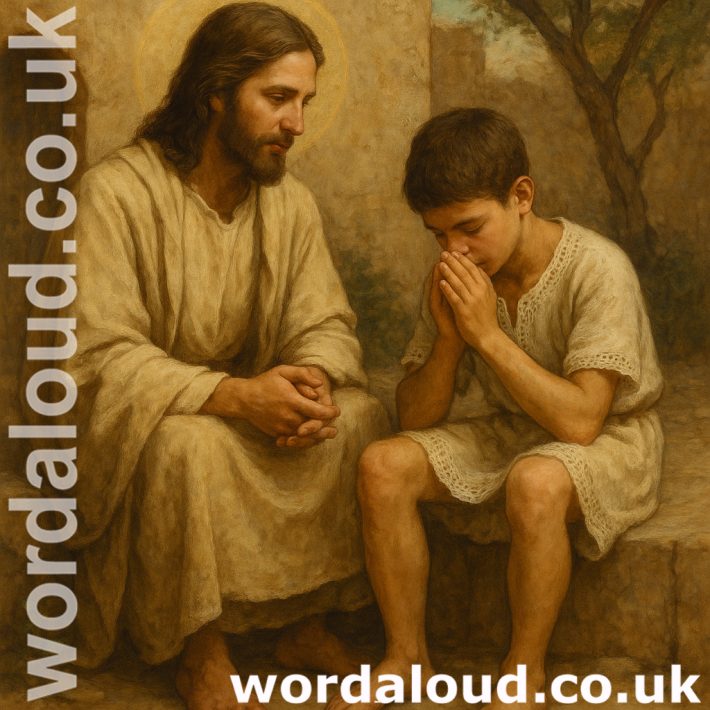
Christian Art | Jesus And A Boy | Confession Of Sin | Forgiveness Of Sin
Office Of Readings | Week 13, Saturday, Ordinary Time | A Reading From The Instructions Of Saint Cyril Of Jerusalem To Catechumens | Confess Your Sin
‘Make your confession at the acceptable time.’
Saint Cyril’s exhortation to catechumens on the cusp of their baptism is both tender and trenchant—a passionate plea for authentic conversion and inward renewal. Saint Cyril’s language, though steeped in fourth-century catechetical formality, rings with timeless clarity: ‘Confess what you have done… if you confess at the acceptable time, you will receive the heavenly treasure.’ The stakes could not be higher, nor the invitation more generous.
Baptismal Catechesis In The Early Church
This text is situated within the intense pre-baptismal preparation of Lent in fourth-century Jerusalem, where Saint Cyril delivered his famed Catechetical Lectures to those preparing for initiation at Easter. The tone of this instruction reflects the final phase of preparation, the scrutinies, in which catechumens were called to examine their hearts, renounce the devil, and confess their sins openly and inwardly before being sealed with the gift of the Holy Spirit.
Thus, Cyril’s phrase ‘Confess your sins at the acceptable time’ is not generic moral advice. It is liturgically charged: it is now, at the turning point of their lives, that the catechumens must present themselves wholly and truthfully to God. The ‘acceptable time’ echoes 2 Corinthians 6:2: ‘Now is the favourable time; this is the day of salvation.’ The Church, in other words, is not simply offering information—it is facilitating a threshold encounter with the living God.
Theological Anthropology Of The New Birth
Cyril’s language of being ‘stripped’ of the old nature and ‘clothed’ with the new is profoundly Pauline, echoing Ephesians 4 and Colossians 3. For Cyril, baptism is not merely symbolic—it effects a real ontological change. The one who enters the font dies to sin and rises to new life, not just as a moral act, but as an inward reconfiguration of the soul. This is no small claim: Cyril describes the human being as becoming a vessel for grace, a co-heir with Christ.
However, this new nature must be freely embraced. Cyril’s emphasis on personal responsibility—’Run hard, in your own interest’—is not Pelagian but synergistic. Divine grace is unmerited, but it does not override human freedom. In his theological framework, grace elevates rather than nullifies free will. Baptism, then, is not passive reception but a covenantal union: the catechumen must be inwardly sincere and externally disposed to receive the gift offered.
This anthropology—of humans made for divine likeness, but wounded by sin—lies at the heart of Eastern Christian theology. Cyril’s insistence on sincerity, humility, and forgiveness aligns with the tradition of the Fathers, in which the path to holiness is always one of ascesis: a laying aside of pride and hypocrisy so that the image of God may shine once more.
The Spirit And The Seal | Identity In Christ
Cyril’s phrase ‘Come before the mystical Seal of God’s kingdom’ is rich with liturgical and sacramental significance. The ‘seal’ (σφραγίς in Greek) refers both to baptism and to the anointing with chrism (confirmation), marking the believer as belonging to Jesus Christ. This sealing is not cosmetic—it is ontological. Just as livestock were once sealed by their owner’s brand, so the Christian is marked indelibly by the Holy Spirit.
The theme of divine adoption runs through the piece: ‘Make yourself ready through faith for the new birth into the freedom of God’s adopted children.’ This is not legal metaphor but intimate transformation. The baptised Christian becomes a son or daughter of God—not metaphorically, but by real participation in the Sonship of Christ. The Trinitarian nature of salvation is implicit here: the Father sends the Son, who pours out the Spirit, who conforms us to Christ, who brings us to the Father.
Forgiveness As Precondition For Receiving Grace
Strikingly, Cyril ends this profound theological instruction with a moral imperative: ‘If you are holding anything against anyone, forget it, let it go.’ The emphasis is clear: forgiveness received must become forgiveness given. This recalls the Lord’s Prayer—’Forgive us our trespasses, as we forgive those who trespass against us.’ For Cyril, this is not an optional moral flourish. It is structural to the Gospel. The one who would receive the remission of sins must first become merciful in heart.
Cyril’s vision is holistic: baptism is not merely a cleansing of the past, but a radical reorientation of the heart, mind and community. In a world where bitterness and resentment can linger, Cyril challenges the believer to embody the Gospel’s mercy before daring to receive it anew.

A Reading From The Instructions Of Saint Cyril Of Jerusalem To Catechumens | Confess Your Sin
If anyone here is a slave to sin then let him make himself ready through faith for the new birth into the freedom of God’s adopted children. Let him put aside his wretched servitude of sin and take on the blessed service of the Lord; so that he may be counted as a worthy sharer in the inheritance of the kingdom of heaven. Through confession, strip yourself naked of your old human nature, which is being torn apart by deceitful desires, and clothe yourself in the new nature, which is being mended and made whole by knowledge of the One who created you. By faith receive the guarantee of the Holy Spirit, so that you will be received into your eternal home. Come before the mystical Seal of God’s kingdom so that you may be easily recognised by the Master.
Be counted as part of the holy and spiritual flock of Christ, to be set apart on his right hand and receive the inheritance that has been prepared for you. Those who still wear the rough garment of their sins are on his left hand because they have not come to the grace of God which is given through Christ in the baptism of rebirth. It is not a new physical birth I mean, but a spiritual second birth of the soul. Bodies are born of visible parents but souls are reborn through faith, for the Spirit blows where it wills.
If you are found worthy, you will hear the words Well done, good and faithful servant – when your conscience has been examined and found to be free of all taint of hypocrisy.
If anyone here thinks of putting God’s grace to the test, he is deceiving himself and ignorant of the power of things. Keep your soul sincere and free of hypocrisy because God searches the mind and the heart.
The present time is the time for confession. Confess what you have done, whether by words or by actions, whether by day or by night. If you confess at the acceptable time, you will receive the heavenly treasure on the Day of salvation.
Make yourself pure so that you may be a vessel of more abundant grace. Remission of sins is given equally to everyone but the sharing of the Holy Spirit is given differently to each man, according to the faith of each. If you have expended little labour, you will receive little in the way of reward; if, on the other hand, you have laboured greatly, great will be the reward you receive. It is for your own benefit that you are running this race: run hard, in your own interest.
If you are holding anything against anyone, forget it, let it go. You have come here to receive forgiveness of sins, so you must first forgive whoever has sinned against you.
Prayer With Jesus | A Prayer for Sincerity and Renewal in Jesus Christ
Almighty and merciful Father,
You have called us from the shadow of sin into the light of Your Kingdom.
Strip from our souls the old garments of deceit, and clothe us in the new life of grace.
Grant us the humility to confess our sins with honest hearts,
and the courage to forgive as we hope to be forgiven.
By Your Holy Spirit, make us worthy vessels of Your mercy.
Cleanse our thoughts, purify our intentions, and free us from all hypocrisy.
As we draw near to the font of life,
seal us with the sign of Your eternal covenant,
that we may be numbered among the children of light,
and rejoice forever in the inheritance of Your saints.
Through Jesus Christ our Lord,
who lives and reigns with You and the Holy Spirit,
one God, now and forever.
Amen.
Glossary Of Christian Terms
Catechumen – A person receiving instruction in the Christian faith, especially in preparation for baptism.
Ontology / Ontological – Refers to the nature of being. In theology, it concerns the real transformation of a person’s nature, not just symbolic change.
Synergistic – In theology, this term refers to cooperation between human free will and divine grace, as opposed to grace acting alone (monergism).
Ascesis – A term from Greek spirituality referring to disciplined spiritual practice, often involving prayer, fasting, and moral striving.
Seal (σφραγίς) – A symbol of ownership and authenticity. In Christian sacramental theology, it refers to the indelible mark of belonging to Christ given in baptism and confirmation.
Predestination – A theological concept referring to God’s eternal plan for salvation, not to be confused with determinism. St Cyril uses the concept in the context of divine foreknowledge and grace.
Mystical – Pertaining to the hidden or spiritual realities of God’s presence, particularly as encountered in the sacraments.
Hypocrisy – Pretending to be virtuous or religious while hiding one’s sins or wrong motives; a key vice opposed in the Gospels.
Remission of sins – The forgiveness or absolution of sins, especially through the sacrament of baptism or reconciliation.



Saint Augustine concludes his teaching on prayer by returning to its centre: the movement of the Holy Spirit within the believer. The true object of all prayer is the vision of God — the ‘life of happiness’ in which body and soul, made incorruptible, will behold the divine goodness for ever. Every other request is secondary and derives its meaning from this one desire. Without it, even good things lose their worth; with it, nothing is lacking [ … ]

Saint Columban (c. 543–615) was an Irish monk and missionary whose work helped to shape early medieval monasticism in continental Europe. His writings, including sermons and monastic rules, reveal a spirituality that is both ascetic and deeply scriptural. The passage we have today develops a theme central to his teaching: the inexhaustible desire for Christ as the fountain of life and bread of life [ … ]
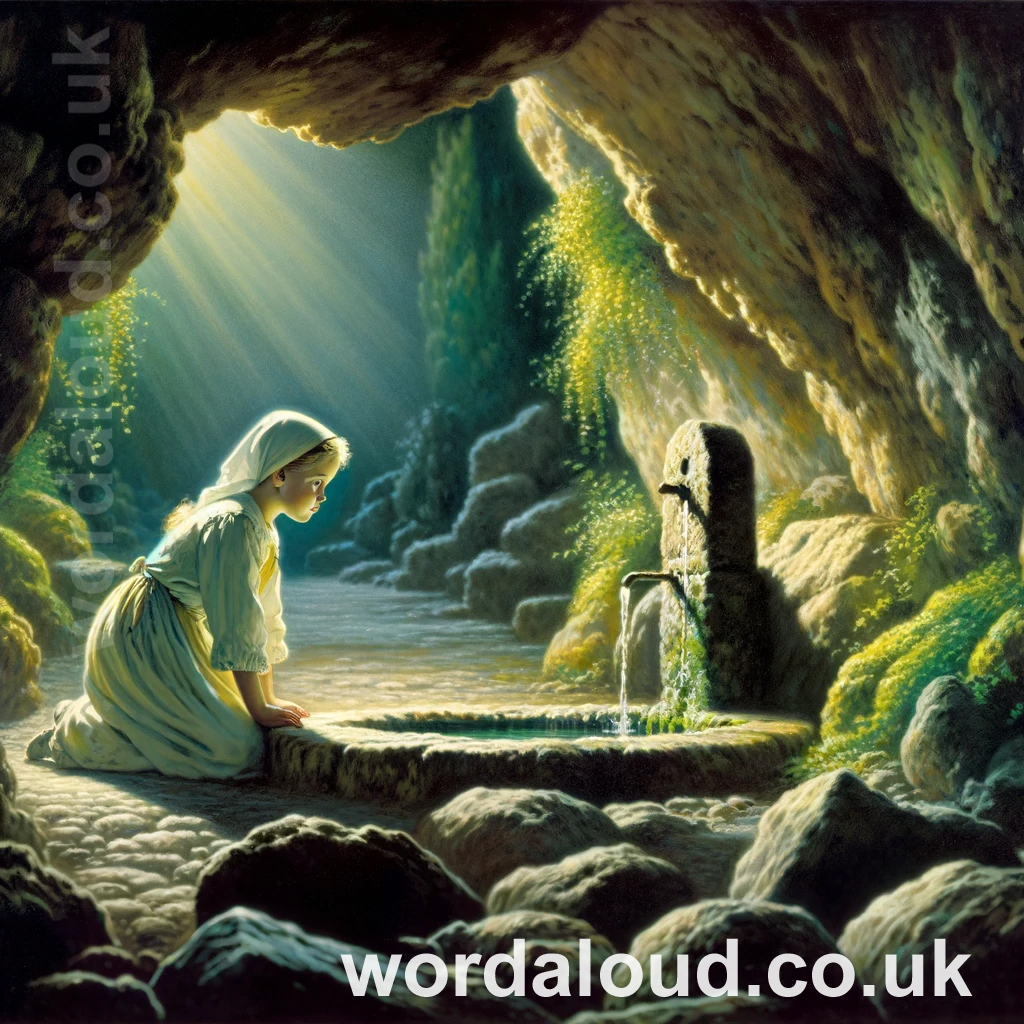
John 4:13-14 (KJV) ‘Jesus answered and said unto her, Whosoever drinketh of this water shall thirst again: But whosoever drinketh of the water that I shall give him shall never thirst; but the water that I shall give him shall be in him a well of water springing up into everlasting life.’ Introduction to the Life of Saint Bernadette Saint Bernadette Soubirous, a humble peasant girl from Lourdes, France, lived her life of faith, humility, and divine grace. Born on January 7, 1844, in the small town of Lourdes, Bernadette was the eldest of nine children in a poor and struggling family. Her father, François Soubirous, was a miller, and her mother, Louise, a laundress. The family lived in a former prison cell known as the Cachot, a damp and cramped space, according to their dire financial situation. Despite their poverty, the Soubirous family was deeply rooted in their Christian faith, a foundation that would profoundly shape Bernadette’s life and spiritual journey. Bernadette’s early years were marked by significant health challenges. She suffered from asthma and other respiratory ailments, which often left her weak and unable to attend school regularly. This lack of formal education meant that Bernadette struggled with reading and writing, and her understanding of Christian doctrine was limited. Nevertheless, she possessed a remarkable simplicity and purity of heart, qualities that would make her an ideal recipient of divine revelations. Bernadette’s life changed irrevocably on February 11, 1858, when she experienced the first of eighteen apparitions of the Blessed Virgin Mary at the grotto of Massabielle. On that cold winter day, Bernadette, her sister Toinette, and a friend were gathering firewood near the grotto when she heard a rustling sound and saw a beautiful lady dressed in white with a blue sash, holding a rosary. The lady, who later identified herself as the Immaculate Conception, appeared to Bernadette over the course of several months, delivering messages of penance, prayer, and the need for a chapel to be built at the site. Despite initial skepticism from her family and the local authorities, Bernadette remained steadfast in her account of the apparitions, enduring intense scrutiny and even ridicule. The apparitions drew enormous attention. Soon, people from all over France and beyond began to visit Lourdes, hoping to witness a miracle. One of the most significant messages conveyed by the Virgin Mary to Bernadette was the instruction to dig in the ground near the grotto, which led to the discovery of a spring. This spring, believed to have healing properties, became the focal point of the pilgrimage to Lourdes. Many miraculous healings have been attributed to the waters of Lourdes, reinforcing the belief in Bernadette’s visions and the sanctity of the site. As the apparitions concluded, Bernadette’s life took a different turn. In 1866, she joined the Sisters of Charity in Nevers, taking the name Sister Marie-Bernard. Her time in the convent was marked by continued poor health and humility, as she carried out menial tasks and lived a life of quiet service. Despite her physical suffering, Bernadette remained devout and accepted her hardships with grace, often repeating the phrase, “I am happier here in my little corner of the convent.” Her unwavering faith and dedication to her religious duties exemplified the depth of her spiritual commitment. Bernadette Soubirous passed away on April 16, 1879, at the age of 35, after a prolonged battle with tuberculosis. Her legacy, however, endured far beyond her earthly life. In 1933, she was canonized as a saint by Pope Pius XI, recognized for her humility, faith, and the miraculous events associated with her life. Today, millions of pilgrims flock to Lourdes each year, seeking spiritual renewal and physical healing at the site of her visions. Saint Bernadette’s life continues to inspire countless individuals around the world, reminding us of the power of faith, the virtue of humility, and the enduring presence of divine grace in our lives. To Visit Lourdes Visiting Lourdes, in the picturesque foothills of the Pyrenees in southwestern France, is an experience that transcends the physical journey, drawing pilgrims into a profound spiritual adventure. The small town, known for the Marian apparitions witnessed by Saint Bernadette Soubirous in 1858, has become one of the world’s most revered pilgrimage sites. As we approach the Sanctuary of Our Lady of Lourdes, the atmosphere is imbued with a palpable sense of reverence and anticipation. The grand basilicas, the tranquil Grotto of Massabielle and the gently flowing waters of the miraculous spring together create a sacred environment that invites reflection, prayer, and a deep connection with the divine. The focal point of any visit to Lourdes is the Grotto, where Bernadette experienced the apparitions of the Blessed Virgin Mary. Here, pilgrims can touch the rock face, light candles, and drink or bathe in the spring’s water, believed to possess healing properties. The profound silence and sense of sacredness at the Grotto allow visitors to contemplate their faith, seek solace and find spiritual renewal. The Rosary Basilica, with its mosaics, and the Basilica of the Immaculate Conception, perched above the Grotto, offer spaces for communal worship and personal meditation. The nightly candlelight processions, where pilgrims from around the globe unite in prayer and song, highlight the universal bond of faith and hope that Lourdes represents. Beyond its physical beauty and historical significance, visiting Lourdes offers a deeply personal and transformative experience. Pilgrims often arrive burdened with ailments, grief, or spiritual crises, seeking comfort and miracles. The stories of healing and faith that emerge from Lourdes are testimonies to the enduring power of belief and the intercession of the Blessed Virgin Mary. The communal aspect of the pilgrimage—sharing meals, prayers, and stories with fellow believers—fosters a sense of solidarity and mutual support. For many, the visit to Lourdes is a journey of healing, not only of the body but also of the soul, providing a renewed sense of purpose, peace, and spiritual clarity that lingers long after returning home. Prayer With Saint Bernadette Prayer for Intercession Dear […]