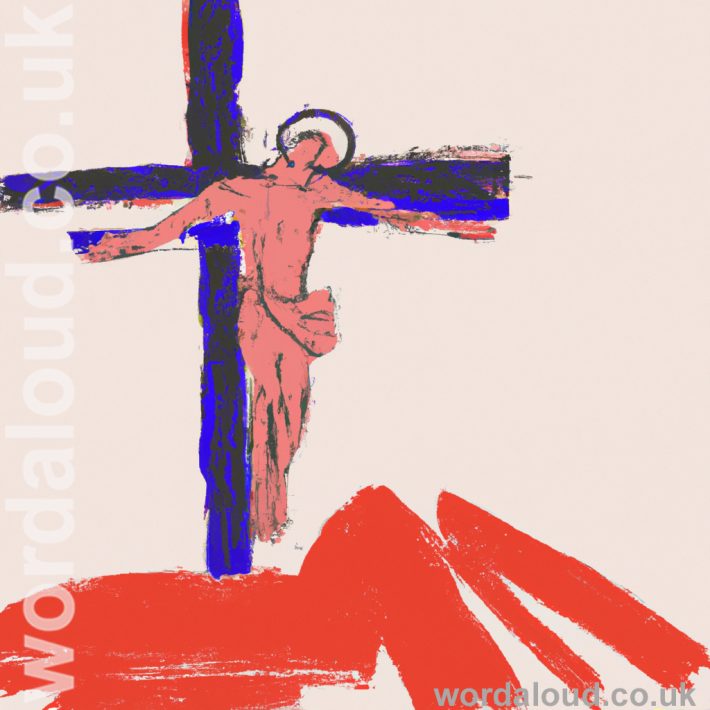
Christian Art | Jesus Christ | The Cross | True Man And True God | Our Saviour
Office Of Readings | Week 20, Friday, Ordinary Time | A Reading From The Discourses Of Saint Ambrose On The Psalms | The Man Christ Jesus, The One Mediator Between God And Men
‘The man Christ Jesus, the one mediator between God and Men.’
Saint Ambrose of Milan (c. 340–397), one of the Latin Fathers of the Church, offers in this commentary a theological reflection on Psalm 49(48), where it is written: ‘Brother cannot redeem brother, nor give to God a ransom for him’ (Ps 49:7). Ambrose interprets this in light of Christ’s unique role as Redeemer, contrasting human limitation with divine sufficiency.
The argument proceeds by juxtaposition. First, Ambrose states the inability of any human being—even the closest of kin—to redeem another. Because all share the same fallen condition, no one has the resources to pay the ransom of another’s soul. Against this background, Christ is introduced: the one man who redeems humanity, not as a fellow victim but as the deliverer who transcends human weakness.
The paradox is central: Christ is ‘a man’ yet not merely so. Ambrose highlights the mystery of the Incarnation: ‘He is a man, yet who will recognise him?’ The rhetorical question points to the hiddenness of Christ’s divinity under the appearance of his humanity. This is linked to 1 Timothy 2:5: ‘There is one God and one mediator between God and men, the man Christ Jesus.’ Christ is both fully human, sharing the condition of those he redeems, and uniquely without sin, making his redeeming sacrifice effective.
Ambrose further emphasises the depth of Christ’s love. He lays down his life not only for brothers or kinsmen but for strangers, demonstrating a love that exceeds natural bonds. The act of redemption is described in sacrificial terms: Christ gives his body and blood as the price of release from sin, cancelling the debt incurred by humanity through Adam’s fall.
Finally, Ambrose clarifies the paradox of Christ as both brother and Lord. Scripture names him ‘brother’ (cf. Heb 2:12), but his redeeming work is possible not in virtue of kinship alone but because ‘God was in Christ, reconciling the world to himself’ (2 Cor 5:19). It is the union of the Word with human nature—the Incarnation—that allows Jesus to redeem. Thus, Christ’s mediation consists in being truly man, yet uniquely united with God.
The passage illustrates Ambrose’s close engagement with Scripture, his use of sharp contrasts to draw out theological truth, and a focus on the Incarnation as the foundation of redemption. His teaching anticipates later Christological formulations: only one who is fully human and fully divine can bridge the gulf between God and humankind.

A Reading From The Discourses Of Saint Ambrose On The Psalms | The Man Christ Jesus, The One Mediator Between God And Men
Brother cannot redeem brother, but a man will redeem man. No one can give to God the ransom for himself nor the price of his soul’s redemption. Christ is saying: What have I to fear in the day of evil? What can do me harm if I do not need a redeemer but am myself the redeemer of all mankind? Shall I free others, yet tremble for myself? See, I shall make all things new, so as to surpass even the love and devotion of brothers. Where a brother, born of the womb, cannot redeem, suffering as he does from the infirmity of a common nature, yet a man will redeem, that man of whom it is written: The Lord will send them a man who will save them; the man who said of himself: You seek to kill me, a man who has spoken the truth to you.
He is a man, yet who will recognize him? Why will no one recognize him? Because, as there is one God, so there is one mediator between God and men, the man Christ Jesus. He alone will redeem man, showing love greater even than that of brothers. He poured out his blood for strangers, as no one is able to do for a brother. He did not spare his own body in redeeming us from sin, but gave himself as the redemption of all, and Paul the apostle is a true witness to him: I speak the truth and do not lie.
But why will this man be the only redeemer? Because no one can equal him in the love he showed in laying down his life for his own poor servants. Nor can anyone equal him in sinlessness, for all men are ruled by sin, and all are victims of the fall of the first Adam. He alone is chosen to redeem, for he alone cannot be subject to that age-old sin. So let us understand by ‘the man’ the one who took upon himself the condition of man in order to crucify in his own flesh the sin of all, and to cancel by his own blood the debt owed by all: the Lord Jesus.
You may ask: How can we say that brother cannot redeem when the man we are discussing has said: I shall declare your name to my brothers? But it was not as our brother but as the man Christ Jesus, in whom God dwelt, that he forgave our sins. For it is written that God was in Christ, reconciling the world to himself. God was in the man Christ Jesus, of whom alone it was said: The Word became flesh and dwelt among us. It was not, therefore, as a brother but as the Lord that he dwelt among us in the flesh.
Christian Prayer With Jesus Christ
Lord Jesus Christ,
true man and true God,
you alone are the mediator between heaven and earth.
By your blood you have redeemed the world,
by your sacrifice you have cancelled our debt.
Grant that, freed from sin and reconciled to the Father,
we may live as your brothers and sisters,
and proclaim your saving love to all nations,
who live and reign with the Father in the unity of the Spirit,
for ever and ever.
Amen.
Glossary Of Christian Terms
Redeemer: One who pays the price to set another free; in Christian theology, Christ redeems humanity from sin and death through his sacrifice.
Mediator: The one who stands between God and humanity to reconcile them; uniquely fulfilled in Christ (1 Tim 2:5).
Ransom: Biblical metaphor for redemption, signifying the cost or price by which humanity is delivered from sin (cf. Mk 10:45).
Incarnation: The Christian belief that the eternal Word of God became flesh in Jesus Christ (Jn 1:14).
Sinlessness of Christ: The doctrine that Jesus, though fully human, was without sin (Heb 4:15), enabling him to redeem others.
Adam: The first man, whose fall into sin introduced death and corruption into the human condition; Christ is the ‘new Adam’ (Rom 5:12–21).
Reconciliation: The restoration of relationship between God and humanity, accomplished in Christ (2 Cor 5:19).


Psalm 71 expresses faith, trust, and unwavering dependence on God. The psalmist expresses a journey through the psalm, seeking refuge, deliverance and divine guidance in the face of adversity and old age. The psalm stands as testament to enduring relationship between the individual and his Creator, a relationship forged in the crucible of life’s trials and joys. It is a psalm of deep reflection, a declaration of hope, and a resounding call to praise God for His continuous presence and salvation throughout the psalmist’s life [ … ]
Psalm 28 is a heartfelt cry to the Lord God. The psalm is a plea for divine intervention, and a declaration of unwavering trust in God’s strength and protection. The psalm resonates with themes of supplication, of contrast between the righteous and the wicked, and acknowledgment of God as the ultimate source of strength and salvation [ … ]

This poem challenges the convention that poetry must rely on embellishment, elaborate imagery, or artifice to be meaningful or beautiful. Herbert begins with rhetorical questions that critique the idea that only fiction or outward, artificial beauty can be the subjects of verse: ‘Who says that fictions only and false hair / Become a verse? Is there in truth no beauty?’ This opening begins the thought of Herbert’s argument that truth and simplicity have their inherent worth in poetry [ … ]