
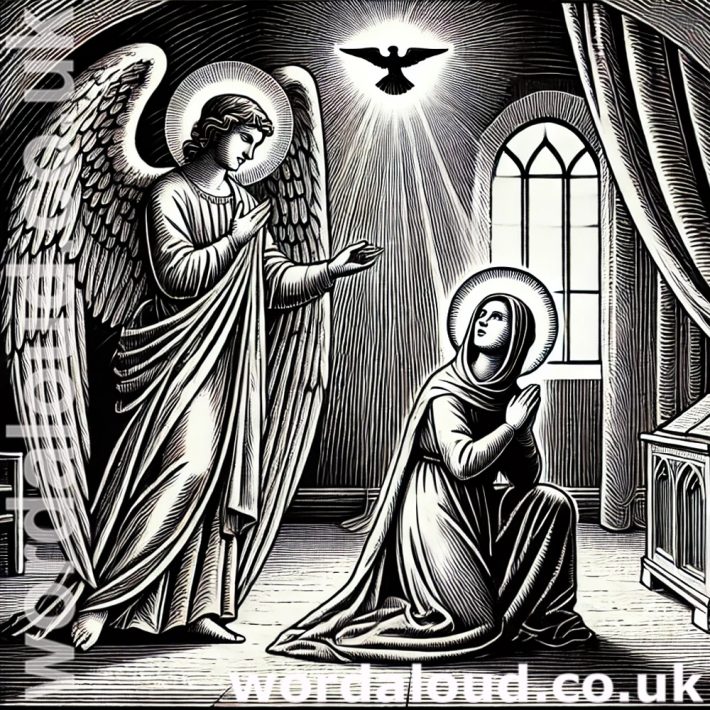
Christian Art | Annunciation | The Virgin Mary | Saint Archangel Gabriel
Office Of Readings | Week 20, Tuesday, Ordinary Time | A Reading From The Homilies Of St Bernard Of Clairvaux On The Glories Of The Virgin Mother | She Was Prepared By The Most High And Prefigured By The Patriarchs
‘She was prepared by the Most High and prefigured by the patriarchs.’
Saint Bernard begins with the claim that ‘there was only one mode of birth that was worthy of God, and that was to be born of a virgin’. With this statement he places the Incarnation within a framework of fittingness (convenientia), a theological mode of reasoning that asks what befits the majesty and holiness of God. The divine birth, he argues, required a vessel untouched by stain, a mother who would embody in her body and soul the purity and humility of the Son whom she would bear.
Virginity and the Purity of the Incarnation
Bernard sees Mary’s virginity not simply as a biological fact but as a theological necessity. The flesh of Christ is taken from her flesh, and so the integrity of her body symbolises the integrity of the new creation that Christ inaugurates. Here Bernard stands within a long tradition: Saint Ambrose had earlier taught that Mary’s virginity manifests the uniqueness of Christ’s birth, and Saint Augustine had spoken of her as the model of consecrated virginity within the Church. Bernard adds a particular emphasis on divine choice and preparation, stressing that God fashioned Mary’s virginity not by chance but by deliberate providence.
Humility as the Ground of Grace
Alongside virginity, Bernard elevates humility as the essential virtue of Mary. He asks: how could the angel have called her ‘full of grace’ unless grace itself had adorned her with all that was required? Mary’s humility makes her receptive, for pride would have resisted the Word’s descent. This connects with Bernard’s broader spiritual teaching, where humility is the soil in which all virtues grow and the path by which the soul returns to God. In Mary, humility is not only a personal quality but the condition that allows the Incarnation to take place.
Prefiguration by Patriarchs and Prophets
Bernard then situates Mary within salvation history. She is not a sudden figure appearing without context, but one prefigured and foreshadowed by patriarchs and prophets. Eve is implicitly recalled: the first virgin whose disobedience brought death, now answered by the Virgin whose obedience brings life. The patriarchs, especially Abraham and Jacob, anticipate her as the ones through whom God’s covenantal promises are carried forward, pointing to the one in whom the promise finds fulfilment. The prophets, such as Isaiah with his oracle of the virgin conceiving (Is 7:14), prepare for her by foretelling the birth of the Messiah. In this sense, Bernard sees Mary as woven into the very fabric of biblical history, her election preordained from the beginning.
Chosen from Eternity
Bernard insists that Mary was ‘not someone just now found by chance, but chosen from the beginning of time’. Here we glimpse medieval debates about Mary’s holiness. Bernard does not articulate the later dogma of the Immaculate Conception, but he expresses a profound sense of Mary’s predestination: that God had foreseen and prepared her as the Mother of the Word. This aligns with the broader theological theme of divine providence, where God’s plan encompasses history in its entirety, and within that plan Mary holds a singular place.
Mary’s Beauty and the Desire of the King
The homily closes with the image of Mary adorned in virtues, radiant in both body and soul, drawing the attention of heaven’s citizens and even of the King himself. This imagery reflects medieval language of beauty as a manifestation of holiness. Mary’s beauty is not external ornament but the splendour of virtue, the radiance of a life wholly conformed to God. The King’s desire, in this sense, is the divine will that longs to dwell with humanity and finds its dwelling in her.
A Reading From The Homilies Of St Bernard Of Clairvaux On The Glories Of The Virgin Mother | She Was Prepared By The Most High And Prefigured By The Patriarchs
There was only one mode of birth that was worthy of God, and that was to be born of a Virgin. Equally, who could come from a Virgin birth except God himself? The maker of mankind, if he was to be made man and destined to be born of man, would have to choose, to create a mother whom he knew to be worthy of him, who he knew would be pleasing to him.
It was his will that she should be a virgin, so that he could proceed from an unstained body, stainless, to purify mankind of its stains.
It was his will that she should be meek and humble of heart, since he was to become the outstanding example of these virtues, so necessary for the health of humanity. He granted childbirth to her, having first inspired her vow of virginity and filled her with the virtue of humility.
To put it another way, how could the Angel have addressed her as full of grace if any, even a little, of these virtues had been present in her already and not given to her by grace? It was given to her to be made holy. She, who was to conceive and give birth to the Holy of holies, was made holy in body by the gift of virginity and holy in mind by the gift of humility.
Adorned with the jewels of such virtues and radiant in both mind and body, the royal Virgin’s beauty draws the attention of the citizens of heaven itself, and its King is filled with desire for her and sends his messenger to her from on high.
The Angel was sent to the Virgin, it says. A virgin in body and a virgin in mind, a virgin by her own choice, a virgin, as the Apostle describes her, holy in mind and body. Not someone just now found by chance, but chosen from the beginning of time, foreseen and prepared by the Most High, waited upon by the angels, prefigured by the patriarchs, preached by the prophets.
Christian Prayer With Jesus Christ
O God Most High,
you prepared the Virgin Mary from all eternity
to be the dwelling place of your Son,
and adorned her with the gifts of humility and purity.
Grant that we, like her, may be made ready
to receive your Word in faith,
to bear him in our lives with obedience,
and to show forth his light in the world.
Through Christ our Lord.
Amen.
Glossary of Christian Terms
Virgin Birth (Parthenogenesis): The belief that Christ was conceived in the womb of Mary by the Holy Spirit without a human father (cf. Lk 1:34–35).
Virginity: In Christian theology, the state of bodily and spiritual integrity symbolising total dedication to God. For Mary, this is both a physical fact and a sign of her consecration.
Humility: The virtue of recognising one’s dependence on God; for Bernard, the essential ground in which grace dwells and the reason Mary was prepared to receive the Word.
Full of grace: The angel Gabriel’s greeting to Mary (Lk 1:28). In Bernard’s interpretation, this means Mary was adorned wholly by God’s gift, not by her own prior merit.
Holy of holies: A biblical expression (cf. Ex 26:33–34) originally referring to the innermost sanctuary of the Temple. Here it describes Christ himself, who is conceived in Mary’s womb.
Prefigured: A theological term meaning ‘foreshadowed.’ Old Testament figures and events are understood to anticipate their fulfilment in Christ and, by extension, in Mary.
Patriarchs: The fathers of Israel—especially Abraham, Isaac, and Jacob—whose lives and promises pointed towards the fulfilment of God’s plan.
Prophets: Old Testament messengers of God, who proclaimed his word and, in Christian interpretation, foretold the coming of Christ and his Mother.
Predestination: The belief that God, in his eternal wisdom, foresees and ordains the role of each person in salvation history. Bernard applies this to Mary, chosen before time to be Christ’s Mother.




The passage, Matthew 19:16-22, recounts the encounter between Jesus and a wealthy young man who asked Jesus what he must do to inherit eternal life. In response, Jesus told him to keep the commandments, to which the young man replied that he had done so since his youth. Jesus then told him to sell all his possessions, give the money to the poor, and follow him. The young man went away sorrowful because he had great possessions, which he finds himself unable to relinquish [ … ]

Psalm 55 is a heartfelt and poignant prayer, a cry for divine help in a time of profound distress and betrayal. The psalmist beseeches God to listen to his supplication, expressing deep anguish caused by treachery of enemies and weight of oppression [ … ]
Psalm 42 expresses deep spiritual longing. The psalm compares the psalmist’s thirst for God to a deer panting for water brooks, conveying intensity of desire to be in God’s presence [ … ]
