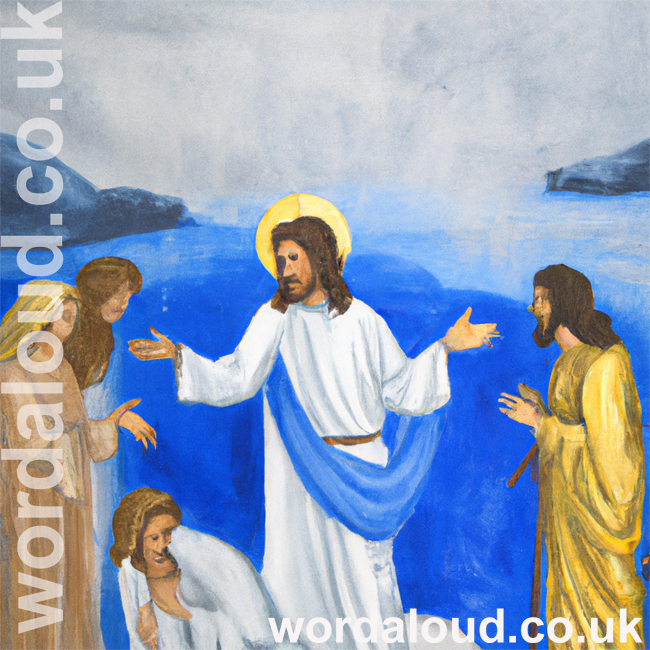
Christian Art | Jesus Preaches To His Disciples
Office Of Readings | Week 23, Tuesday, Ordinary Time | A Reading From The Sermons Of Saint Bernard | I Will Take My Stand To Watch And See What The Lord Will Say To Me
‘I will take my stand to watch and see what the Lord will say to me.’
Saint Bernard reflects on the challenge of listening to Christ’s words and persevering in discipleship. He recalls the moment in John’s Gospel when some of Jesus’ followers turned away because they could not accept his teaching about the Eucharist (John 6:60–69). This becomes for Bernard a symbol of the two possible responses to God’s word: some recognise it as spirit and life, others find it hard and seek consolation elsewhere.
Bernard highlights the persistence of God’s call, ‘God has spoken once,’ meaning that his word is a single, continuous utterance, enduring throughout history. The divine voice is not occasional or fragmented but remains constant, reaching every generation. Echoing Psalm 95(94), he warns against hardening one’s heart, for that the human heart is the place where God desires to dwell and to speak.
Drawing upon the prophet Habakkuk (Habakkuk 2:1), Bernard urges vigilance: the believer is called to stand upon the watch-tower, attentive to God’s voice and discerning his will amid struggle. For Bernard, the ‘watch-tower’ is the heart itself — the place of inner judgement and counsel where Christ is present. Yet he cautions against placing confidence in one’s own reasoning or defences, recognising human frailty. True security comes from openness to God’s continuous word and readiness to obey it.
The reading brings together scriptural themes of hearing God’s voice, resisting hardness of heart, and practising spiritual watchfulness. Bernard places emphasis on the discipline of interior attentiveness: standing on the inner ramparts of the soul, so as not to be overcome by faint-heartedness, but to be strengthened by the enduring word of Christ.
A Reading From The Sermons Of Saint Bernard | I Will Take My Stand To Watch And See What The Lord Will Say To Me
We read in the gospel that when the Lord was teaching his disciples and urged them to share in his passion by the mystery of eating his body, some said: This is a hard saying, and from that time they no longer followed him. When he asked the disciples whether they also wished to go away, they replied: Lord, to whom shall we go? You have the words of eternal life.
I assure you, my brothers, that even to this day it is clear to some that the words which Jesus speaks are spirit and life, and for this reason they follow him. To others these words seem hard, and so they look elsewhere for some pathetic consolation. Yet wisdom cries out in the streets, in the broad and spacious way that leads to death, to call back those who take this path. Finally, he says: For forty years I have been close to this generation, and I said: They have always been faint-hearted. You also read in another psalm: God has spoken once. Once, indeed, because for ever. His is a single, uninterrupted utterance, because it is continuous and unending.
He calls upon sinners to return to their true spirit and rebukes them when their hearts have gone astray, for it is in the true heart that he dwells and there he speaks, fulfilling what he taught through the prophet: Speak to the heart of Jerusalem. You see, my brothers, how the prophet admonishes us for our advantage: If today you hear his voice, harden not your hearts. You can read almost the same words in the gospel and in the prophet. For in the gospel the Lord says: My sheep hear my voice. And in the psalm blessed David says: You are his people (meaning, of course, the Lord’s) and the sheep of his pasture. If today you hear his voice, harden not your hearts.
Hear also the prophet Habakkuk in today’s reading. Far from hiding the Lord’s reprimands, he dwells on them with attentive and anxious care. He says: I will stand upon my watch-tower and take up my post on the ramparts, keeping watch to see what he will say to me and what answer I will make to those who try to confute me. I beg you, my brothers, stand upon our watch-tower, for now is the time for battle. Let all our dealings be in the heart, where Christ dwells, in right judgement and wise counsel, but in such a way as to place no confidence in those dealings, nor rely upon our fragile defences.
Christian Prayer With Jesus
Lord, you speak with a word that endures for ever. Keep us attentive to your voice and guard us from hardness of heart. Teach us to stand watch in our inner life, alert to your presence, and to rely not on our own strength but on your wisdom. May Christ dwell within us, guiding our counsel and sustaining us in times of trial. Through the same Christ our Lord. Amen.
Glossary Of Christian Terms
‘This is a hard saying’ – A reference to John 6:60, when some disciples found Jesus’ teaching about eating his body too difficult to accept.
Wisdom cries out in the streets – From Proverbs 1:20–21, an image of divine wisdom calling people away from folly and destruction.
‘God has spoken once’ – From Psalm 62(61):11; interpreted by Bernard as meaning God’s word is continuous and unending.
‘If today you hear his voice, harden not your hearts’ – From Psalm 95(94):7–8, also quoted in Hebrews 3:7–8, a call to openness to God.
Watch-tower – From Habakkuk 2:1; symbolises vigilance and readiness to hear God’s word.
Ramparts – The defensive walls of a city; used metaphorically for the inner vigilance of the heart.
Confute – To refute or argue against; Habakkuk expects opposition but resolves to await God’s response.




Through these Bible verses, Jesus concludes his Priestly Prayer before his disciples. Through his prayer to his Father, Jesus is also saying goodbye to the disciples. He is about to endure his Passion. These words are Jesus’ last testament before he is glorified. Jesus has asked for the Father’s guidance and help for the disciples. They are called to be united in faith as they preach the Gospel and endure the hardships and hostility of the world. Now Jesus extends his prayer to include all Christians to come [ … ]

The Church teaches that marriage is a sacrament, which means that it is an outward sign of an inward grace. In marriage, a man and a woman are united in a way that reflects the union between Christ and the Church [ … ]

Christian Art | George Herbert | The Temple | The Church | The Sinner George Herbert | The Temple | The Church | The Sinner Lord, how I am all ague, when I seek What I have treasur’d in my memorie! Since, if my soul make even with the week, Each seventh note by right is due to thee. I finde there quarries of pil’d vanities, But shreds of holinesse, that dare not venture To shew their face, since crosse to thy decrees. There the circumference earth is, heav’n the centre. In so much dregs the quintessence is small: The spirit and good extract of my heart Comes to about the many hundredth part. Yet Lord restore thine image, heare my call: And though my hard heart scarce to thee can grone, Remember that thou once didst write in stone. George Herbert | The Temple | The Church | The Sinner The poet reflects on his spiritual state, describing a struggle with weakness, sin, and the desire for divine alignment. The poem opens with the poet addressing God, expressing discomfort, likened to an ‘ague’ (fever or chill), when he searches his memory for spiritual treasures. This ‘ague’ suggests both a physical and spiritual unease, revealing the tension the poet feels in self-examination. The second line conveys a sense of regret as the poet searches for ‘treasur’d’ holiness in his memory. He recognizes that, although he might strive to keep his soul ‘even with the week’, dedicating every seventh day to God, he falls short. This phrase reflects the expectation to honour the Sabbath, but the poet’s efforts are met with disappointment in their perceived spiritual emptiness. The poet goes on to examine his inner self, describing ‘quarries of pil’d vanities’ that dominate his mind. Here, ‘quarries’ implies an overwhelming quantity of earthly or superficial concerns, while ‘vanities’ suggests that these concerns are meaningless in the context of divine expectation. In contrast, he finds only ‘shreds of holinesse’, fragmented attempts at righteousness, which he hesitates to bring forward as these elements are ‘crosse to thy decrees’, or in opposition to God’s laws. This imagery underscores the poet’s internal conflict and recognition of shortcomings. Further, the poet contrasts earth and heaven, saying that ‘the circumference earth is, heav’n the centre.’ This phrase symbolizes the poet’s focus on worldly concerns (the circumference) that orbit around a neglected spiritual core (the heavenly center). The poet reflects that his life is filled with ‘dregs’, the lesser, unrefined aspects of his being, while ‘quintessence’, or the purest part of himself, is scarce. This ‘quintessence’ is described as the ‘spirit and good extract’ of the poet’s heart, amounting to a ‘many hundredth part’ — a small fraction of life’s essence. The poet realizes that, despite attempts to cultivate holiness, his internal state largely lacks spiritual substance. The final lines shift to a plea for restoration. The poet calls on God to ‘restore thine image’, asking for renewal and transformation. This restoration request implies a yearning to reflect God’s nature more fully, as humanity is believed to be made in God’s image. The poet acknowledges that his heart ‘scarce… can grone’ to God, reflecting the difficulty he feels in truly connecting with or petitioning the divine. The poem ends with reference to the biblical account of the Ten Commandments, when God ‘didst write in stone’. This allusion serves as both a reminder of God’s past willingness to communicate directly and a plea for a similar intervention to etch divine law into the poet’s heart. The poem examines themes of introspection, human fallibility, and a longing for divine transformation. The poet’s self-examination reveals struggle to balance earthly concerns with spiritual commitments, culminating in a plea for God’s direct action to restore spiritual integrity.