
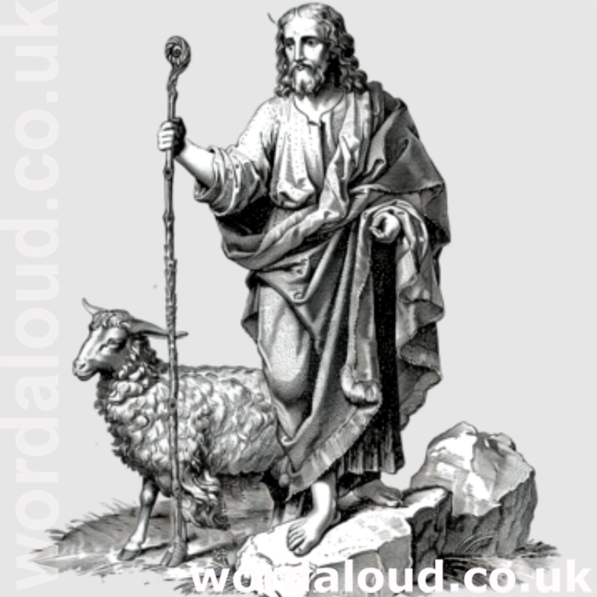
Christian Art | Jesus Christ The Good Shepherd
Office Of Readings | Week 25, Wednesday, Ordinary Time | From The Sermon Of Saint Augustine On The Shepherds | Do What They Say, Not What They Do
‘Do whatever they tell you, but do not follow what they do.’
Saint Augustine addresses the duty of pastors to speak the truth even when that truth provokes resistance, and he warns the flock to distinguish between authoritative teaching and faulty example. He draws on Ezekiel’s imagery of negligent shepherds and on the watchman motif (Ezekiel 3:17–21): a pastor who fails to warn sinners bears responsibility for their ruin; a pastor who speaks the prophetic word but the people ignore it has done his duty.
Two related points run through the passage. First, silence in the face of sin exposes the community to harm and transfers culpability to those charged with warning. The pastor’s role includes announcing God’s judgment when necessary; refusing that task risks the spiritual death of those neglected. Second, Augustine insists that the flock must obey the teaching even when the teacher’s life falls short. He formulates this as a practical rule: ‘Do whatever they tell you, but do not follow what they do.’ The words of Scripture and the instruction of God, mediated through ministers, retain authority independent of the minister’s personal conduct.
Augustine’s solution to the problem of bad leadership is twofold. Where leaders fail, God will reassign the flock to shepherds who will serve properly; meanwhile the people must hold to Scripture and the truth it contains. The distinction between teaching and example preserves both the authority of the apostolic word and the accountability of ministers for their lives. The passage integrates pastoral responsibility, the duty to warn, and the imperative for the faithful to live by God’s commands regardless of human failing.
From The Sermon Of Saint Augustine On The Shepherds | Do What They Say, Not What They Do
Shepherds, hear the word of the Lord. But what are the shepherds to hear? Thus says the Lord God: Behold I myself am over the shepherds, and I will claim my sheep from their hands.
Hear and learn, you sheep of God. God calls for an accounting of his sheep from the wicked shepherds and inquires into the death of his sheep at their hands. For in another passage he speaks through the same prophet: Son of man, I have appointed you a watchman for the house of Israel. You shall hear the word from my mouth and you shall point out the way to them in my name. When I say to the sinner: You shall die, and you do not speak to warn the wicked man from his wicked way, because of his wickedness he shall die, but you shall be held responsible for his death. If, however, you warn the wicked man to turn away from his wickedness, and he fails to do so, he shall die in his iniquity, but you shall have saved your soul.
Dear brothers, what does this mean? Do you see how dangerous it is to keep silent? The sinner dies and rightly so; he dies in his wickedness and in his sin, for his failure to heed you has killed him. He could have found the Lord, the living shepherd who says: I live. But he was heedless; and the one appointed for this task, the watchman, did not warn him. The wicked one then justly suffers death and the watchman rightly suffers damnation. But the Lord says, if you say to the wicked man: You shall surely die, and if he fails to heed the sword of judgment with which I have threatened him, that sword will overtake and kill him, and he will die in his sin; but you will have saved your soul. Therefore it is our task not to keep silent, and it is your task, even if we ourselves are silent, to hear the words of the shepherd from the Scriptures.
I have said that he will take the sheep from the bad shepherds and give them to shepherds who are good. Let us consider whether he does so. I see him taking the seep from the bad shepherds, when he says: Behold, I myself am over the shepherds, and I will claim my sheep from their hands; and I will turn away from them so that they may not pasture my sheep and the shepherds shall no longer give pasture. For when I say: ‘Let them pasture my sheep,’ they give pasture to themselves and not to my sheep. Therefore I will turn away from them so that they may not pasture my sheep.
How does the Lord turn away from them to keep them from pasturing his sheep? Do whatever they tell you, but do not follow what they do. It is as if he said: ‘The words they say are mine, but their deeds are their own.’ If you do not follow the example of the bad shepherds, they are not giving you pasture. But if you do what they say, it is I who am feeding you.
Christian Prayer With Jesus Christ
Lord God,
you call your servants to speak your truth and to care for your flock.
Give courage to those who warn and teach,
and grant discernment to the people that they may follow your word even when leaders fall short.
Bring to your Church pastors who will feed the sheep in your name,
and keep us all faithful to the instruction of your Gospel.
Through Christ our Lord. Amen.
Glossary Of Christian Terms
Watchman – Scriptural image (Ezekiel 3:17–21) for a person appointed to warn others of danger; Augustine applies it to pastoral duty.
Pastor / Shepherd – Church leaders entrusted with teaching, warning and caring for the faithful.
‘Do whatever they tell you, but do not follow what they do’ – Augustine’s summary: accept the teaching given through ministers, but do not imitate their faults.
Turning away (of the Lord) – God’s removal of pastoral authority from those who serve self-interest rather than the flock (cf. Ezekiel 34).
Accountability – The obligation of pastors to give an account for their stewardship before God; failure to warn the wicked implicates the watchman.




In this verse, Jesus speaks about welcoming the stranger. Jesus teaches us that caring for those in need, including refugees, is an expression of our love for God. This passage calls us to open our hearts and homes to those who are seeking refuge and safety, reflecting God’s compassion and mercy [ … ]

Saint Leo considers the Lord’s instruction that Christian justice must exceed that of the scribes and Pharisees. He frames this not as an expansion of legal detail but as a transformation of motive. The justice of the kingdom is marked by compassion, because mercy reflects the way God has acted toward humanity. Leo recalls the central Christian claim: God restores the guilty not by force of law but by forgiveness. The transition from sin to innocence is not earned but given, and this gift becomes the model for Christian conduct. Justice is therefore fulfilled when believers imitate the divine pattern—allowing mercy to rise above strict judgment [ … ]

It is a time of vigil while Jesus rests and we await his resurrection on Easter Sunday. Jesus has died to free us from our sins. While he rests, the church is a quiet and sombre place. We think of Jesus’ first followers and of what they must have felt and thought through this time. They must have felt very alone and abandoned, and indeed at risk of losing their own lives [ … ]
