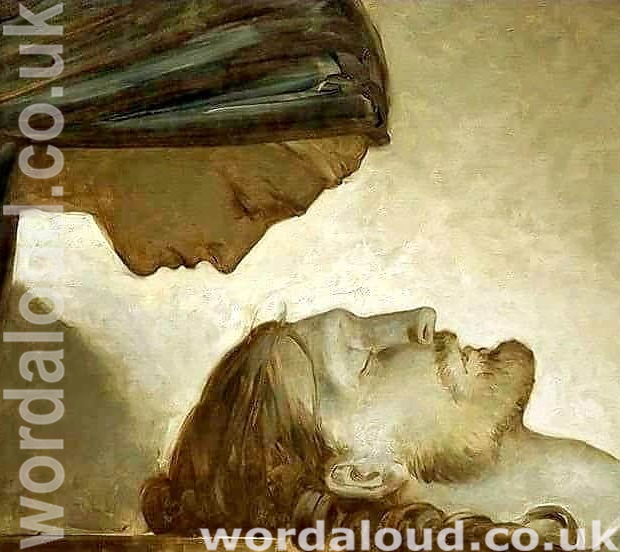
Christian Art | Jesus Christ Is Crucified | Holy Saturday | Stabat Mater
Office Of Readings | Week 26, Thursday, Ordinary Time | From The Letter Of Saint Polycarp To The Philippians | May Christ Build You Up In Faith And In Truth
‘May Christ build you up in faith and in truth.’
Saint Polycarp brings together the pastoral, theological, and practical elements that have characterised his message to the Philippians. Written in the early second century, it reflects the steady, humane tone of a bishop who has guided his community through times of trial and who now speaks from long experience in faith.
Polycarp begins with an expression of humility. Though confident that his readers are ‘well grounded in the Scriptures’, he describes himself as less knowledgeable. This modesty is characteristic of the early Fathers, who saw teaching not as an assertion of authority but as a shared act of service within the body of Christ. His self-deprecation mirrors the biblical wisdom of Proverbs and the humility of the apostolic tradition—an example to leaders who must teach without pride.
He quotes from the Psalms and Ephesians—’Be angry and do not sin’ and ‘Do not let the sun set on your anger’—to urge moderation of passion and the discipline of forgiveness. Anger, left unchecked, divides the Christian community; therefore, Polycarp calls for gentleness, patience, chastity, and perseverance as the true marks of maturity in faith. His prayer that Christ ‘build you up in faith and in truth’ evokes the image of the Church as a spiritual house constructed by God, a motif drawn from both Paul and Peter.
The letter’s tone then widens from pastoral counsel to universal intercession. Polycarp urges the community to pray not only for the saints and for one another, but also for rulers, authorities, and even persecutors. This reflects the teaching of Christ in the Sermon on the Mount and the practice of the early Church as described in the First Letter of Peter and the First Letter to Timothy. For Polycarp, such prayer is both obedience and witness—it transforms hostility into an opportunity for charity and ensures that ‘your good works will be seen by all men’.
The remainder of the letter moves into practical matters: the exchange of letters with Saint Ignatius of Antioch, the sending of couriers, and the commendation of trusted companions. Such details remind the reader that the early Christian Church was not a remote or idealised body, but a network of small communities bound together by correspondence, shared struggle, and mutual support. These final lines give a vivid glimpse into the living unity of the second-century Church—a communion maintained through friendship, prayer, and the movement of people as well as of words.
Polycarp concludes, as he began, with a blessing. His prayer that the Philippians may ‘find protection in the Lord Jesus Christ’ sums up the purpose of the letter: to strengthen the Church in faith, truth, and endurance, so that all may remain steadfast amid uncertainty.

From The Letter Of Saint Polycarp To The Philippians | May Christ Build You Up In Faith And In Truth
I am sure that you are well grounded in the Scriptures and nothing of their message escapes you, I, however, have not been so fortunate, As these same Scriptures put it: Be angry and do not sin and Do not let the sun set on your anger. Blessed is the man who bears this in mind, as I am sure you do.
May God the father of our Lord Jesus Christ and the eternal high priest himself, the son of God, Jesus Christ, build you up in faith and in truth and in great gentleness. May you never know anger, but be patient, long-suffering, persevering and chaste. May he grant you a place among his saints; and may he give the same to us along with you, as well as to all on earth who put their faith in our Lord Jesus Christ and in his Father who has raised him from the dead.
Keep all the saints in your prayers. Pray, too, for our rulers, for our leaders, and for all those in power, even for those who persecute and hate you, and for those who are enemies of the cross. In this way, your good works will be seen by all men, and you will be perfected in him.
Both you and Ignatius have written me to ask whether anyone going to Syria will deliver your letter as well as ours. If the opportunity offers itself, I will do it; if I cannot, I will sent a representative.
As you request, we have returned to you the letters Ignatius sent us and as many other letters as we had; they are being enclosed with this letter. You will derive great benefit from them, for they are full of faith and patience, and great edification in all that refers to our Lord. Send us any certain information you may possess about Ignatius and his companions.
I am sending this letter to you by Crescens, whom I commended to you when I was present, and do so again. He has lived blamelessly among us, as I am sure he will among you. When his sister comes to you, she too will come with our commendation.
May you find protection in the Lord Jesus Christ, and may his grace be with all who are yours. Amen.
Christian Prayer With Jesus Christ
Eternal Father,
you have built your Church upon the foundation of faith and truth.
Grant that we, following the example of Saint Polycarp,
may live with gentleness, patience, and purity of heart.
Teach us to forgive as we have been forgiven,
to pray for friend and foe alike,
and to seek unity in all things through your Son, Jesus Christ.
May your grace sustain us,
and may your peace guard all who trust in you,
through the same Christ our Lord.
Amen.
Glossary Of Christian Terms
Saint Polycarp – Bishop of Smyrna (modern-day İzmir, Turkey) and a disciple of the Apostle John; martyred around AD 155. His Letter to the Philippians is one of the earliest Christian writings after the New Testament.
Be angry and do not sin – A quotation from Psalm 4:4 (and echoed in Ephesians 4:26), urging self-control and the reconciliation of anger before day’s end.
Faith and truth – For Polycarp, these are the twin foundations of Christian life: faith as trust in God’s promise, and truth as fidelity to the Gospel.
Chastity – Moral purity and self-discipline; in early Christian teaching, a sign of devotion to God and of integrity in relationships.
Persecutors – Those who opposed or punished Christians during the early centuries of the Church, often under Roman authority.
Saint Ignatius of Antioch – An early Christian bishop and martyr who wrote a series of letters on his way to execution in Rome, expressing deep faith and pastoral concern.
Crescens – A Christian messenger mentioned by Polycarp as the bearer of his letter, likely a trusted member of the Church community.
Intercession – Prayer made on behalf of others, reflecting the Church’s unity in charity and shared responsibility before God.
The saints – In Polycarp’s usage, all faithful Christians who strive to live in holiness, both living and departed.




This passage from the Second Vatican Council’s Pastoral Constitution on the Church in the Modern World (Gaudium et spes) situates Christian hope within both the temporal and eternal dimensions of human existence. It speaks of the transformation of the universe, the destiny of humanity, and the relationship between earthly progress and the kingdom of God [ … ]

Today’s Gospel verses again speak of the conflict between Jesus and the scribes and Pharisees, and again we sense the verses reflecting the breaking away of Christianity from Judaism, and the tensions in the aftermath of the fall of Jerusalem. Jesus’ rebuke of the scribes and Pharisees, the lawyers, is stinging. Jesus associates them with the history of murder of the righteous through Scripture, from the first murder of Abel to the murder of Zechariah, a prophet who died by stoning in Jerusalem around the year 800 BC because he accused the Jewish people of being unfaithful to God’s law (cf. 2 Chronicles 24: 20-22) [ … ]

Christian Art | George Herbert | The Temple | The Church | The Sinner George Herbert | The Temple | The Church | The Sinner Lord, how I am all ague, when I seek What I have treasur’d in my memorie! Since, if my soul make even with the week, Each seventh note by right is due to thee. I finde there quarries of pil’d vanities, But shreds of holinesse, that dare not venture To shew their face, since crosse to thy decrees. There the circumference earth is, heav’n the centre. In so much dregs the quintessence is small: The spirit and good extract of my heart Comes to about the many hundredth part. Yet Lord restore thine image, heare my call: And though my hard heart scarce to thee can grone, Remember that thou once didst write in stone. George Herbert | The Temple | The Church | The Sinner The poet reflects on his spiritual state, describing a struggle with weakness, sin, and the desire for divine alignment. The poem opens with the poet addressing God, expressing discomfort, likened to an ‘ague’ (fever or chill), when he searches his memory for spiritual treasures. This ‘ague’ suggests both a physical and spiritual unease, revealing the tension the poet feels in self-examination. The second line conveys a sense of regret as the poet searches for ‘treasur’d’ holiness in his memory. He recognizes that, although he might strive to keep his soul ‘even with the week’, dedicating every seventh day to God, he falls short. This phrase reflects the expectation to honour the Sabbath, but the poet’s efforts are met with disappointment in their perceived spiritual emptiness. The poet goes on to examine his inner self, describing ‘quarries of pil’d vanities’ that dominate his mind. Here, ‘quarries’ implies an overwhelming quantity of earthly or superficial concerns, while ‘vanities’ suggests that these concerns are meaningless in the context of divine expectation. In contrast, he finds only ‘shreds of holinesse’, fragmented attempts at righteousness, which he hesitates to bring forward as these elements are ‘crosse to thy decrees’, or in opposition to God’s laws. This imagery underscores the poet’s internal conflict and recognition of shortcomings. Further, the poet contrasts earth and heaven, saying that ‘the circumference earth is, heav’n the centre.’ This phrase symbolizes the poet’s focus on worldly concerns (the circumference) that orbit around a neglected spiritual core (the heavenly center). The poet reflects that his life is filled with ‘dregs’, the lesser, unrefined aspects of his being, while ‘quintessence’, or the purest part of himself, is scarce. This ‘quintessence’ is described as the ‘spirit and good extract’ of the poet’s heart, amounting to a ‘many hundredth part’ — a small fraction of life’s essence. The poet realizes that, despite attempts to cultivate holiness, his internal state largely lacks spiritual substance. The final lines shift to a plea for restoration. The poet calls on God to ‘restore thine image’, asking for renewal and transformation. This restoration request implies a yearning to reflect God’s nature more fully, as humanity is believed to be made in God’s image. The poet acknowledges that his heart ‘scarce… can grone’ to God, reflecting the difficulty he feels in truly connecting with or petitioning the divine. The poem ends with reference to the biblical account of the Ten Commandments, when God ‘didst write in stone’. This allusion serves as both a reminder of God’s past willingness to communicate directly and a plea for a similar intervention to etch divine law into the poet’s heart. The poem examines themes of introspection, human fallibility, and a longing for divine transformation. The poet’s self-examination reveals struggle to balance earthly concerns with spiritual commitments, culminating in a plea for God’s direct action to restore spiritual integrity.