

Christian Art | Saint Catherine Of Siena
Office Of Readings | Week 30, Saturday, Ordinary Time | A Reading From The Dialogue Of Saint Catherine Of Siena On Divine Providence | How Good, How Delightful Is Your Spirit, Lord,
Dwelling In All Men
‘How good, how delightful is your spirit, Lord, dwelling in all men.’
Saint Catherine records a divine address from God the Father, expressing the logic and tenderness of divine providence. The text presents a theological anthropology — an account of what it means to be human in relation to God — rooted in creation, memory, intellect, and will. Each faculty corresponds to a mode of divine communication: memory preserves awareness of God’s goodness, intellect apprehends divine truth through the Son, and will loves the good revealed by the Holy Spirit.
The Father’s speech follows the classical structure of Christian reflection on creation and redemption. Humanity is made ‘in my image and likeness’, endowed with powers that reflect divine life. Yet disobedience — the primal turning away of the will — has fractured this likeness. Divine providence, therefore, is not an abstract system but the ongoing personal care of God who restores what has been disordered.
Catherine’s vision of God’s care is marked by an almost judicial realism: God ‘commutes’ the death sentence of sin through the obedience of the Son. This language of exchange recalls Pauline and patristic theology, in which Christ’s obedience is both satisfaction and renewal. The emphasis is not on retribution but on transformation — humanity is offered life ‘not merely human but divine’.
The passage reveals a unity of Trinitarian action. The Father creates, the Son reveals and redeems, the Spirit infuses love and freedom. Providence is thus not occasional intervention but the eternal, interior movement of divine love extending into time. Human history is interpreted as the unfolding of this provident will, even through suffering and disorder.
Catherine’s dialogue presupposes an experiential theology. The speaker is not reasoning abstractly about God but recounting the divine voice heard in contemplation. The ‘look of mercy’ and ‘indescribable kindness’ indicate that the knowledge of God is received in love. For Catherine, divine providence is not a doctrine to be inferred but a presence to be recognised — a living relationship in which creation, redemption, and sanctification converge.
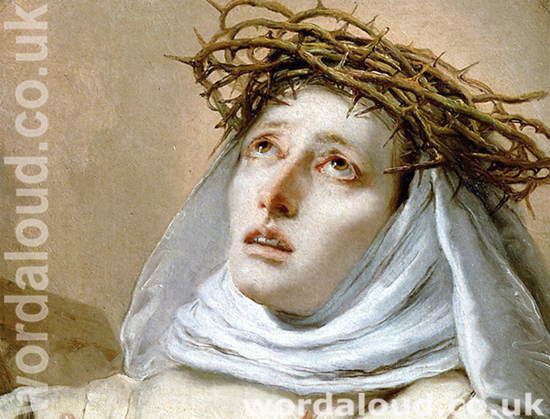
A Reading From The Dialogue Of Saint Catherine Of Siena On Divine Providence | How Good, How Delightful Is Your Spirit, Lord, Dwelling In All Men
With a look of mercy that revealed his indescribable kindness, God the Father spoke to Catherine:
‘Beloved daughter, everything I give to man comes from the love and care I have for him. I desire to show my mercy to the whole world and my protective love to all those who want it.
But in his ignorance man treats himself very cruelly. My care is constant, but he turns my life-giving gifts into a source of death. Yes, I created him with loving care and formed him in my image and likeness. I pondered, and I was moved by the beauty of my creation.
I gave him a memory to recall my goodness, for I wanted to share in my own power. I gave him an intellect to know and understand my will through the wisdom of my Son, for I am the giver of every good gift and I love him with a father’s constant love. Through the Holy Spirit I gave him a will to love what he would come to know with his intellect.
In my loving care I did all this, so that he could know me and perceive my goodness and rejoice to see me forever. But as I have recounted elsewhere, heaven had been closed off because of Adam’s disobedience. Immediately after his sin all manner of evil made its advance throughout the world.
So that I might commute the death consequent upon this disobedience, I attended to you with loving care – out of provident concern I handed over my only-begotten Son to make satisfaction for your needs. I demanded supreme obedience from him so that the human race might be freed of the poison which had infected the entire earth because of Adam’s disobedience. With eager love he submitted to a shameful death on the cross and by that death he gave you life, not merely human but divine.
Christian Prayer With Jesus
Eternal Father,
source of all life and goodness,
you formed us in your image
and renewed us in the obedience of your Son.
Grant that we may trust your provident care
and recognise your mercy at work in all things.
Strengthen our memory to recall your goodness,
our intellect to perceive your truth,
and our will to love what you command.
Through your Son, our Redeemer,
and in the power of the Holy Spirit,
may we rejoice to see your face for ever,
who live and reign, one God, now and always.
Amen.
Glossary Of Christian Terms
Providence: God’s wise and continual ordering of creation toward its good; the sustaining act by which God brings all things to fulfilment.
Theological Anthropology: The study of humanity in the light of divine revelation, especially regarding the image of God in memory, intellect, and will.
Obedience: The free alignment of the human will with God’s will; in Christ, the means by which redemption is accomplished.
Satisfaction: A theological term for the act by which Christ, through his obedient suffering, reconciles humanity to God.
Image and Likeness: The scriptural expression (Genesis 1:26) describing humanity’s participation in divine life through reason and freedom.
Trinitarian Action: The inseparable yet distinct work of the Father, Son, and Holy Spirit in creation and redemption.
Provident Concern: The active care of God, expressed not as sentiment but as creative, redemptive initiative in history.
Participation: The sharing of created beings in the uncreated life of God, the basis for the deification of the human person.
Deification (Theosis): The transformation of human nature by grace into communion with divine life; a key theme in Catherine’s spirituality.
Contemplation: The direct awareness of God’s truth and goodness, often expressed in visionary or mystical language.



Psalm 14 explores the clash between faith and disbelief, wisdom and folly [ … ]
The apostles have returned exhausted and energized to Jesus. They have succeeded in their mission and they are full of the glory of what they have accomplished. They long to tell Jesus all that they have done in Jesus’ name. This is a triumph for the disciples. They long to share [ … ]
Saint Augustine reflects on Ezekiel 34, where God condemns unfaithful shepherds who exploit the flock for their own benefit while neglecting their pastoral duties. The text distinguishes between the shepherds’ concern for themselves and their neglect of the sheep. The imagery of consuming milk and wearing wool symbolises the material benefits that leaders receive from their communities. These are not illegitimate in themselves, as Paul’s writings indicate, but they become corrupt when they are detached from genuine pastoral care [ … ]
