
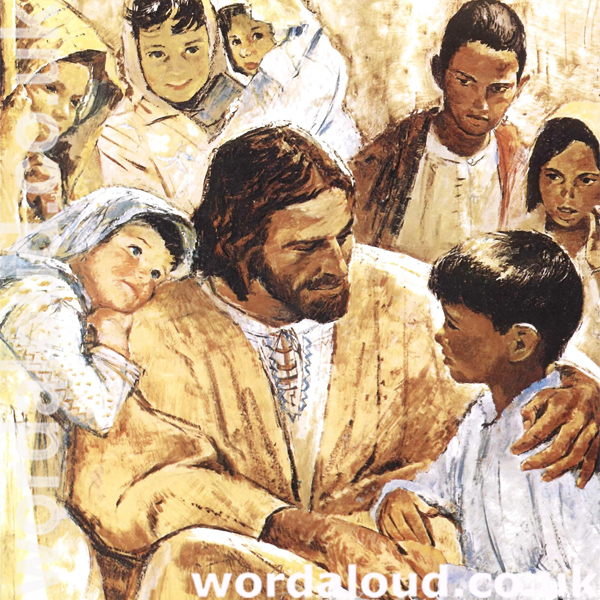
Christian Art | Jesus Asks Us To Become As Little Children In Order To Enter Heaven
Office Of Readings | Week 6, Ordinary Time, Sunday | A Reading From The Commentary Of Saint Ephraem On The Diatesseron | The Word Of God Is An Inexhaustible Fountain
‘God’s word is an inexhaustible spring of life.’
This passage from Ephrem the Syrian offers a contemplative and poetic account of the nature of divine revelation, centred on the inexhaustibility of the Word of God. Unlike the more argumentative tone of Latin writers such as Augustine of Hippo or Leo the Great, Ephrem proceeds through imagery and analogy, inviting reflection rather than analysis.
The opening assertion establishes the governing theme: no single word of God can be fully comprehended. This is not presented as a limitation to be overcome, but as a condition intrinsic to the relationship between the finite human mind and divine speech. Ephrem’s comparison with a ‘living spring’ is precise. One drinks truly, yet never exhausts the source. Knowledge of God is therefore real but partial, participatory rather than possessive. The implication is epistemological as well as spiritual: understanding is conditioned by capacity.
This notion is developed through the image of multiplicity. God’s word is said to present ‘different facets’ and ‘many colours’, adapting itself to the disposition of the hearer. Ephrem thus avoids a rigid or uniform conception of meaning. The text of Scripture is not reduced to a single, fixed layer but is understood as bearing manifold significance. This does not imply arbitrariness; rather, it reflects the richness of a divine source that exceeds any one interpretation. Each reader encounters what he is able to receive, without thereby exhausting what is given.
The metaphor of the ‘tree of life’ introduces a further dimension. The Word is not only to be understood but to be received as nourishment. Here Ephrem aligns himself with scriptural imagery, including the account of the rock in the wilderness and its interpretation by Paul the Apostle. The Word sustains life in a manner analogous to food and drink, yet its efficacy is spiritual rather than material. This reinforces the earlier point: engagement with Scripture is not merely intellectual but transformative.
A significant aspect of the passage is its warning against presumption. The one who discovers some insight must not assume completeness. Ephrem identifies a subtle danger: that partial understanding might lead either to pride (imagining the whole has been grasped) or to dismissal (judging the Word insufficient). Both responses are corrected by gratitude. What has been received is to be acknowledged as a genuine participation in a greater whole. The appropriate stance is neither mastery nor scepticism, but receptivity.
The extended comparison with thirst and the spring develops this theme further. Ephrem reverses the expected relation: the goal is not to exhaust the spring, but to be sustained by it. The imagery is carefully chosen. A spring that could be exhausted would ultimately fail to sustain; its very inexhaustibility guarantees ongoing life. Thus, limitation becomes a condition of possibility. Human inability to comprehend fully is not a defect in the Word, but a sign of its plenitude.
The final movement of the text introduces a temporal dimension. What cannot be grasped now may be received later. Growth in understanding is linked to perseverance rather than immediate comprehension. Ephrem resists both impatience and discouragement. The Word yields its riches progressively, in accordance with the maturity of the reader. This suggests a dynamic relationship between Scripture and the believer, one that unfolds over time.
In sum, Ephrem presents a theology of Scripture marked by abundance, adaptability, and depth. The Word of God is not a finite object to be mastered, but a living reality that sustains, challenges, and exceeds the one who approaches it. His emphasis lies in cultivating the appropriate disposition: humility, gratitude, and perseverance before a mystery that remains ever fruitful.
A Reading From The Commentary Of Saint Ephraem On The Diatesseron | The Word Of God Is An Inexhaustible Fountain
Lord, who can comprehend even one of your words. We loose more of it than we grasp, like those who drink from a living spring. For God’s work offers different facets according to the capacity of the listener, and the Lord has portrayed his message in many colors, so that whoever gazes upon it can see in it what suits him. Within it he has buried manifold treasures, so that each of us might grow rich in seeking them out.
The word of God is a tree of life that offers us blessed fruit from each of its branches. It is like that rock which was struck open in the wilderness, from which all were offered spiritual drink. As the Apostle says: They ate spiritual food and they drank spiritual drink.
And so whenever anyone discovers some part of the treasure, he should not think that he has exhausted God’s word. Instead he should feel that this is all that he was able to find of the wealth contained in it. Nor should he say that the word is weak and sterile or look down on it simply because this portion was all that he happened to find. But precisely because he could not capture it all he should give thanks for its riches.
Be glad then that you are overwhelmed, and do not be saddened because he has overcome you. A thirsty man is happy when he is drinking, and he is not depressed because he cannot exhaust the spring. So let this spring quench your thirst, and not you thirst the spring. For from it you can satisfy your thirst without exhausting the spring, then when you thirst again you can drink from it once more; but if when your thirst is sated the spring is also dried up, then your victory would turn to your own harm.
Be thankful then for what you have received, and do not be saddened at all that such an abundance still remains. What you have received and attained is your present share, while what is left will be your heritage. For what you could not take at one time because of your weakness, you will be able to grasp at another if you only persevere. So do not foolishly try to drain in one draught what cannot be consumed all at once, and do not cease out of faintheartedness from what you will be able to absorb as time goes on.
Christian Prayer With Jesus Christ
O God,
whose word is living and inexhaustible,
like a spring that never fails,
grant that we may draw from it with humility and joy.
Teach us to receive what you give,
without pride in what we understand
or discouragement at what we do not.
Open our minds and hearts,
that we may find nourishment in your truth
and grow steadily in wisdom and faith.
Give us perseverance,
that returning again and again to your word,
we may be formed by it
and brought at last to the fullness of life in Jesus Christ.
Through the same Christ our Lord.
Amen
Glossary Of Christian Terms
Word of God
God’s self-communication to humanity, especially through Scripture and supremely in Jesus Christ.
Scripture
The sacred writings of the Bible, regarded as inspired by God and authoritative for faith and life.
Revelation
The act by which God makes himself known to humanity, both through creation and more fully through Scripture and Christ.
Inspiration
The belief that the authors of Scripture were guided by the Holy Spirit in such a way that their writings convey God’s truth.
Mystery
A divine reality that cannot be fully comprehended by human reason but can be known in part through faith.
Grace
The free gift of God’s life and help, enabling understanding, growth, and transformation.
Spiritual Nourishment
The sustenance of the soul through engagement with God’s word, prayer, and the life of faith.
Humility
The recognition of one’s limits before God, especially in matters of knowledge and understanding.
Perseverance
Steadfastness in faith and practice, particularly in continuing to seek and receive God’s word over time.
Discernment
The ability to perceive and judge rightly in spiritual matters, especially in interpreting Scripture.
Living Water
A biblical image for the life-giving grace of God, often associated with the Spirit and the sustaining power of divine truth.
Tree of Life
A symbol of divine life and blessing, used to describe the sustaining and fruitful nature of God’s word.
Spiritual Understanding
Insight into divine truths that goes beyond literal meaning, involving the transformation of the inner person.
Tradition
The living transmission of the Church’s teaching and interpretation of Scripture across generations.
Contemplation
A form of prayerful reflection in which the mind rests in attentive awareness of God and divine truth.




Aphraates was a prominent Syriac Christian writer of the early Church, active in the 4th century. He is best known for a series of homilies called the Demonstrations, which provide valuable insights into the theology, liturgy, and practices of the early Syriac Church. Aphraates is often referred to as the Persian Sage, reflecting his origins in the region of the Sasanian Empire (modern-day Iraq and Iran) [ … ]

Mark’s Gospel tells us that, astonishingly quickly, Jesus has become the focus of a vast popular movement. He is preaching in Galilee, and his listeners have come all the way from Judea, from Jerusalem, and from Jordan, Tyre and Sidon. It is an international crowd, and these really are great distances. Jerusalem is over 100 kilometres from Lake Galilee, at its nearest point and as the crow flies. That’s a good few days on foot, and no package tour pilgrimage [ … ]

Pope Saint Gregory the Great’s reflection on Job situates the Christian life within a dual struggle: the battle against opposition from without and the struggle against weakness within. Drawing on the image of a soldier, he describes the saint as constantly engaged in warfare, not of worldly conquest but of endurance and teaching. Patience functions as a shield against external aggression, while doctrine becomes the weapon to counter the subtler dangers of persuasion and error [ … ]