
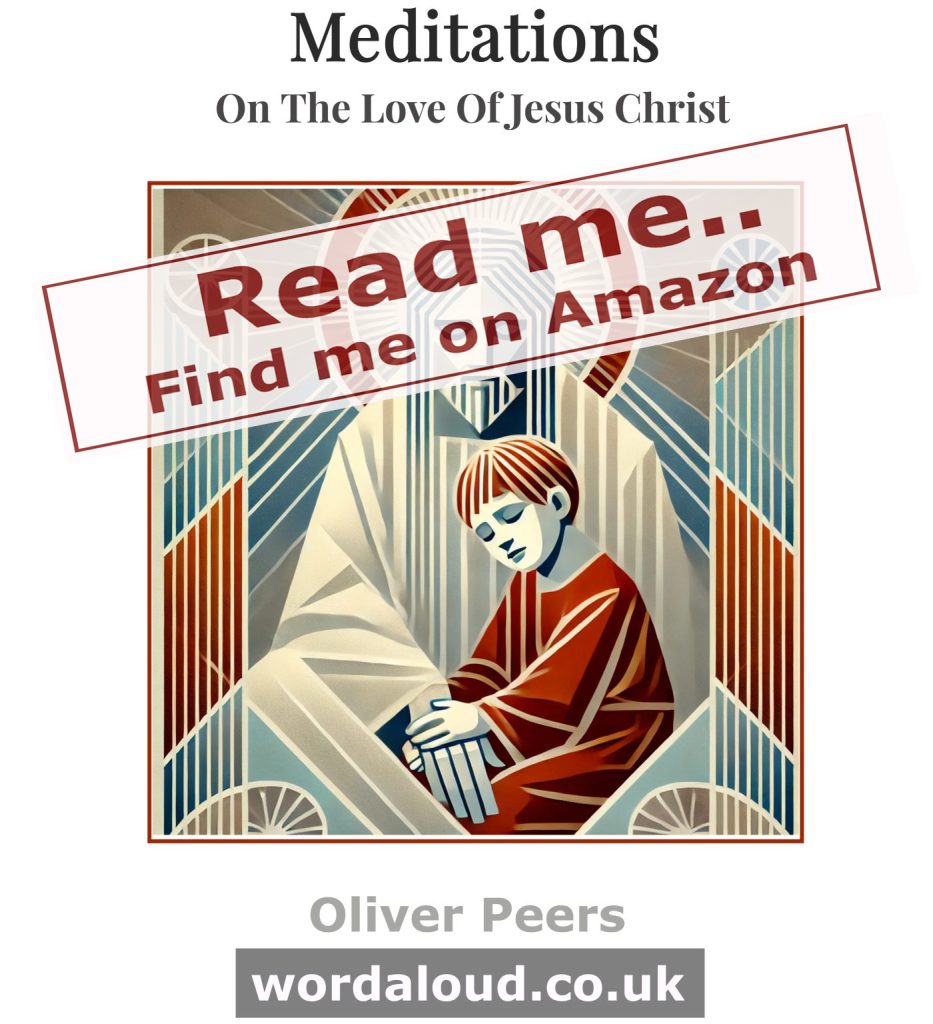
Christian Art | A Boy At Prayer With Jesus | Cross Of Our Salvation In The Eucharist
Office Of Readings | Eastertide Week 2, Saturday | A Reading From The Constitution Of The Second Vatican Council On The Sacred Liturgy | God’s Plan Of Salvation
‘On the plan of salvation.’
‘God’s Plan of Salvation’ – Sacrosanctum Concilium
The passage from Sacrosanctum Concilium offers a sweeping and theologically rich overview of God’s salvific plan as realized in the liturgy of the Church. It encapsulates the Council’s renewed vision of how divine revelation, the mystery of Christ, and sacramental worship are deeply and inseparably intertwined. Every element—from the ancient covenants to the Church’s liturgical life today—is interpreted in light of the Paschal Mystery, the central event of salvation history.
God’s Initiative In Salvation History
The passage begins by recalling the biblical foundation of salvation history: ‘God spoke in former times to our forefathers through the prophets…’ (cf. Hebrews 1:1–2) This reveals that the liturgy is not an invention of the Church, but a response to the divine initiative. God’s desire that all people be saved (1 Tim 2:4) underscores the universal scope of the liturgical mission. His self-disclosure through the prophets culminates in the Incarnation: ‘Then, in the fullness of time, he sent his Son…’ (cf. Gal 4:4).
This historical movement reaches its climax in Jesus Christ, the Word made flesh, who brings healing and reconciliation not merely through words but through his very person. In this, the document affirms the unity of Christ’s divine and human natures, echoing the hypostatic union defined at the Council of Chalcedon (451 AD). His human nature becomes the ‘instrument of our salvation’—a critical theological claim that justifies the sacramentality of the Church. The material world (e.g. water, oil, bread, wine) can now mediate divine grace because Christ has sanctified human nature itself.
The Paschal Mystery As The Heart Of Redemption
The text continues by identifying Christ’s passion, death, resurrection, and ascension—the ‘Paschal Mystery’—as the moment of perfect redemption. ‘By dying he destroyed our death, and by rising he restored our life.’ This phrase, taken from the ancient Easter preface, captures the essence of Christian hope. The Paschal Mystery is not just a historical event but a timeless reality made present in every celebration of the liturgy.
The image of Christ’s side, from which the Church is born as he ‘lay asleep on the cross’, is rich with typological and patristic significance. Echoing Genesis, where Eve is drawn from Adam’s side, early Church Fathers such as Augustine and Ambrose saw in the blood and water flowing from Christ’s pierced side (John 19:34) the symbols of the Eucharist and Baptism. The Church, like Eve, is both bride and body, emerging from the crucified Christ to share in his life and mission.
Apostolic Mandate And The Church’s Liturgical Mission
Just as the Father sent the Son, so the Son sends the Apostles, empowered by the Holy Spirit, to continue his saving work. Their mission is twofold: to proclaim the Gospel and to effect the reality of salvation through ‘the sacrifice and sacraments that are the pivot of the whole life of the liturgy’. This expresses a key insight of Vatican II: that the liturgy is not merely a memorial or symbolic representation, but an actual participation in the redemptive action of Christ.
The Apostles do not just announce salvation—they sacramentally mediate it. In this way, preaching and sacramental action are inseparable. The Church’s missionary and liturgical identities are two sides of the same coin. Every time the Eucharist is celebrated, the Church fulfils her apostolic mandate to proclaim the Lord’s death ‘until he comes’ (1 Cor 11:26).
Baptism | Participation In The Death And Resurrection Of Jesus Christ
Through baptism, the faithful are not simply initiated into a community—they are mystically united to Christ’s death and resurrection. The passage draws directly on Romans 6, emphasizing that the baptized are ‘dead with Christ, buried with Christ, risen with Christ’. In other words, the Paschal Mystery is not merely remembered, it is entered into. This is the foundational reason why the liturgy is the ‘source and summit of the Christian life’ (SC 10): it is where Christians become who they are called to be.
The gift of the Spirit enables the newly baptized to cry ‘Abba, Father’ (Romans 8:15; Galatians 4:6), fulfilling Jesus’ own promise that worshipers will adore the Father ‘in Spirit and in truth’ (John 4:23). This makes liturgical worship not just an external activity, but the full engagement of the believer’s inner life—heart, mind, and soul—in divine communion.
Eucharist And The Ecclesial Life
Participation in the Eucharist is the continuation of this baptismal transformation. When the faithful ‘eat the supper of the Lord’, they are joined to his sacrificial death and anticipate his return in glory. The reference to Pentecost emphasizes that the Church’s liturgical life began at its very birth: ‘They remained steadfast in the teaching of the apostles and in the communion of the breaking of bread…’ (Acts 2:42). From that moment, the Church has never ceased to gather, celebrate, and proclaim the Paschal Mystery.
The liturgy, then, is not only a ritual or tradition, but a dynamic and communal experience of salvation. The Scriptures are read, the Eucharist is celebrated, and thanksgiving is rendered—eucharistia—in praise of God’s ‘inexpressible gift’ (cf. 2 Cor 9:15). This points again to the essential link between worship and mission: liturgy both forms the Church and sends it into the world to embody the mystery it celebrates.

A Reading From The Constitution Of The Second Vatican Council On The Sacred Liturgy
In his desire that all men should be saved and come to the knowledge of the truth, God spoke in former times to our forefathers through the prophets, on many occasions and in different ways. Then, in the fullness of time he sent his Son, the Word made man, anointed by the Holy Spirit, to bring good news to the poor, to heal the broken-hearted as the physician of body and spirit and the mediator between God and men. In the unity of the person of the Word, his human nature was the instrument of our salvation. Thus in Christ there has come to be the perfect atonement that reconciles us with God, and we have been given the power to offer the fullness of divine worship.
This work of man’s redemption and God’s perfect glory was foreshadowed by God’s mighty deeds among the people of the Old Covenant. It was brought to fulfilment by Christ the Lord, especially through the paschal mystery of his blessed passion, resurrection from the dead and ascension in glory: by dying he destroyed our death, and by rising again he restored our life. From his side, as he lay asleep on the cross, was born that wonderful sacrament which is the Church in its entirety.
As Christ was sent by the Father, so in his turn he sent the apostles, filled with the Holy Spirit. They were sent to preach the Gospel to every creature, proclaiming that we had been set free from the power of Satan and from death by the death and resurrection of God’s Son, and brought into the kingdom of the Father. They were sent also to bring into effect this saving work that they proclaimed, by means of the sacrifice and sacraments that are the pivot of the whole life of the liturgy.
So, by baptism men are brought within the paschal mystery. Dead with Christ, buried with Christ, risen with Christ, they receive the Spirit that makes them God’s adopted children, crying out: Abba, Father; and so they become the true adorers that the Father seeks.
In the same way, whenever they eat the supper of the Lord they proclaim his death until he comes. So, on the very day of Pentecost, on which the Church was manifested to the world, those who received the word of Peter were baptised. They remained steadfast in the teaching of the apostles and in the communion of the breaking of bread, praising God and enjoying the favour of all the people.
From that time onward the Church has never failed to come together to celebrate the paschal mystery, by reading what was written about him in every part of Scripture, by celebrating the Eucharist in which the victory and triumph of his death are shown forth, and also by giving thanks to God for the inexpressible gift he has given in Christ Jesus, to the praise of God’s glory.

Context And Background | Sacrosanctum Concilium
Sacrosanctum Concilium, Latin for ‘This Sacred Council’, is the Constitution on the Sacred Liturgy of the Second Vatican Council, promulgated by Pope Paul VI on December 4, 1963. It was the first major document to be issued by the Council and set the tone for the rest of Vatican II’s work by emphasizing renewal, accessibility, and participation in the life of the Church.
The Constitution was the product of widespread consultation and theological development throughout the early 20th century, especially the Liturgical Movement, which sought to recover the ancient and communal dimensions of Christian worship. Influential figures behind this movement included Dom Lambert Beauduin, Josef Jungmann, and Pius Parsch, who emphasized greater lay participation, the vernacular in worship, and the liturgy as the ‘source and summit’ (fons et culmen) of Christian life.
Core themes of Sacrosanctum Concilium include:
- Active participation of the laity in the liturgy, not as passive observers but as fully engaged worshippers.
- Restoration and simplification of rites to highlight their meaning and accessibility.
- Greater use of Sacred Scripture in liturgical celebrations.
- Use of the vernacular language alongside Latin, especially in the readings and prayers of the faithful.
- The liturgy as a celebration of the Paschal Mystery, making Christ’s death and resurrection present and effective.
The document deeply reoriented the Church’s approach to worship, stressing that liturgical action is the privileged encounter with Jesus Christ and a foretaste of the heavenly banquet.



There is a beautiful lesson in love, which is to test ourselves when we are offering gifts of love to our beloved/s, and this is by imagining that we actually don’t know the person or people to whom we are giving. This way, we can make sure that what we are doing is giving, rather than making an investment and expecting something in return [ … ]

Psalm 125, one of the Psalms of Ascent, opens with a comparison of those who trust in the Lord to mount Zion. This comparison signifies stability and permanence. The psalmist uses the physical geography of Jerusalem and its surrounding mountains to illustrate the protection provided by the Lord to God’s people. This imagery serves as a metaphor for divine security and steadfastness [ … ]

Dear Jesus, In times of trouble and distress, I come to you, seeking comfort and peace. You understand the depths of my heart and the challenges I face. I bring my burdens to you, as they feel heavy and overwhelming. I trust that you will provide the rest and strength I need during these difficult moments [ … ]