
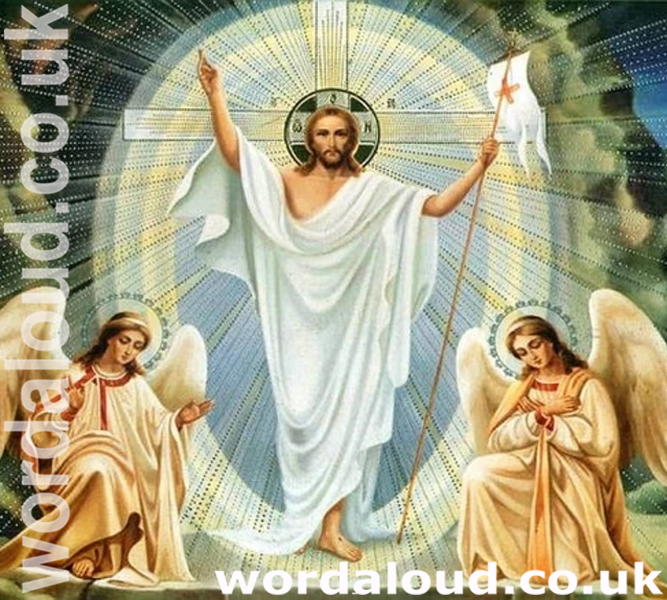
Christian Art | Jesus Christ | Risen Lord
Office Of Readings | Week 18, Saturday, Ordinary Time | A Reading From The Treatise Of Saint Irenaeus Against The Heresies | I Desire Mercy Not Sacrifice
‘I desire mercy not sacrifice.’
Irenaeus reflects on the words of Hosea, repeated by Jesus, that God desires mercy rather than sacrifice. Irenaeus presents this not as a rejection of ritual worship in itself, but as a statement that God seeks faith, obedience, and righteousness as the basis for human salvation. Jesus uses the prophet’s teaching to challenge those who condemn the innocent, aligning his own authority with that of the prophetic tradition.
Irenaeus turns to the Eucharist to show how this principle is fulfilled in Christian worship. At the Last Supper, Jesus took bread and wine—ordinary elements of creation—and declared them to be his body and blood. This was not because God required food, but so that the Church might respond with gratitude, offering back to God the ‘first-fruits’ of his own creation.
The Church’s offering is not limited to one place or people. Irenaeus links it to Malachi’s prophecy that a pure sacrifice would be offered to God in every place, and that his name would be honoured among the nations. This prophecy, he says, is realised in the Eucharist, celebrated across the world through Jesus Christ.
He also reflects on the meaning of the name of Jesus. Just as a king who paints his son’s portrait rightly calls it his own work, so the Father claims the name of his Son as his own. It belongs to him both because it is his Son’s name and because he has ‘written’ it into the life of the world for its salvation.
Finally, Irenaeus notes that in the vision of Revelation, incense symbolises the prayers of the saints. The Eucharistic offering, joined with these prayers, becomes the pure sacrifice promised by the prophets and offered by the Church in unity with Christ.

A Reading From The Treatise Of Saint Irenaeus Against The Heresies | I Desire Mercy Not Sacrifice
God did not seek sacrifices and holocausts, but faith, and obedience, and righteousness, for the sake of their salvation. As God said, teaching his will through Hosea the prophet, What I want is love, not sacrifice; knowledge of God, not holocausts. Our Lord taught the same, saying If you had understood the meaning of the words: What I want is mercy, not sacrifice, you would not have condemned the blameless. Thus he bore witness to the truth of the prophets’ teachings while convicting the people of culpable folly.
Giving directions to his disciples to offer to God the first-fruits of his own creation — not offering them as if God needed them but so that they themselves should not be sterile or ungrateful — he took a created thing, bread, gave thanks, and said This is my body. And as for the cup, which is part of the same creation as us, he proclaimed it to be his blood and taught that it was the new offering of the new covenant. The Church received this from the Apostles and offers it to God throughout the world, to the God who gives us food, the first-fruits of his gifts under the new covenant. Malachi, one of the twelve prophets, foretold this as follows: I am not pleased with you, says the Lord of Hosts; from your hands I find no offerings acceptable. But from farthest east to farthest west my name is honoured among the nations and everywhere a sacrifice of incense is offered to my name, and a pure offering too, since my name is honoured among the nations, says the Lord of Hosts. Thus he clearly indicated that the people of old (the Jews) would cease to make offerings to God, but that in every place a sacrifice would be offered, and a pure sacrifice at that; and his name would be glorified among the nations.
What other name is there which is glorified among the Gentiles than that of our Lord, by whom the Father is glorified, and man also? Because it is the name of his own Son, who was made man by him, he calls it his own. Just as a king, if he himself paints a portrait of his son, is right in calling this portrait his own, both because it is a portrait of his son and because he himself painted it, so also the Father professes the name of Jesus Christ, glorified in the Church throughout the world, to be his own, both because it is that of his Son, and because he himself wrote it and gave it for the salvation of mankind.
The prophet’s words are doubly appropriate, both because the Son’s name belongs properly to the Father, and because the Church everywhere makes her offering to almighty God through Jesus Christ: In every place incense is offered to my name, and a pure sacrifice. For as John says in the Apocalypse, incense is the prayer of the saints.
Christian Prayer With Jesus Christ
Lord of mercy and truth,
You have called us not to empty rituals but to lives filled with love, obedience, and the knowledge of You.
In Your Son Jesus Christ, You have given us the pure offering that fulfils every prophecy—the gift of his Body and Blood, our food and salvation.
Grant that we may approach this holy sacrifice with grateful hearts, offering ourselves as living sacrifices, holy and pleasing to You.
May our worship be joined to the prayer of the saints, rising like incense before Your throne, and may the name of Jesus be glorified from the rising of the sun to its setting.
Through Christ our Lord,
Amen.
Glossary Of Christian Terms
Hosea – A prophet of the 8th century BC, whose writings emphasise God’s steadfast love and call for faithfulness rather than empty ritual.
Mercy, not sacrifice – A biblical phrase meaning that God desires compassion, justice, and faithful obedience more than formal offerings.
Holocausts – Whole-burnt offerings in the sacrificial system of ancient Israel.
First-fruits – The first portion of a harvest, offered to God in thanksgiving.
New covenant – The relationship between God and humanity established through Jesus Christ, replacing the old covenant given through Moses.
Eucharist – The Christian act of thanksgiving instituted by Jesus at the Last Supper, in which bread and wine are consecrated as his body and blood.
Malachi – One of the twelve minor prophets in the Hebrew Bible, active in the 5th century BC, who foretold a universal and pure offering to God.
Incense – In biblical worship, a fragrant smoke offered to God; in Revelation, it symbolises the prayers of the faithful.
Revelation (Apocalypse) – The final book of the New Testament, containing visions of the end times and the ultimate triumph of God.
Name of Jesus – In biblical thought, a name carries the identity and authority of the person; here, it expresses the presence and saving power of Christ.



Herbert’s poem unfolds as meditation on inner peace and spiritual discipline, crafted through precise imagery and reflective admonition. Herbert begins with a command to restless thoughts, urging them to remain within confines of their own being. This invocation sets the tone for the poem as both a prayer and an internal dialogue, where the soul seeks to reconcile its innate restlessness with a divine imperative for order and calm. This act of addressing thoughts directly implies their unruliness, underscoring tension between human inclination toward distraction and spiritual call to stillness [ … ]

Faith is not merely a passive acceptance but an active trust in God’s promises. It is a dynamic and living aspect of our relationship with God. When we face life’s challenges, our faith can be tested. These tests are opportunities for growth, allowing us to deepen our reliance on God [ … ]

As the disciples accompany Jesus on the way to Jerusalem, so we are asked to unite ourselves to Jesus in his passion and death, so that we may share in his resurrection and accompany Jesus in his glory as Holy Week culminates in Easter [ … ]
