
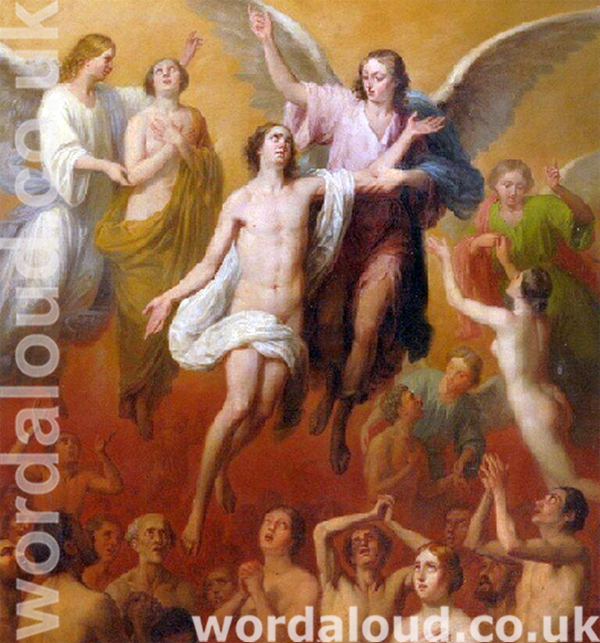
Christian Art | Prayers For The Dead | All Souls | Purgatory | Let Us Carry The Cross Of Jesus In Our Lives
Office Of Readings | Week 31, Saturday, Ordinary Time | A Reading From The Treatise Of Saint Ambrose On The Blessing Of Death | Let Us Carry The Death Of Jesus In Our Bodies
‘Let us show Christ crucified in our lives.’
Saint Ambrose interprets death not merely as an end but as a transformative process that begins within the believer’s earthly life. His language of ‘crucifixion’ and ‘death’ does not describe physical demise but spiritual participation in the death of Christ. The Christian is called to manifest Christ crucified in conduct and intention, allowing the power of the cross to reorder the inner life.
Ambrose begins with Saint Paul’s declaration, ‘The world is crucified to me, and I to the world.’ For Ambrose, this crucifixion signifies a present and active detachment from the disorder of sin. The believer who ‘bears the death of Jesus’ within his body also bears his life. Death to sin and self is therefore the condition for life in grace. This is not a passive state but a continual discipline in which the ‘law of our fallen nature’ yields to the ‘law of reason’ illumined by Christ.
Ambrose introduces a striking paradox: that this kind of ‘death’ is more powerful than ‘life’. The mortification of the old self releases a vitality that no earthly power can produce. The believer’s outward self decays so that the inward self may be renewed. The imagery recalls Saint Paul’s teaching in 2 Corinthians — the theme of decay and renewal as the rhythm of sanctification. To die with Christ is to enter already into the movement of resurrection.
He expands this inner dying into moral and social dimensions. The ‘bonds’ of fallen nature are identified with the injustices and oppressions denounced by the prophet Isaiah. To imitate death is to loosen such bonds, to break the yoke of evil in both personal and communal life. True spiritual detachment thus includes moral liberation and the pursuit of justice; it is not withdrawal but transformation of the world through charity.
Ambrose then situates death within God’s providence. Death entered the world to bring sin to an end, while resurrection ensures that creation does not perish. The two belong together as aspects of divine mercy: death limits evil; resurrection restores life. Hence the Christian’s death becomes a Passover — a passage from corruption to incorruption, from turmoil to rest. Ambrose adopts the biblical metaphor of journey: death is a crossing, a transition toward peace, not an annihilation.
He redefines death as ‘the burial of sin and the resurrection of goodness’. To die among the just, as Scripture says, is to be buried with them in holiness — to cast off sin and put on grace. This imagery unites the moral, sacramental, and eschatological dimensions of Christian existence. Baptism, repentance, and final death all share the same pattern: dying to sin, rising to new life.
Ambrose’s meditation thus portrays death, rightly understood, as integral to Christian discipleship. The believer is called to undergo this death daily — to show forth Christ crucified in thought, action, and desire — until the final moment when the temporal struggle is completed and life, already begun in grace, is made eternal in glory.

A Reading From The Treatise Of Saint Ambrose On The Blessing Of Death | Let Us Carry The Death Of Jesus In Our Bodies
The Apostle tells us: The world is crucified to me, and I to the world. We are to understand that this death by crucifixion takes place in this life, and that this death is a blessing. So he goes on to urge us to bear the death of Jesus with us in our bodies, for whoever bears the death of Jesus in his body will bear also in his body the life of the Lord Jesus.
Death must be active within us if life also is to be active within us. Life is life after death, a life that is a blessing. This blessing of life comes after victory, when the contest is over, when the law of our fallen nature no longer rebels against the law of our reason, when we no longer need to struggle against the body that leads to death, for the body already shares in victory. It seems to me that this ‘death’ is more powerful than ‘life.’ I accept the authority of the Apostle when he says: Death is therefore active within us, but life also is active within you. Yet the ‘death’ of this one man was building up life for countless multitudes of peoples! He therefore teaches us to seek out this kind of death even in this life, so that the death of Christ may shine forth in our lives – that blessed death by which our outward self is destroyed and our inmost self renewed, and our earthly dwelling crumbles away and a home in heaven opens before us.
The person who cuts himself off from this fallen nature of ours and frees himself from its chains is imitating death. These are the bonds spoken of by the Lord through Isaiah: Loose the bonds of injustice, untie the thongs of the yoke, set free the oppressed and break every yoke of evil.
The Lord allowed death to enter this world so that sin might come to an end. But he gave us the resurrection of the dead so that our nature might not end once more in death; death was to bring guilt to an end, and the resurrection was to enable our nature to continue forever.
‘Death’ in this context is a Passover to be made by all mankind. You must keep facing it with perseverance. It is a Passover from corruption, from mortality to immortality, from rough seas to a calm harbor. The word ‘death’ must not trouble us; the blessings that come from a safe journey should bring us joy. What is death but the burial of sin and the resurrection of goodness? Scripture says: Let my soul die among the souls of the just; that is, let me be buried with the just, so that I may cast off my sins and put on the grace of the just, of those who bear the death of Christ with them, in their bodies and in their souls.
Christian Prayer With Jesus
Lord Jesus Christ,
you accepted death to destroy death
and by your cross opened the way to life.
Grant that we may bear your death in our bodies,
that your life may be revealed in us.
Teach us to die each day to sin and self,
to loosen the bonds of injustice,
to walk in the freedom of your Spirit,
and to await the final Passover
from this world to the joy of your kingdom.
For you live and reign with the Father and the Holy Spirit,
one God, now and forever.
Amen.
Glossary Of Christian Terms
Crucifixion (Spiritual): The voluntary renunciation of sin and self-will through identification with the suffering and obedience of Christ.
Mortification: The discipline of subduing sinful desires so that the life of grace may flourish.
Law of Reason: In Ambrose’s usage, the moral order within the human person enlightened by faith and directed toward God’s will.
Law of the Flesh (Fallen Nature): The tendency within human nature toward self-gratification and rebellion against divine order.
Passover (Metaphor): A transition from one state to another — here, from sin to grace, from mortality to immortality — echoing Israel’s passage from slavery to freedom.
Providence: God’s wise governance of creation, directing even suffering and death toward redemption.
Justice (Biblical): Right relationship with God and others, expressed through mercy, equity, and the breaking of oppressive bonds.
Inner Renewal: The transformation of the soul by grace through continual conversion and participation in Christ’s life.
The Burial of Sin: The putting away of wrongdoing through repentance and grace, often associated with baptismal imagery.
Resurrection of Goodness: The moral and spiritual rebirth that follows repentance; the emergence of new life from death to sin.




Saint Aelred of Rievaulx presents the highest expression of Christian love: the love of one’s enemies. His reflection is deeply rooted in the Gospel, particularly in Christ’s own example on the cross, where Jesus prays, “Father, forgive them, for they do not know what they are doing.” For Aelred, this moment encapsulates the essence of divine love—self-giving, patient, and without retaliation [ … ]
The devotion to the Sacred Heart of Jesus has its origins in early Christian thought and gradually developed into a formal practice over many centuries. The devotion focuses on the heart of Jesus Christ as a symbol of Jesus’ love, particularly Jesus’ willingness to suffer and die for humanity. This devotion has evolved through biblical interpretation, theological reflection, mystical experiences, and papal endorsements [ … ]
Psalm 61 expresses need for divine assistance and refuge during tumultuous times [ … ]
