
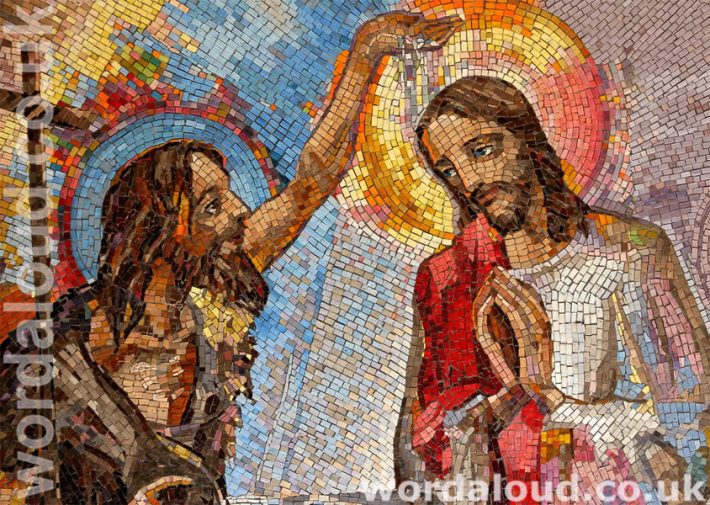
Christian Art | John The Baptist With Jesus | Baptism Of The Lord
Office Of Readings | Advent Sunday Week 2 | A Reading From The Commentary On Isaiah By Eusebius Of Caesarea | A Voice Of One Crying In The Wilderness
‘A voice of one crying in the wilderness.’
Eusebius reads Isaiah as a map of the gospel: a prophecy pointing ahead to John the Baptist, to Christ’s appearance, and to the mission of those who would later preach Christ to the world. He pays close attention to the detail that the voice cries not in the city but in the wilderness. For him this matters, because the wilderness symbolises the place where God is not expected, where the ground is rough, where paths have never been cleared. Eusebius sees this as an image of the world before the gospel, a world without the knowledge of God.
John the Baptist therefore becomes the first sign that God is entering this unprepared land. His message—prepare the way, make straight the paths—marks the beginning of a new approach from God. The wilderness is no longer a place of absence but the place where God chooses to appear. Eusebius recalls Christ’s baptism as the moment when this becomes visible: the heavens open, the Spirit descends, and the Father’s voice reveals the Son. All of this, he says, is the fulfilment of Isaiah’s promise that the glory of the Lord would appear where no one expected it.
Eusebius then turns to the command to prepare a way. For Eusebius, this ‘way’ is the preaching of the gospel. The gospel opens a road across previously impassable ground, allowing people who once knew nothing of God to recognise God’s presence. Isaiah’s prophecy of a straight path becomes the simple, direct proclamation of Christ: a message meant for all people, not just a few.
Eusebius next speaks of the ‘high mountain’ from which good news is to be proclaimed. He identifies this mountain with Zion, which for him symbolises the apostolic community. The apostles, raised up not by privilege but by being chosen and taught by Christ, become the ones who will stand high and announce God’s salvation. The evangelists, too, stand in this line: bearers of good news who speak first to Israel but ultimately to all nations.
Eusebius presents a quiet, unfolding movement: from prophet, to forerunner, to Christ, to apostle, to evangelist, and then outward to the whole world. Everything begins in a barren, neglected place, and from there the gospel spreads. The wilderness becomes the doorway through which God enters human history. What seemed empty becomes the place where God speaks most clearly.
A Reading From The Commentary On Isaiah By Eusebius Of Caesarea | A Voice Of One Crying In The Wilderness
The voice of one crying in the wilderness: Prepare the way of the Lord, make straight the paths of our God. The prophecy makes clear that it is to be fulfilled, not in Jerusalem but in the wilderness: it is there that the glory of the Lord is to appear, and God’s salvation is to be made known to all mankind.
It was in the wilderness that God’s saving presence was proclaimed by John the Baptist, and there that God’s salvation was seen. The words of this prophecy were fulfilled when Christ and his glory were made manifest to all: after his baptism the heavens opened, and the Holy Spirit in the form of a dove rested on him, and the Father’s voice was heard, bearing witness to the Son: This is my beloved Son, listen to him.
The prophecy meant that God was to come to a deserted place, inaccessible from the beginning. None of the pagans had any knowledge of God, since his holy servants and prophets were kept from approaching them. The voice commands that a way be prepared for the Word of God: the rough and trackless ground is to be made level, so that our God may find a highway when he comes. Prepare the way of the Lord: the way is the preaching of the Gospel, the new message of consolation, ready to bring to all mankind the knowledge of God’s saving power.
Climb on a high mountain, bearer of good news to Zion. Lift up your voice in strength, bearer of good news to Jerusalem. These words harmonise very well with the meaning of what has gone before. They refer opportunely to the evangelists and proclaim the coming of God to men, after speaking of the voice crying in the wilderness. Mention of the evangelists suitably follows the prophecy on John the Baptist.
What does Zion mean if not the city previously called Jerusalem? This is the mountain referred to in that passage from Scripture: Here is mount Zion, where you dwelt. The Apostle says: You have come to mount Zion. Does not this refer to the company of the apostles, chosen from the former people of the circumcision?
This is the Zion, the Jerusalem, that received God’s salvation. It stands aloft on the mountain of God, that is, it is raised high on the only-begotten Word of God. It is commanded to climb the high mountain and announce the word of salvation. Who is the bearer of the good news but the company of the evangelists? What does it mean to bear the good news but to preach to all nations, but first of all to the cities of Judah, the coming of Christ on earth?
Christian Prayer With Jesus
Lord, prepare in us a clear path for your coming.
Open our hearts where the ground is rough,
and make straight in us whatever has grown crooked.
Give us the courage to bear your good news,
and to recognise your presence where we least expect it.
Amen.
Glossary Of Christian Terms
Wilderness – A place without the knowledge or worship of God; also an image for the inner places that feel empty or unprepared.
Prepare the way – To open the heart to God’s approach, and to clear obstacles to the gospel.
Zion – A biblical name for Jerusalem; here used to symbolise the apostolic community.
Evangelists – Those who proclaim the good news of Christ, especially the authors of the four gospels.
Glory of the Lord – God’s presence made visible or recognisable.



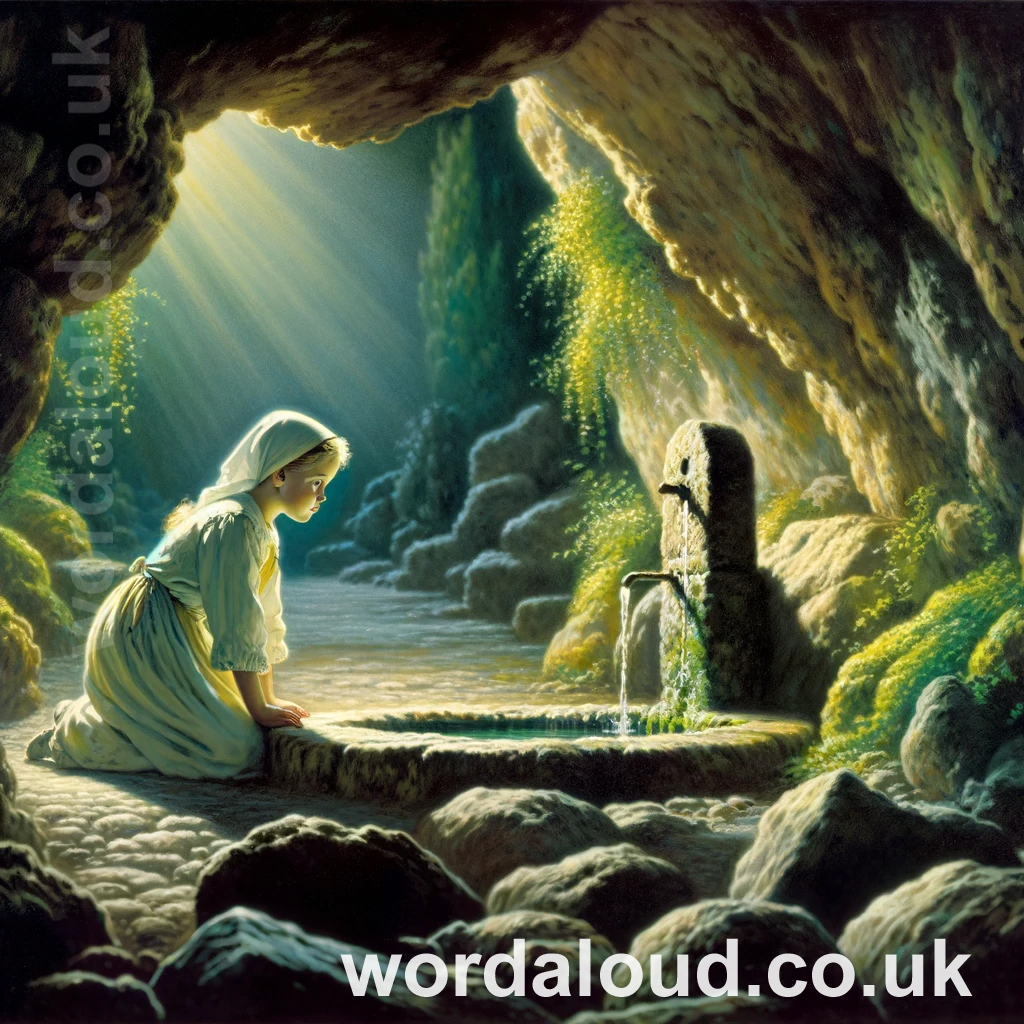
John 4:13-14 (KJV) ‘Jesus answered and said unto her, Whosoever drinketh of this water shall thirst again: But whosoever drinketh of the water that I shall give him shall never thirst; but the water that I shall give him shall be in him a well of water springing up into everlasting life.’ Introduction to the Life of Saint Bernadette Saint Bernadette Soubirous, a humble peasant girl from Lourdes, France, lived her life of faith, humility, and divine grace. Born on January 7, 1844, in the small town of Lourdes, Bernadette was the eldest of nine children in a poor and struggling family. Her father, François Soubirous, was a miller, and her mother, Louise, a laundress. The family lived in a former prison cell known as the Cachot, a damp and cramped space, according to their dire financial situation. Despite their poverty, the Soubirous family was deeply rooted in their Christian faith, a foundation that would profoundly shape Bernadette’s life and spiritual journey. Bernadette’s early years were marked by significant health challenges. She suffered from asthma and other respiratory ailments, which often left her weak and unable to attend school regularly. This lack of formal education meant that Bernadette struggled with reading and writing, and her understanding of Christian doctrine was limited. Nevertheless, she possessed a remarkable simplicity and purity of heart, qualities that would make her an ideal recipient of divine revelations. Bernadette’s life changed irrevocably on February 11, 1858, when she experienced the first of eighteen apparitions of the Blessed Virgin Mary at the grotto of Massabielle. On that cold winter day, Bernadette, her sister Toinette, and a friend were gathering firewood near the grotto when she heard a rustling sound and saw a beautiful lady dressed in white with a blue sash, holding a rosary. The lady, who later identified herself as the Immaculate Conception, appeared to Bernadette over the course of several months, delivering messages of penance, prayer, and the need for a chapel to be built at the site. Despite initial skepticism from her family and the local authorities, Bernadette remained steadfast in her account of the apparitions, enduring intense scrutiny and even ridicule. The apparitions drew enormous attention. Soon, people from all over France and beyond began to visit Lourdes, hoping to witness a miracle. One of the most significant messages conveyed by the Virgin Mary to Bernadette was the instruction to dig in the ground near the grotto, which led to the discovery of a spring. This spring, believed to have healing properties, became the focal point of the pilgrimage to Lourdes. Many miraculous healings have been attributed to the waters of Lourdes, reinforcing the belief in Bernadette’s visions and the sanctity of the site. As the apparitions concluded, Bernadette’s life took a different turn. In 1866, she joined the Sisters of Charity in Nevers, taking the name Sister Marie-Bernard. Her time in the convent was marked by continued poor health and humility, as she carried out menial tasks and lived a life of quiet service. Despite her physical suffering, Bernadette remained devout and accepted her hardships with grace, often repeating the phrase, “I am happier here in my little corner of the convent.” Her unwavering faith and dedication to her religious duties exemplified the depth of her spiritual commitment. Bernadette Soubirous passed away on April 16, 1879, at the age of 35, after a prolonged battle with tuberculosis. Her legacy, however, endured far beyond her earthly life. In 1933, she was canonized as a saint by Pope Pius XI, recognized for her humility, faith, and the miraculous events associated with her life. Today, millions of pilgrims flock to Lourdes each year, seeking spiritual renewal and physical healing at the site of her visions. Saint Bernadette’s life continues to inspire countless individuals around the world, reminding us of the power of faith, the virtue of humility, and the enduring presence of divine grace in our lives. To Visit Lourdes Visiting Lourdes, in the picturesque foothills of the Pyrenees in southwestern France, is an experience that transcends the physical journey, drawing pilgrims into a profound spiritual adventure. The small town, known for the Marian apparitions witnessed by Saint Bernadette Soubirous in 1858, has become one of the world’s most revered pilgrimage sites. As we approach the Sanctuary of Our Lady of Lourdes, the atmosphere is imbued with a palpable sense of reverence and anticipation. The grand basilicas, the tranquil Grotto of Massabielle and the gently flowing waters of the miraculous spring together create a sacred environment that invites reflection, prayer, and a deep connection with the divine. The focal point of any visit to Lourdes is the Grotto, where Bernadette experienced the apparitions of the Blessed Virgin Mary. Here, pilgrims can touch the rock face, light candles, and drink or bathe in the spring’s water, believed to possess healing properties. The profound silence and sense of sacredness at the Grotto allow visitors to contemplate their faith, seek solace and find spiritual renewal. The Rosary Basilica, with its mosaics, and the Basilica of the Immaculate Conception, perched above the Grotto, offer spaces for communal worship and personal meditation. The nightly candlelight processions, where pilgrims from around the globe unite in prayer and song, highlight the universal bond of faith and hope that Lourdes represents. Beyond its physical beauty and historical significance, visiting Lourdes offers a deeply personal and transformative experience. Pilgrims often arrive burdened with ailments, grief, or spiritual crises, seeking comfort and miracles. The stories of healing and faith that emerge from Lourdes are testimonies to the enduring power of belief and the intercession of the Blessed Virgin Mary. The communal aspect of the pilgrimage—sharing meals, prayers, and stories with fellow believers—fosters a sense of solidarity and mutual support. For many, the visit to Lourdes is a journey of healing, not only of the body but also of the soul, providing a renewed sense of purpose, peace, and spiritual clarity that lingers long after returning home. Prayer With Saint Bernadette Prayer for Intercession Dear […]
Saint Clement’s reflection on divine fidelity presents an early instance of Christian reasoning that links observation of the natural order with trust in the promise of resurrection. The structure of the argument proceeds by analogy: the visible alternation of night and day, the decay and renewal of seed, the continuous pattern of the seasons, all provide evidence that death does not end a process but belongs within it. The ordered rhythm of nature is treated not as mere metaphor but as a form of testimony, available to perception and open to interpretation by faith [ … ]
Dear Jesus, Thank you for the blessing of family. Help me to appreciate and cherish my family members, both biological and spiritual. Guide me to be a source of love, support, and encouragement to them. Grant us the strength to overcome challenges together and to celebrate our joys with gratitude. May our family be a reflection of your love and grace. Help us to forgive one another, to be patient, and to build each other up. Let your peace reign in our home, and may we always seek to do your will. Amen [ … ]
