
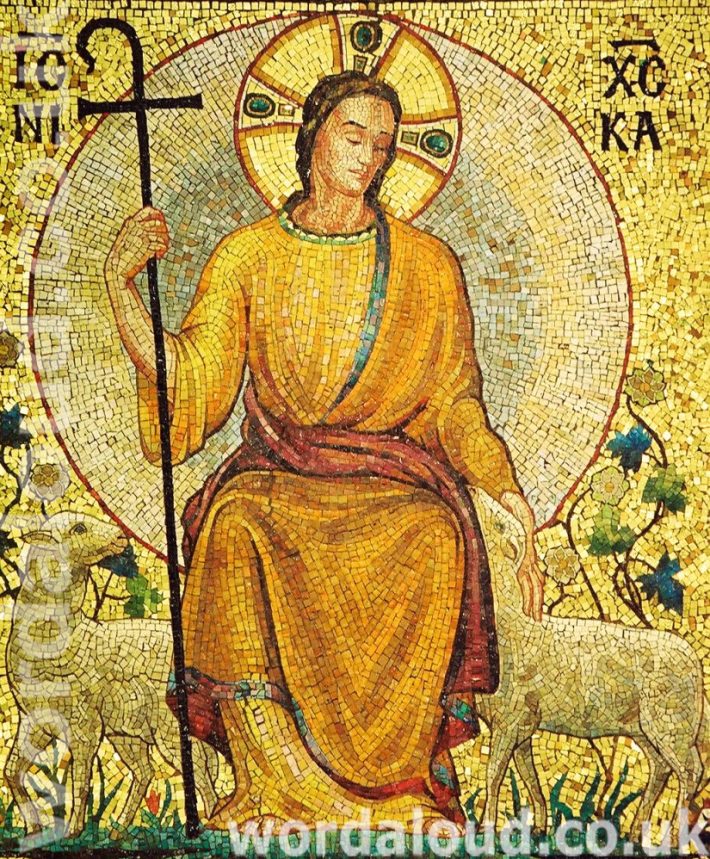
Christian Art | Jesus Christ Is The Good Shepherd
Office Of Readings | Week 3, Friday, Ordinary Time | A Reading From The Commentary Of Saint John Fisher On The Psalms | God’s Wonderful Deeds
‘The wonderful works of God.’
In his commentary on the Psalms, Saint John Fisher reflects on the pattern of God’s saving action in history and the human response to it. He moves from the story of Israel to the life of the Church, showing a continuity of divine generosity and a repeated failure of gratitude.
The reading begins with a summary of the great acts of God on behalf of Israel. Fisher recalls the liberation from Egypt, the crossing of the Red Sea, the gift of food and water in the wilderness, protection from enemies, and the settlement in the promised land. Each event is presented as an expression of God’s care and power. These are not isolated miracles but part of a sustained relationship in which God provides, guides, and protects his people.
Despite this care, Israel’s response was often marked by forgetfulness and infidelity. Fisher notes how quickly the people turned from worship of God to the worship of idols. The contrast between divine faithfulness and human ingratitude forms a central tension in the passage. God’s generosity remains steady, while human loyalty proves fragile.
Fisher then extends the story to include the Gentiles. Those who were once outside the covenant, drawn to lifeless idols, have now been brought into God’s people. Using the image of the olive tree from Saint Paul, he describes how the Gentiles have been grafted into the life of Israel and made sharers in its promises. This inclusion is not an afterthought but part of God’s plan to spread his grace more widely.
The supreme sign of God’s generosity is the gift of his Son. Fisher presents Christ as both sacrifice and offering, given for the redemption and purification of God’s people. Through Christ, God’s love reaches its fullest expression, going beyond all earlier acts of deliverance.
Yet Fisher does not soften his assessment of human response. He speaks plainly about continued ingratitude, even in the face of such mercy. The failure to live according to God’s law, despite knowing his goodness, is presented as a serious contradiction.
The reading ends with a call to memory. God’s works must be written down and passed on so that future generations will know his goodness and continue to praise him. For Fisher, remembrance is not merely historical record but an act of faith, keeping the Church rooted in gratitude for what God has done.

A Reading From The Commentary Of Saint John Fisher On The Psalms | God’s Wonderful Deeds
First God freed Israel from the bondage of Egypt by performing many signs and wonders. He permitted them to cross the Red Sea dry-shod. He fed them in the desert with food from heaven in the form of manna and quail. When they were suffering from thirst, he produced an overflowing spring of water from the hardest rock. He gave them victory over all the enemies who made war against them. He forced the river to flow backward for a time. He divided the promised land and distributed it among them according to the number of their tribes and families.
Yet even though he treated them so lovingly and generously, the Israelites were ungrateful and seemed forgetful of all this. They abandoned the worship of God and more than once they were guilty of the abominable sin of idolatry.
Then he also took pity on us, when we were pagans who went off to mute idols wherever we were led. He severed us from the wild olive tree of paganism and, breaking our natural branches, he grafted us onto the true olive tree of Judaism and made us share in the root of his grace and richness. Finally, he did not spare his own Son but gave him up for us all, as an offering and a sacrifice to God in a fragrant odor, so that he would redeem us from all our iniquity and cleanse for himself an acceptable people.
Now all these things are not merely certain arguments but also clear proof of his deep love and kindness for us. And yet we are the most ungrateful of men. Indeed, we have gone beyond the bounds of ingratitude: we give no thought to his love, nor do we recognize the extent of his kindnesses to us. Rather we reject the one who lavishes so many favours and even appear to despise him; and the remarkable mercy that he has continually shown to sinners does not move us to form our lives and conduct according to his most holy command.
Clearly these things are worthy to be written down in the second generation so as to preserve their memory for ever. Thus all who are still to be counted among Christians will know the great kindness of God toward us and never cease singing his divine praises.
Christian Prayer With Jesus Christ
God of mighty deeds and faithful love,
you have acted with power and mercy
throughout the history of your people.
We thank you for your works of deliverance,
for your care in times of need,
and for the gift of your Son,
given for our redemption.
Forgive us when we forget your goodness
or take your grace for granted.
Turn our hearts back to you,
that our lives may reflect
the gratitude we owe you.
Help us to remember and to hand on
the story of your saving love,
so that praise may never cease
among your people.
Through Christ our Lord.
Amen
Glossary Of Christian Terms
Exodus | The deliverance of Israel from slavery in Egypt
Red Sea | The sea crossed by Israel when fleeing from Egypt
Manna | Food given by God to Israel in the desert
Quails | Birds provided as food in the wilderness
Promised land | The land God gave to Israel
Idol-worship | The worship of false gods
Gentiles | People who were not part of Israel
Olive tree | A biblical image for God’s people
Grafted | Joined into a living community
Redemption | Being freed from sin and restored to God
Fragrant offering | A sacrifice pleasing to God
Ingratitude | Failure to recognise and respond to kindness
Holy law | God’s moral and religious teaching



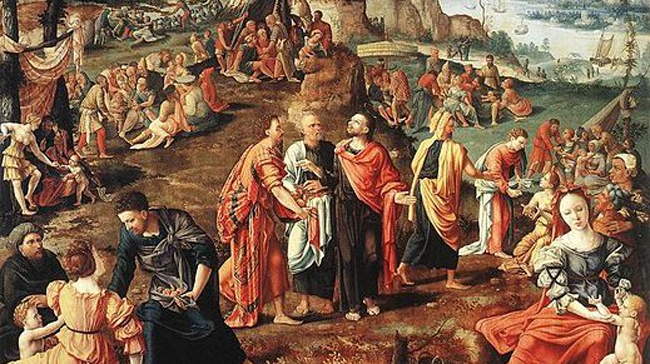
After the feeding of the five thousand, Jesus has gone into the hills alone to pray, while his disciples begin to cross over the Sea of Galilee ahead of him. Jesus has walked across the sea to join his disciples, who cannot comprehend what is happening and who Jesus truly is [ … ]
Psalm 57 is born of recognition of one’s own limitations and awareness of God. This psalm encapsulates universal experience of facing adversity and challenges [ … ]

In this reading from his letter to the Ephesians, Saint Ignatius of Antioch reflects on the importance of unity within the Christian community. Writing as a prisoner on his way to martyrdom, Ignatius speaks with humility and urgency. He does not present himself as a figure of authority, but as a fellow disciple who is still learning what it means to follow Christ [ … ]
