
Christian Art | Jesus Christ | Fishers Of Men
Office Of Readings | Week 3, Saturday, Ordinary Time | A Reading From The Pastoral Constitution On The Church In The Modern World Of The Second Vatican Council | The Mystery Of Death
‘The mystery of death.’
This reading from the Pastoral Constitution on the Church in the Modern World addresses the human concern with the subject of death. It approaches the subject not only as a biological event but as a spiritual and existential mystery that touches the deepest questions about meaning, identity, and destiny.
The reading begins by recognising the fear that accompanies death. Human beings experience not only physical decline but also a profound anxiety about the possibility of complete extinction. Yet this fear is matched by a deeper intuition. The human heart senses that it is made for more than a temporary existence. The Council describes this as the ‘seed of eternity’ within the person, a sign that human life cannot be fully explained by material processes alone.
The reading then turns to the limits of human effort. Science and medicine can extend life and reduce suffering, but they cannot answer the question of what lies beyond death. The longing for lasting life, the Council suggests, is not a problem to be solved but a truth about human nature.
Christian faith responds to this longing with a promise rooted in revelation. Humanity was created for communion with God, and death does not have the final word. Because of sin, bodily death entered human history, but through Christ this destiny has been transformed. The resurrection of Christ is presented as the decisive victory over death, restoring humanity to the fullness of life intended by God.
The reading also speaks of continuity of relationship. Faith allows believers to remain united in Christ with those who have died, trusting that they now live in God’s presence. Death, therefore, is not simply separation but a passage within a larger communion.
At the same time, the Council does not minimise the reality of suffering. Christians, like all people, must struggle against evil and face death. Yet through participation in Christ’s death and resurrection, this struggle is given meaning and direction. The paschal mystery becomes the pattern of human hope.
The final section widens the horizon beyond the Church. God’s saving will is not limited to those who explicitly profess Christian faith. All people of good will, in ways known only to God, are offered a share in Christ’s saving mystery. The Holy Spirit works invisibly in human hearts, drawing them towards the same destiny of life with God.
The reading ends with a note of confidence and praise. Through Christ, the darkness of death is illuminated, and believers are invited to live as children of God, calling on him with trust and hope.

A Reading From The Pastoral Constitution On The Church In The Modern World Of The Second Vatican Council | The Mystery Of Death
In the face of death the enigma of human existence reaches its climax. Man is not only the victim of pain and the progressive deterioration of his body; he is also and more deeply, tormented by the fear of final extinction. But the instinctive judgment of his heart is right when he shrinks from, and rejects, the idea of a total collapse and definitive end of his own person. He carries within him the seed of eternity, which cannot be reduced to matter alone, and so he rebels against death. All efforts of technology, however useful they may be, cannot calm his anxieties; the biological extension of his life-span cannot satisfy the desire inescapably present in his heart for a life beyond this life.
Imagination is completely helpless when confronted with death. Yet the Church, instructed by divine revelation, affirms that man has been created by God for a destiny of happiness beyond the reach of earthly trials. Moreover, the Christian faith teaches that bodily death, to which man would not have been subject if he had not sinned, will be conquered; the almighty and merciful Savior will restore man to the wholeness that he had lost through his own fault. God has called man, and still calls him, to be united in his whole being in perpetual communion with himself in the immortality of the divine life. This victory has been gained for us by the risen Christ, who by his own death has freed man from death.
Faith, presented with solid arguments, offers every thinking person the answer to his questionings concerning his future destiny. At the same time, it enables him to be one in Christ with his loved ones who have been taken from him by death and gives him hope that they have entered into true life with God.
Certainly, the Christian is faced with the necessity, and the duty, of fighting against evil through many trials, and of undergoing death. But by entering into the paschal mystery and being made like Christ in death, he will look forward, strong in hope, to the resurrection.
This is true not only of Christians but also of all men of good will in whose heart grace is invisibly at work. Since Christ died for all men, and the ultimate vocation of man is in fact one, that is, a divine vocation, we must hold that the Holy Spirit offers to all the possibility of being united with this paschal mystery in a way known only to God.
Such is the great mystery of man, enlightening believers through the Christian revelation. Through Christ and in Christ light is thrown on the enigma of pain and death which overwhelms us without his Gospel to teach us. Christ has risen, destroying death by his own death; he has given us the free gift of life so that as sons in the Son we may cry out in the Spirit, saying: Abba, Father!
Christian Prayer With Jesus Christ
God of life and hope,
you have placed within us
a longing for what does not pass away.
In the face of death and suffering,
strengthen us with the light of Christ’s resurrection.
Give us confidence that our lives are held in your hands
and that nothing is lost in your love.
Comfort those who mourn,
and keep them united in hope
with those who have gone before us.
Sustain all who struggle with fear or doubt,
and draw every heart towards your promise of life.
May we live and die in Christ,
trusting in your mercy
and waiting for the day
when death is no more.
Through Jesus Christ our risen Lord.
Amen
Glossary Of Christian Terms
Enigma | A deep and difficult mystery
Seed of eternity | The inner sense that human life is meant to last beyond death
Final extinction | The idea that death ends personal existence
Divine revelation | God’s self-disclosure through Scripture and Christ
Paschal mystery | The passion, death, and resurrection of Christ
Resurrection | The raising of the dead to new life
Communion | Living relationship with God and with one another in Christ
Grace | God’s free and active presence working in human hearts
Vocation | God’s call to a particular destiny
Holy Spirit | God’s Spirit, who guides and sanctifies
Good will | A sincere desire to seek and do what is right
Immortality | Life that does not end
Abba, Father | A prayerful way of addressing God with trust and closeness



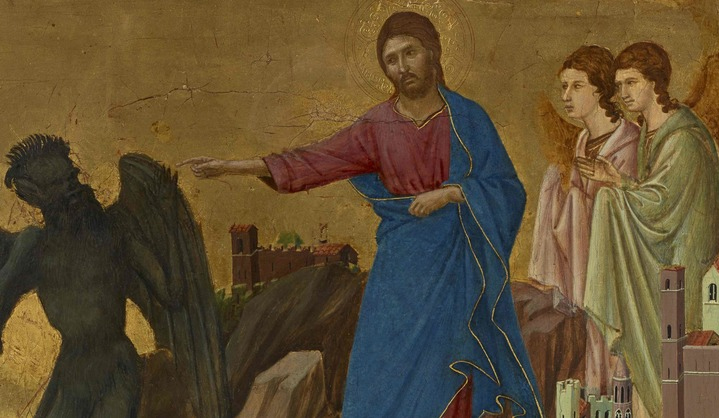
Jesus has performed miracles and his redeeming power over the devils which possess people is clearly apparent; Jesus’ power over evil is manifest. The people marvel, and yet their hearts are hardened to the truth of Jesus. Rather than see with their eyes and understand, they reject the truth of Christ. They retreat to within the evil that holds them captive, which prevents them from seeing the truth of Jesus. They mutter and grumble and gossip, actively seeking to suggest the worst possible and false interpretation of what they have witnessed. They have seen the work of absolute good. They choose to accuse this good of being evil. They do not rise to the message of Christ [ .. ]

In this meditation, Saint Augustine leads us to the very heart of Holy Week: the mystery of divine love revealed in the passion and death of Christ. The reading centers on Christ’s declaration from the Gospel of John: ‘No one has greater love than this, to lay down one’s life for one’s friends’ (John 15:13). For Augustine, this is not merely a moving sentiment but the highest expression of divine charity (caritas), the model of love that defines the Christian life [ … ]
Within the Discourse on the Church, the Discourse of the Community, Jesus speaks of the ways in which we may recall our brothers and sisters to the truth path when perhaps there has been a straying. This is to say, Jesus speaks of fraternal correction, of how Christian communities should work to sanctify others, in such a way that those who have sinned may be most readily and with dignity recalled [ … ]