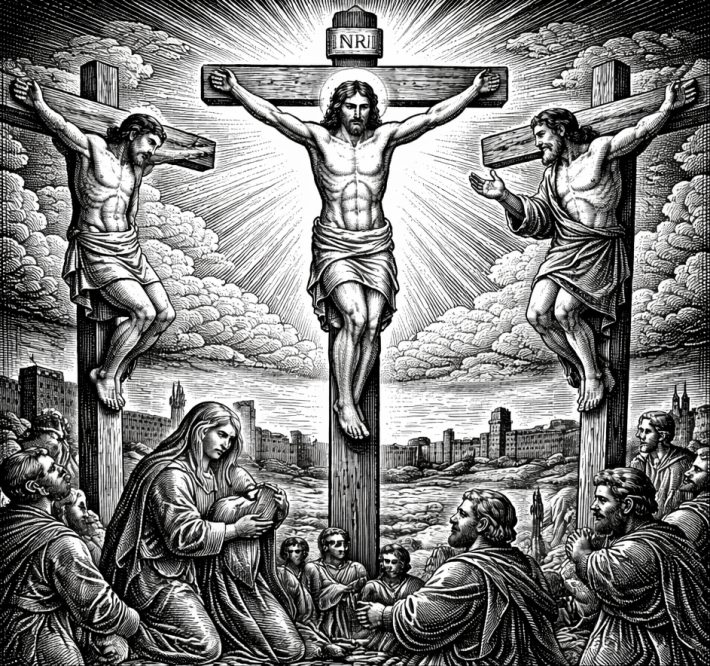
Christian Art | Lord, Remember Me When You Come Into Your Kingdom
Office Of Readings | Monday, Week 7, Ordinary Time | A Reading From The Homilies On Ecclesiastes Of Saint Gregory Of Nyssa | The Wise Man’s Eyes Are Fixed On His Head
‘Christ is our head, and the wise man keeps his eyes upon him.’
This reading of Saint Gregory of Nyssa presents a concentrated meditation on the orientation of the human mind towards Christ as the condition for true wisdom. The argument is structured around a single governing image: the direction of one’s gaze. To ‘keep one’s eyes fixed’ on Christ is not merely a metaphor for devotion, but a description of the ordering of the whole person.
The opening establishes the theological foundation. Christ is identified, following Paul the Apostle, as the ‘head’. This image conveys both origin and authority. To look towards Christ is therefore to orient oneself towards the source and measure of all reality. Gregory immediately draws the ethical consequence: where Christ is the focus, there can be no ‘shadow of evil’. The absence of darkness is not achieved through effort alone, but through proximity to the light.
The analogy of light and darkness is central. Just as darkness cannot subsist in the presence of light, so trivial or disordered concerns lose their hold when the mind is directed towards Christ. Gregory’s point is not that lesser goods cease to exist, but that they no longer dominate attention. The transformation is perceptual. What once appeared significant is relativised in the presence of what is ultimate. Christ is then described as the embodiment of all virtue—truth, justice, immortality—so that to contemplate him is to contemplate the fullness of the good.
The contrast between the wise man and the fool develops this theme. Wisdom consists in rightly directed attention; folly, in misdirection. The fool ‘gropes in darkness’ not because light is absent, but because he does not turn towards it. Gregory reinforces this through the image of the lamp. Light, though present, is ineffective if concealed. The implication is that divine illumination is available, but it must be rightly received and made operative.
A significant development occurs in the treatment of apparent folly. Those who withdraw from worldly preoccupations and devote themselves to contemplation may be judged as impractical or deficient. Gregory addresses this by invoking the example of Paul, who calls himself a ‘fool for Christ’s sake’. This self-description is not an admission of irrationality but a redefinition of wisdom. What appears as blindness to the world is, in fact, clarity of vision directed towards what truly matters. The inversion of values is deliberate: worldly judgement is not the standard by which spiritual wisdom is measured.
The description of Paul’s hardships—privation, persecution, instability—serves to illustrate the cost of such orientation. Yet these external conditions do not alter his focus. The rhetorical question—what can separate him from the love of Christ—underscores the stability of his gaze. Circumstances, however severe, do not compel a reorientation towards lesser goods. This introduces a dimension of perseverance: the fixation on Christ must be maintained despite adversity.
The final exhortation gathers the argument into a concise directive: ‘Seek the things that are above.’ Gregory interprets this as synonymous with fixing one’s gaze on Christ. The upward movement is not spatial but spiritual. It signifies a reordering of priorities, in which the ultimate good governs all others.
In sum, Gregory presents a coherent vision of the Christian life centred on attention. To look towards Christ is to participate in light, truth, and goodness; to look elsewhere is to fall into confusion. The passage emphasises not multiplicity of practices but unity of focus. Wisdom consists in this sustained orientation, maintained through discipline and tested in adversity.

A Reading From The Homilies On Ecclesiastes Of Saint Gregory Of Nyssa | The Wise Man’s Eyes Are Fixed On His Head
We shall be blessed with clear vision if we keep our eyes fixed on Christ, for he, as Paul teaches, is our head, and there is in him no shadow of evil. Saint Paul himself and all who have reached the same heights of sanctity had their eyes fixed on Christ, and so have all who live and move and have their being in him.
As no darkness can be seen by anyone surrounded by light, so no trivialities can capture the attention of anyone who has his eyes on Christ. The man who keeps his eyes upon the head and origin of the whole universe has them on virtue in all its perfection; he has them on truth, on justice, on immortality and on everything else that is good, for Christ is goodness itself.
The wise man, then, turns his eyes toward the One who is his head, but the fool gropes in darkness. No one who puts his lamp under a bed instead of on a lamp stand will receive any light from it. People are often considered blind and useless when they make the supreme Good their aim and give themselves up to the contemplation of God, but Paul made a boast of this and proclaimed himself a fool for Christ’s sake. The reason he said, We are fools for Christ’s sake was that his mind was free from all earthly preoccupations. It was as though he said, ‘We are blind to the life here below because our eyes are raised toward the One who is our head.’
And so, without board or lodging, he traveled from place to place, destitute, naked, exhausted by hunger and thirst. When men saw him in captivity, flogged, shipwrecked, led about in chains, they could scarcely help thinking him a pitiable sight. Nevertheless, even while he suffered all this at the hands of men, he always looked toward the One who is his head and he asked: What can separate us from the love of Christ, which is in Jesus? Can affliction or distress? Can persecution, hunger, nakedness, danger or death? In other words, ‘What can force me to take my eyes from him who is my head and to turn them toward things that are contemptible?’
He bids us follow his example: Seek the things that are above, he says, which is only another way of saying: ‘Keep your eyes on Christ.’
Christian Prayer With Jesus Christ
O God,
light without shadow and source of all goodness,
grant that we may fix our eyes upon your Son, Jesus Christ.
Turn our hearts away from all that distracts and diminishes,
and direct our minds towards what is true and lasting.
Strengthen us in times of trial,
that no hardship may draw us away from your love,
and that we may persevere with steady faith.
Teach us to seek what is above,
and to live in the light of your presence,
until we come to the fullness of your glory.
Through Christ our Lord.
Amen
Glossary Of Christian Terms
Christ as Head
A biblical image (from Paul the Apostle) expressing Christ as the source, ruler, and unifying principle of the Church and of all creation.
Contemplation
A sustained and attentive focus on God, especially through interior prayer and reflection.
Light (Divine Light)
A symbol of God’s truth, goodness, and presence, opposed to darkness as ignorance or sin.
Darkness
A state of ignorance, sin, or separation from God.
Wisdom
The right ordering of thought and life according to God; in this context, the orientation of the mind towards Christ.
Folly (Spiritual Foolishness)
What appears irrational by worldly standards but reflects deeper spiritual truth (e.g. being a ‘fool for Christ’).
Detachment
Freedom from excessive concern with worldly matters, enabling focus on God.
Perseverance
Steadfastness in faith and love, especially under trial or suffering.
Virtue
Moral excellence rooted in alignment with God’s will, exemplified in Christ.
Love of Christ
The unbreakable relationship between Christ and the believer, sustaining faith through all circumstances.
Salvation
Deliverance from sin and participation in the life of God.
Glory
The fullness of God’s presence and the ultimate destiny of the believer.
Spiritual Vision
The capacity to perceive divine truth through faith and contemplation.
Conversion of Mind
A reorientation of thought and attention from worldly concerns to God.
Eternal Good
The ultimate and unchanging good found in God, surpassing all temporal goods.


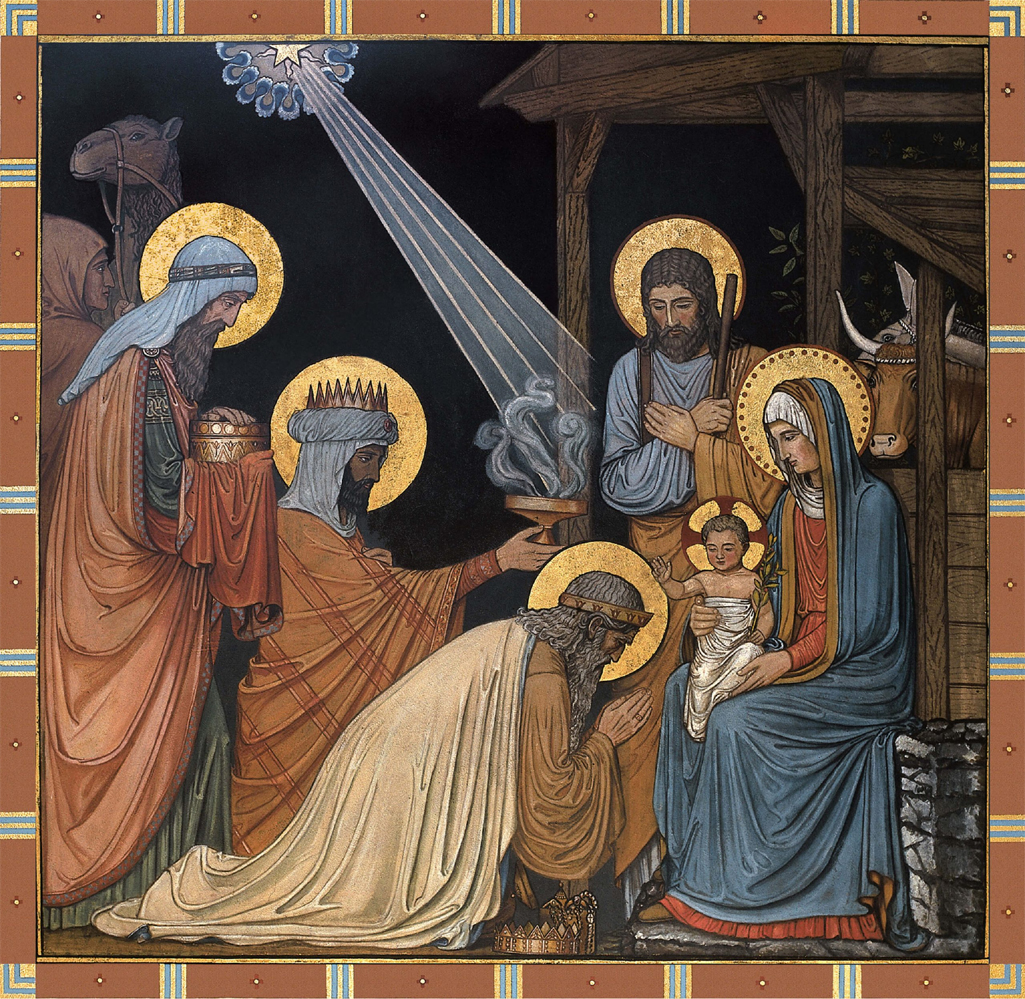
The Epiphany is an extraordinary event in the Bible, whereby we hear of the gift and revelation of Christ to all mankind. The three wise men have long studied the heavens; they have been looking for signs, for truths to guide them. They are of the east, of the orient, not of the Jewish people. They have seen the new star that is there to signify Christ and have come on pilgrimage to seek, to find and to worship Jesus [ … ]
Jesus’ Passion is near. It is almost time for Jesus to permit himself to be crucified. It is true to this that the Greeks, non-Jews, have come to seek Jesus and to hear his word. Jesus’ mission, to come to earth to save everyone, is becoming fulfilled [ … ]

This poem addresses the burial and rejection of Christ’s body, using images of coldness, hardness, and stone to explore themes of human indifference, sin, and divine love. The poet begins by questioning where Christ’s body is placed, lamenting that it finds rest on ‘a cold hard stone’. Despite the existence of ‘so many hearts on earth’, none is receptive enough to ‘receive thee’, symbolizing the rejection and abandonment Christ endures even in death. The stone, a literal image of Christ’s tomb, also symbolizes the hardened state of human hearts unwilling to accept or contain him [ … ]