Matthew 1: 18-24 – 18th December Weekday | 4th Sunday Advent Year A (Audio Bible, Spoken Word)
18 ¶ Now the birth of Jesus Christ was on this wise: When as his mother Mary was espoused to Joseph, before they came together, she was found with child of the Holy Ghost.
19 Then Joseph her husband, being a just man, and not willing to make her a publick example, was minded to put her away privily.
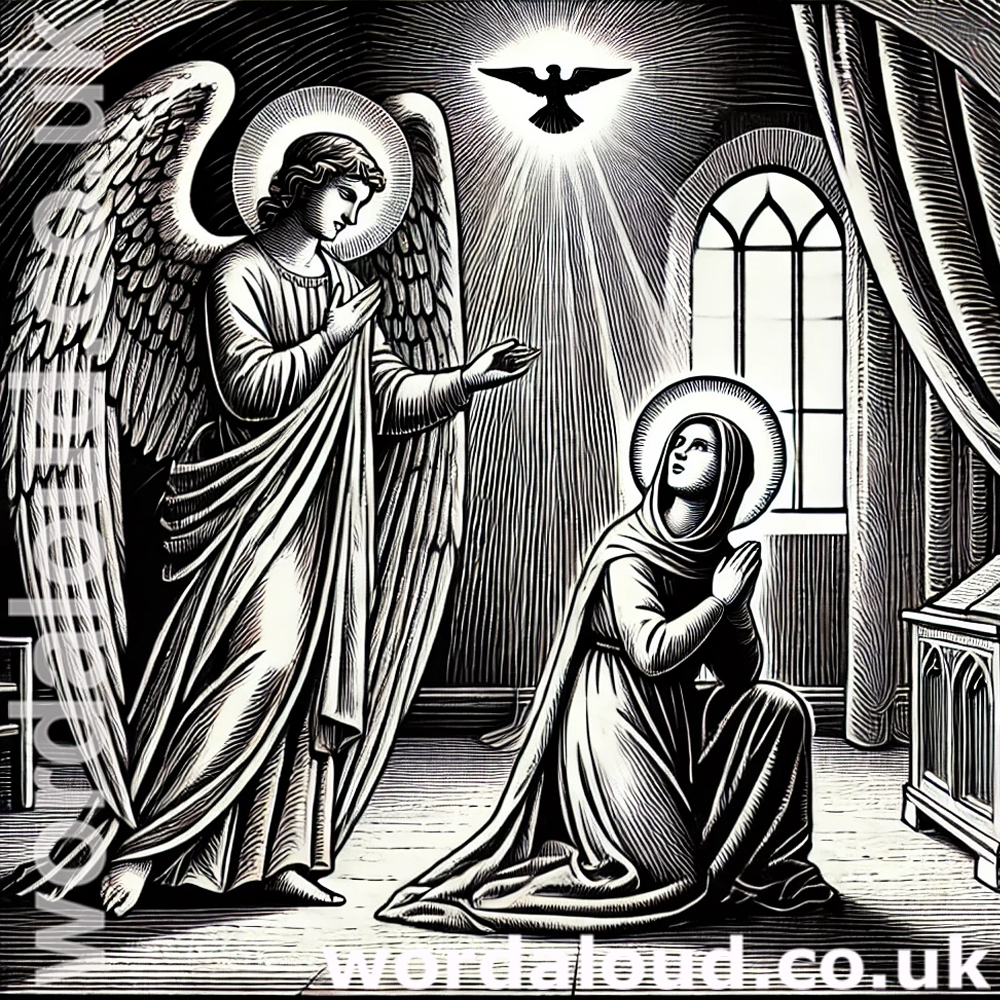
20 But while he thought on these things, behold, the angel of the Lord appeared unto him in a dream, saying, Joseph, thou son of David, fear not to take unto thee Mary thy wife: for that which is conceived in her is of the Holy Ghost.
21 And she shall bring forth a son, and thou shalt call his name JESUS: for he shall save his people from their sins.
22 Now all this was done, that it might be fulfilled which was spoken of the Lord by the prophet, saying,
23 Behold, a virgin shall be with child, and shall bring forth a son, and they shall call his name Emmanuel, which being interpreted is, God with us.
24 Then Joseph being raised from sleep did as the angel of the Lord had bidden him, and took unto him his wife.
According to Jewish law, couples became engaged around one year prior to marriage, and this engagement was most solemn and binding – an act of divorce would be needed to break the relationship. It is during this period that Mary is found to be with child of the Holy Ghost. She has done nothing wrong, she is a virgin, Christ’s conception is miraculous, but on the surface of things this was a terrible state of affairs, for Mary and Joseph also.
Joseph is a just man. He is, then, a man who follows God and the Law, keeping the commandments. He now proves himself better than merely just. While justice would have demanded Mary be stoned to death, Joseph decides that he will put her away secretly, to shield her from punishment and public ignominy.
Now the angel visits Joseph to tell him the truth, that Mary is with child, with a son who will be called Jesus, meaning saviour, that the 700 year old prophecy of Isaiah is fulfilled. And Joseph believes and obeys just as Mary has done. Joseph, through his legal paternity, not only enables Jesus to be counted a son of David; he proves himself a worthy man, most fit to be Jesus’ earthly father, to shield the boy and his mother through the trials of Jesus’ infancy.
‘For I say unto you, That except your righteousness shall exceed the righteousness of the scribes and Pharisees, ye shall in no case enter into the kingdom of heaven.’ (Matthew 5: 20)
King James Audio Bible | KJV | King James Version King Herod There were several individuals named Herod who played significant roles in ancient history, particularly in the history of the Roman Empire and the region of Palestine. Here is a brief overview of the most notable Herods: Herod the Great: Also known as Herod I, he was a Roman client king of Judea, ruling from 37 BC to 4 BC. He is perhaps most famous for his role in the biblical story of the birth of Jesus, in which it is said that he ordered the slaughter of all male children in Bethlehem under the age of two in an attempt to kill the newborn Jesus. Herod Antipas: Also known as Herod II, he was the son of Herod the Great and ruled over Galilee and Perea, two regions in Palestine, from 4 BC to 39 AD. He is mentioned in the New Testament as the ruler who imprisoned John the Baptist and later had him beheaded. Herod Agrippa I: Also known as Herod III, he was the grandson of Herod the Great and ruled over Judea from 41 to 44 AD. He is mentioned in the New Testament as the ruler who imprisoned the apostle Paul. Herod Agrippa II: Also known as Herod IV, he was the great-grandson of Herod the Great and ruled over parts of Palestine and Syria from 50 to 100 AD. He is mentioned in the New Testament as the ruler who heard Paul’s defence before the Roman governor Festus. These rulers, who were known as the Herodian dynasty, were not Jewish but rather descended from a Greek family that had converted to Judaism. Despite this, they were appointed as rulers by the Roman Empire and were generally unpopular among the Jewish population due to their collaboration with the Roman occupation and their often brutal methods of rule. Herod The Great Herod the Great, also known as Herod I, was a Roman client king of Judea who ruled from 37 BC to 4 BC. He was born in 73 BC in Idumea, a region in southern Palestine, and was the son of Antipater the Idumean, an Edomite who had been appointed as a governor of Judea by the Roman general Pompey. Herod rose to power after the Roman general Julius Caesar appointed him as king of Judea in 40 BC. He consolidated his power over the next few years by defeating his rivals and establishing himself as the undisputed ruler of the region. As king, Herod embarked on a massive building program that included the expansion and renovation of the Temple in Jerusalem, the construction of the port city of Caesarea Maritima, and the fortification of several cities in Judea. He also commissioned the construction of a number of palaces and other buildings, including the famous Herodium, a palace-fortress located south of Jerusalem. Despite his many accomplishments, Herod was a controversial figure who was known for his harsh rule and his willingness to use violence to maintain his power. He was married several times and had a large number of children, several of whom he had executed when they posed a threat to his rule. One of the most famous stories associated with Herod is the biblical account of the birth of Jesus, in which it is said that he ordered the slaughter of all male children in Bethlehem under the age of two in an attempt to kill the newborn Jesus. According to the New Testament, Jesus was saved by his parents, who fled to Egypt, and later returned to Palestine after Herod’s death. Herod died in 4 BC at the age of 70, leaving a legacy as one of the most significant rulers in the history of ancient Palestine. Herod Antipas Herod Antipas, also known as Herod II, was the son of Herod the Great and ruled over Galilee and Perea, two regions in Palestine, from 4 BC to 39 AD. He was born in 20 BC and was named after his father’s patron, the Roman emperor Augustus. Like his father, Herod Antipas was known for his ambitious building projects, including the construction of the city of Tiberias on the Sea of Galilee and the expansion of the Temple in Jerusalem. He was also known for his political cunning and his ability to navigate the complex political landscape of the Roman Empire. Herod Antipas is mentioned in the New Testament as the ruler who imprisoned John the Baptist, a prominent religious figure who criticized Herod’s marriage to his sister-in-law, Herodias. According to the New Testament, John was eventually beheaded at the request of Herodias’ daughter, Salome, who danced for Herod and his guests at a banquet. Herod Antipas is also mentioned in the New Testament as the ruler who oversaw the trial and execution of Jesus. Although he initially wanted to release Jesus, he ultimately handed him over to the Roman authorities at the urging of the Jewish religious leaders. Herod Antipas’ rule came to an end in 39 AD when the Roman emperor Caligula exiled him to Gaul, modern-day France. He died in exile a few years later. Herod Agrippa I Herod Agrippa I, also known as Herod III, was the grandson of Herod the Great and ruled over Judea from 41 to 44 AD. He was born in 10 BC and was the son of Aristobulus and Bernice, two of Herod the Great’s children. Herod Agrippa I was well-educated and fluent in both Greek and Hebrew, and he was highly regarded by the Roman authorities for his loyalty and his ability to maintain order in Judea. He was appointed as king of Judea in 41 AD by the Roman emperor Claudius, who was impressed by his abilities and saw him as a reliable ally in the region. As king, Herod Agrippa I continued the building projects of his grandfather and expanded the Temple in Jerusalem. He also implemented a number of reforms aimed at improving the lives of the […]
In his letter to Saint Polycarp, Bishop of Smyrna, Saint Ignatius of Antioch speaks not only as a spiritual father and friend but also as one who writes under the shadow of martyrdom. On the way to his execution in Rome around AD 107, Ignatius pens a letter that overflows with spiritual depth, pastoral wisdom, and a vision of Christian endurance grounded in Jesus Christ [ … ]
Saint Winifred, also known as Saint Winefride, was born in the 7th century in Wales. She was the daughter of a chieftain named Tyfid ap Eiludd. From a young age, Winifred was devoted to her faith, choosing a life of piety and religious dedication. She was greatly influenced by her uncle, Saint Beuno, a renowned Welsh saint and abbot, who played a significant role in her spiritual education [ … ]
Search Google Here | A Holy Land Jerusalem Pilgrimage? | A Safari? | An Escape..