
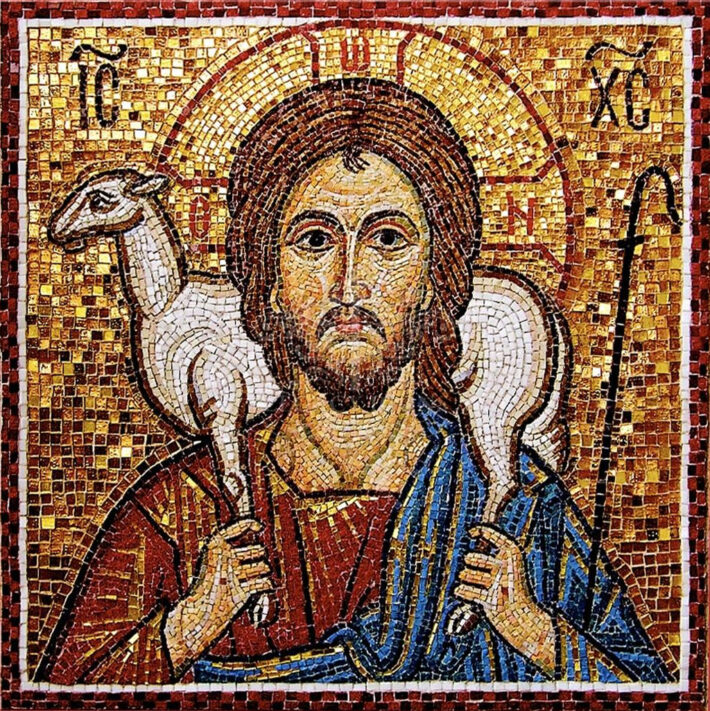
John 10: 11-18
11 I am the good shepherd: the good shepherd giveth his life for the sheep.
12 But he that is an hireling, and not the shepherd, whose own the sheep are not, seeth the wolf coming, and leaveth the sheep, and fleeth: and the wolf catcheth them, and scattereth the sheep.
13 The hireling fleeth, because he is an hireling, and careth not for the sheep.
14 I am the good shepherd, and know my sheep, and am known of mine.
15 As the Father knoweth me, even so know I the Father: and I lay down my life for the sheep.
16 And other sheep I have, which are not of this fold: them also I must bring, and they shall hear my voice; and there shall be one fold, and one shepherd.
17 Therefore doth my Father love me, because I lay down my life, that I might take it again.
18 No man taketh it from me, but I lay it down of myself. I have power to lay it down, and I have power to take it again. This commandment have I received of my Father.
Christ offers himself to the people as the good shepherd, recalling a favourite theme of Old Testament prophecy. Priests and kings are so described, and indeed God is spoken of as a shepherd, as we hear, for example, in Psalm 23:
THE Lord is my shepherd; I shall not want.
2 He maketh me to lie down in green pastures: he leadeth me beside the still waters.
3 He restoreth my soul: he leadeth me in the paths of righteousness for his name’s sake.
4 Yea, though I walk through the valley of the shadow of death, I will fear no evil: for thou art with me; thy rod and thy staff they comfort me.
God’s promise is to take care of his people. His promise is that a new shepherd will come to us, descended of the house of David. We hear in Ezekiel 34:
11 ¶ For thus saith the Lord God; Behold, I, even I, will both search my sheep, and seek them out.
12 As a shepherd seeketh out his flock in the day that he is among his sheep that are scattered; so will I seek out my sheep, and will deliver them out of all places where they have been scattered in the cloudy and dark day.
13 And I will bring them out from the people, and gather them from the countries, and will bring them to their own land, and feed them upon the mountains ofIsraelby the rivers, and in all the inhabited places of the country.
14 I will feed them in a good pasture, and upon the high mountains ofIsraelshall their fold be: there shall they lie in a good fold, and in a fat pasture shall they feed upon the mountains ofIsrael.
15 I will feed my flock, and I will cause them to lie down, saith the Lord God.
16 I will seek that which was lost, and bring again that which was driven away, and will bind up that which was broken, and will strengthen that which was sick…
23 And I will set up one shepherd over them, and he shall feed them, even my servant David; he shall feed them, and he shall be their shepherd.
24 And I the Lord will be their God, and my servant David a prince among them; I the Lord have spoken it.
Today’s Bible verses continue to develop Jesus’ declaration of himself as the Good Shepherd. We have heard how false teachers have, as it were, crept into the sheepfold over the wall, rather than entering through the gate as the shepherd does. Jesus has developed the thought, going on to describe himself both as the shepherd and as the gateway to the sheepfold. It is through Jesus that we enter into the sheepfold to be saved.
Now Jesus distinguishes himself further, as the good shepherd, from false teachers who, like mercenaries, care only for their own interests and not for the sheep. Such are those who block the people’s way to Jesus, among them some teachers of the Old Law, the Jewish authorities, the scribes and the Pharisees, whose position, whose vested interests, Jesus threatens. These are deceivers of the people, blind men, blind guides, who seek to occlude our love and knowledge of Jesus.
In this parable, Jesus tells us that he will save us by laying his life down for us. He adds that he has further flocks of sheep to gather together, all the people over the whole world, who are to be joined as one flock with one shepherd. Jesus’ giving of his life flows from his infinite love for us, in complete contrast to the attitude of the hirelings who do not really care for the sheep.
Further to this, Jesus speaks of the mutual knowledge between himself and those who believe in him, and he compares this to the mutual knowledge of the Father and the Son, which itself is a truth at the heart of our salvation. Through his divinity, and through his relationship with God the Father, Christ will freely lay down his life for his sheep, for us, and then have power to have life again, and to bring us to life.
‘So the sheep find the Lord’s pastures; for anyone who follows him with an undivided heart is nourished in a pasture which is forever green. What are the pastures of these sheep if they are not the deepest joys of the everlasting fresh pastures of paradise? For the pasture of the saints is to see God face to face; when the vision of God never fails, the soul receives its fill of the food of life for ever.
‘And so, dear brethren, let us seek these pastures and there join in the joy and the celebrations of so many citizens of heaven. Let their happiness and rejoicing be an invitation to us. Let our hearts grow warm, brethren, let our faith be rekindled, let our desires for heavenly things grow warm; for to love like this is to on the way.’ Pope St Gregory the Great
Audio Bible KJV | Endnotes
The Parable of the Good Shepherd is a beautiful illustration of such love and care as Jesus has for his disciples – Christians. Jesus will do everything in his power to protect and provide for us. In a world filled with uncertainty and danger, the parable offers a message of hope and comfort to all who believe in Jesus.
The Good Shepherd represents the qualities of a good leader, who is willing to lay down his life for the benefit of others. Jesus’ teachings in the Sermon on the Mount, together with his prayer in as he endures and masters his agony in the Garden of Gethsemane, demonstrate selflessness and desire of Jesus for well-being of all people. Through sacrifice on the Cross, Jesus redeemed humanity and thereby offers all people the chance of relationship with him and to experience the fullness of life that he offers – ultimately to live with Jesus in heaven.
In the Christian Church, the Parable of the Good Shepherd is a reminder of the importance of pastoral care and the role of leaders in caring for the spiritual needs of their congregations. As Jesus is the Good Shepherd for his followers, Church leaders are called to be shepherds for their congregations, guiding and caring for them in their spiritual journey.
We pray with Jesus as it were in the Garden of Gethsemane. We are the prodigal son come home. Through faith in Jesus and obedience to his teachings, we experience the peace and security offered by our Good Shepherd, and live a life of joy and fulfilment in his presence.




In this portion of his treatise, Saint Cyprian of Carthage underscores the profoundly communal nature of Christian prayer, especially as it is expressed in the Our Father. Writing in the mid-third century amidst persecution and internal divisions, Cyprian offers not only theological reflection but also pastoral guidance on the meaning and practice of unity in prayer [ … ]

Psalm 115 in the King James Version (KJV) of the Bible presents a narrative that contrasts the living God of Israel with lifeless pagan idols. This psalm is part of the ‘Egyptian Hallel’ group, typically read during Passover, and reflects a time when the Israelites, despite facing mockery from neighboring peoples, reaffirm their faith in God [ … }

As Jesus walks ahead of his disciples on the road to Jerusalem, the people who follow Jesus are amazed and afraid. This is the response of the people, not merely to a great teacher or to a nice man, but to God among them. So often in the Bible, the response of a person to God or to one of God’s messengers, the angels, is just this: they are amazed and they are afraid. Mark’s Gospel is telling us here that, on his way to his Passion, his brutal death, Jesus is God become man [ … ]