
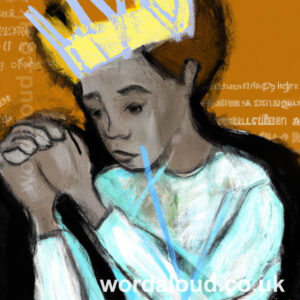
Christian Art | A Boy Writes In The Sand | King James Audio Bible | Prayer With Jesus
Matthew 19: 13-15 – Week 19 Ordinary Time, Saturday (King James Audio Bible KJV, Spoken Word)
See also Mark 10: 13-16 – Week 7 Ordinary Time, Saturday
13 ¶ Then were there brought unto him little children, that he should put his hands on them, and pray: and the disciples rebuked them.
14 But Jesus said, Suffer little children, and forbid them not, to come unto me: for of such is the kingdom of heaven.
15 And he laid his hands on them, and departed thence.
In listening to these Gospel verses, questions present themselves. We might ask both why the children are brought to Jesus to be blessed, and why then the disciples rebuke the people bringing the children. We try to see within this scene.
The bringing of the children to Jesus might seem to prefigure Christian baptism, or perhaps the blessing of children before they are of an age to receive the Eucharist. Baptism presupposes a need to be cleansed, to be healed, even as a child. Perhaps we see in the scene the great loving care of the parents to bring the children into Jesus’ presence, so that they might be safe from spiritual harm. The little children must have seemed so fragile; perhaps Jesus’ blessing could give them strength, and could help them to grow into a healthy adult life.
Why, then, do the disciples rebuke the people bringing the children? It may be that there is a lesson here in ritual purity, and in the greater purity offered by Jesus – by Jesus’ laying on of hands, as by baptism in Jesus’ name. The little children might still live in conditions which could be regarded as being ritually unclean, and so to touch Jesus would be thought to render Jesus unclean. This had already happened, when a leper touched Jesus (See Mark 1: 40-45), and then Jesus had to live outside of the towns, in lonely places. The disciples are, according to this understanding, seeking to protect Jesus from such ritual uncleanness. Jesus, though, cannot let the people continue to see the children in this way.
Our sense of our need to become as little children is now reinforced by Jesus. Of such is the Kingdom of Heaven. We must know in our hearts just how much humility can be required to be as children. The truth of our total dependency on God’s mercy, for example, can be difficult for us fully to accept. All too often, we might wish to parade our own merits and insist upon exerting ourselves individualistically, using only our own resources, rather than giving ourselves to communion with God and our fellow human beings, our fellow Christians. Community with one another and God is no easy option; pride can very easily intervene, drawing us away from our greatest potential, which would in itself include our every effort, in brotherhood and humility, in life in Christ.
‘Suffer little children, and forbid them not, to come unto me: for of such is the kingdom of heaven.’ As we accept the deep truths of this message, in relation to ourselves, so Jesus lays his hands upon us, and we are home; we are brothers and sisters in Christ.
Concluding Prayer
Lord God,
source and origin of our salvation,
make our lives here on earth so proclaim your glory,
that we may praise you without ceasing in heaven.
We make our prayer through our Lord.

King James Audio Bible | Endnotes
In Order To Enter The Kingdom Of Heaven, You Must Become Like A Child
The passage Matthew 19:13-15 tells the story of how Jesus welcomed children and used them as an example for entering the Kingdom of Heaven. When the disciples tried to prevent children from coming to Jesus, Jesus rebuked them and said: ‘Suffer little children, and forbid them not, to come unto me: for of such is the kingdom of heaven.’ (Matthew 19:14, KJV)
What does it mean to become like a child in order to enter the Kingdom of Heaven? To understand this, we must first understand what qualities Jesus saw in children that Jesus wanted us to emulate.
One quality is humility. Children do not have the pride and self-importance that adults often have. They are willing to learn, to ask questions, and to admit when they don’t know something. Jesus said: ‘Whosoever therefore shall humble himself as this little child, the same is greatest in the kingdom of heaven.’ (Matthew 18:4, KJV)
Another quality is faith. Children have a simple, trusting faith that is not burdened by doubts and skepticism. Jesus said: ‘Verily I say unto you, Except ye be converted, and become as little children, ye shall not enter into the kingdom of heaven.’ (Matthew 18:3, KJV) This kind of faith requires a willingness to surrender control and trust in God’s goodness and power.
Furthermore, children have a sense of wonder and awe about the world around them. They are filled with curiosity and amazement at the things they see and experience. Jesus said: ‘Whosoever shall not receive the kingdom of God as a little child, he shall not enter therein.’ (Mark 10:15, KJV) We must be open to the wonder and mystery of God’s creation, and not let our familiarity with it dull our sense of awe and gratitude.
Christians have reflected on the meaning of this passage and its implications for Christian living. Saint Augustine wrote: ‘Let us become children, and we shall be wise; for the wisdom of this world is foolishness with God.’ (Exposition On Psalm 131) Martin Luther, father of the Protestant Reformation, commented that ‘faith is the work of God in us, not our work. We become like children when we receive faith as a gift from God and trust in Him like a child trusts its parents’ (Luther’s Works, Vol. 54, p. 197).
Pope Francis has emphasized the importance of childlike faith in his teachings. In his encyclical letter Lumen Fidei, he writes: ‘Faith is a way of seeing. It opens the eyes to a new light, and enables us to grasp the depth of Christ’s love, which gives us the grace to become like Him. This is why Jesus tells us that we must become like children if we wish to enter the Kingdom of Heaven.’ (Lumen Fidei, 35)
John Calvin, a prominent figure of the Protestant Reformation, wrote in his commentary on Matthew 18:3: ‘Christ is not teaching us to be foolish and childish, but to be humble and teachable, to cultivate a meek and modest disposition, to embrace the doctrine of salvation with a docile spirit, and to submit ourselves to God with childlike obedience.’
John Wesley, founder of Methodism, interpreted the passage as a call to simplicity and innocence. He wrote: ‘By this, he does not mean that we should be childish or trifling, but innocent, humble, and teachable; that we should take heed of despising or offending any of those who believe in him, and that we should be as simple as doves, without any mixture of guile or cunning.’

Rebirth As A Child In Jesus | Born Again
The idea of becoming like a child has also been associated with rebirth or regeneration. In John 3:3, Jesus tells Nicodemus: ‘Verily, verily, I say unto thee, Except a man be born again, he cannot see the kingdom of God.’ (KJV) This new birth involves a transformation of the heart and a turning away from sin towards God. This spiritual rebirth is often compared to the process of childbirth, where a person becomes like a newborn baby in their faith and dependence on God.
Moreover, the call to become like a child has implications for how we approach God in prayer. In his book The Practice Of The Presence Of God Brother Lawrence, a seventeenth-century French monk, wrote: ‘Let us not think that to be truly childlike, we must be simpletons. We must be as wise as serpents and as harmless as doves, but above all, let us trust God like little children, who know that their father is a kind and loving parent.’ (The Practice Of The Presence Of God, Letter 4)
Surrender Like A Child To God
To become like a child includes the idea of surrender and dependence on God. Children are often reliant on their parents or caretakers for their basic needs and safety. In the same way, Christians are called to surrender their lives to God and trust in His provision and care.
Saint Augustine wrote in his Confessions: ‘Our hearts are restless until they rest in Thee.’ (Confessions, Book I, Chapter I) Saint Augustine recognized that true peace and fulfillment can only be found in a relationship with God, which involves surrendering our desires and will to His.
Twelfth-century monk Bernard of Clairvaux wrote in his treatise On Loving God: ‘What is the loving fear of God, but that which we have sometimes experienced as children towards our parents, whom we love because we fear them?’ (On Loving God, Chapter V) Bernard saw the fear and reverence that children have for their parents as a model for how Christians should approach God with awe and respect.
Furthermore, the call to become like a child has implications for our relationships with others. Jesus says in Matthew 18:4: ‘Whosoever, therefore, shall humble himself as this little child, the same is greatest in the kingdom of heaven.’ (KJV) This humility involves recognizing our own limitations and weaknesses, as well as the value and worth of others.
Saint Teresa of Avila, a sixteenth-century Spanish mystic and writer, wrote in her book The Interior Castle: ‘The soul that has entered the castle of self-knowledge, and has learned to know itself, will not have much respect for any other thing. It will think nothing of greatness, wealth, or beauty, and even the pleasures of sense will be held of little account, if they interfere with its spiritual progress.’ (The Interior Castle, Fourth Mansion, Chapter III).
Saint Teresa of Avila recognized that true humility involves recognizing the unimportance of worldly goods and the ultimate value of spiritual growth and relationship with God.

Saint Peter Chrysologus contrasts the two Adams to show the transformation of human nature through Christ. The first man, Adam, is the origin of the human race in its mortality; the second, Christ, is the origin of its renewal and life. Both share the same humanity, but they differ absolutely in their source and purpose. Adam received life; Christ gives it. Adam was shaped from the earth; Christ took flesh from the Virgin, raising human nature into union with God [ … ]
Psalm 82 cries for justice and righteous governance. The psalm acknowledges God as the ultimate arbiter, who scrutinizes celestial rulers referred to as ‘gods’. This call to divine scrutiny explores governance, morality, and is a call for intervention to establish a more righteous order [ … ]

There is a sacramental quality to Jesus’ healing of the deaf man, as he takes him to one side, touches him, lifts his eyes to heaven, and then speaks the healing words of command. In the act of healing, as Jesus lays on his hands, he seems to act as intermediary between the deaf man and heaven, and so it through this that the man is healed [ … ]