Christian Art | King James Audio Bible | Daily Bible Verses Advent | Week 2 Thursday
Matthew 11: 11-15 | King James Audio Bible KJV | Daily Bible Verses | Advent | Week 2 Thursday
11 Verily I say unto you, Among them that are born of women there hath not risen a greater than John the Baptist: notwithstanding he that is least in the kingdom of heaven is greater than he.
12 And from the days of John the Baptist until now the kingdom of heaven suffereth violence, and the violent take it by force.
13 For all the prophets and the law prophesied until John.
14 And if ye will receive it, this is Elias, which was for to come.
15 He that hath ears to hear, let him hear.
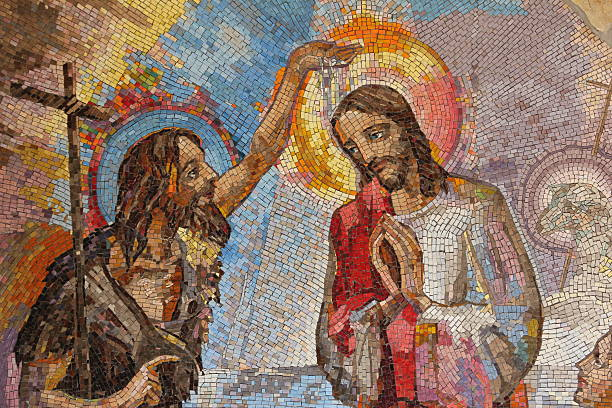
In today’s verses, Jesus pays tribute to John the Baptist, telling the crowds that John the Baptist, until the dawn of the New Testament, the arrival of the Kingdom of God, was the greatest of people. John the Baptist was a courageous, inspirational figure and had the honour of proclaiming Christ’s presence, then he looked on satisfied as his disciples went from him to follow Christ: ‘He must increase, but I must decrease.’
It is Christ who has brought to us the saving gift of grace. Those who repent of their sins and accept the grace of God enter into the Kingdom of heaven, becoming greater than those who went before could have imagined. John too, as Christ’s redemptive mission extends backwards through time, will be elevated to become a son of God.
The Kingdom of heaven has, though, suffered violence since Christ came into the world. The forces of evil are ranged against it, working with renewed vigour in their assault on the good. We are aware of the violence against Christ in his lifetime, of the persecution of Christians in times to come, and of the temptations to sin we encounter.
We in turn respond to the powers of hell with violence of our own, fighting the enemies of our souls to attain to heaven.
‘This violence is not directed against others. It is a violence used to fight your own weaknesses and miseries, a fortitude, which prevents you from camouflaging your own infidelities, a boldness to own up to the faith even when the environment is hostile.’ St Josemaria Escriva
Concluding Prayer | Love Revealed By Jesus Christ
Clear a pathway, Lord, in our hearts
to make ready for your only Son,
so that when he comes
we may serve you in sincerity of heart.
We make our prayer through our Lord.


King James Audio Bible | Endnotes
John the Baptist was a man of great faith and devotion to God. He lived in the wilderness of Judea and preached repentance to all who would listen, baptizing those who sought to turn away from sin and towards a closer relationship with our Lord. As the scripture tells us: ‘In those days came John the Baptist, preaching in the wilderness of Judaea, And saying, Repent ye: for the kingdom of heaven is at hand.’ (Matthew 3:1-2)
And there is Jesus, Son of God, our Savior, our Christianity. Jesus of Nazareth lived a life of love, service, and teaching, performing healing miracles that forgave sin and testified to his divine nature. As the angel announced to the shepherds: ‘Fear not: for, behold, I bring you good tidings of great joy, which shall be to all people. For unto you is born this day in the city of David a Saviour, which is Christ the Lord.’ (Luke 2:10-11)
Baptism, an ancient ritual introduced to Christianity through John the Baptist, is a sacrament in our faith that symbolizes purification and renewal. Through the pouring of water, we are baptized into a new life in Christ and are made anew. And as John testified: ‘I saw the Spirit descending from heaven like a dove, and it abode upon him. And I knew him not: but he that sent me to baptize with water, the same said unto me, Upon whom thou shalt see the Spirit descending, and remaining on him, the same is he which baptizeth with the Holy Ghost.’ (John 1:32-33)
In his teachings, Jesus proclaimed: ‘I am the way, the truth, and the life.’ (John 14:6) This reminds that he is the path to salvation and eternal life. And through the centuries, Christians have sought solace and guidance through the simple prayer known as the ‘Jesus Prayer’: ‘Lord Jesus Christ, Son of God, have mercy on me, a sinner.’
Finally, let us remember the Garden of Gethsemane, where Jesus went to pray before his arrest and crucifixion. This sacred site serves as a reminder of his unwavering faith in the face of suffering and sacrifice. As it is written: ‘And he went a little further, and fell on his face, and prayed, saying, O my Father, if it be possible, let this cup pass from me: nevertheless not as I will, but as thou wilt.’ (Matthew 26:39)
May these words and the memories they evoke serve to strengthen our faith and our commitment to following the path laid out for us by John the Baptist and Jesus Christ. Amen.



In this Easter sermon, Saint Augustine speaks tenderly and passionately to the newly baptized, those who have recently passed through the saving waters of baptism at the Easter Vigil. His words are full of warmth, joy, and hope, as he invites these ‘little children in Christ’ to recognize the extraordinary gift they have received and to live according to the new life that has been planted within them [ … ]
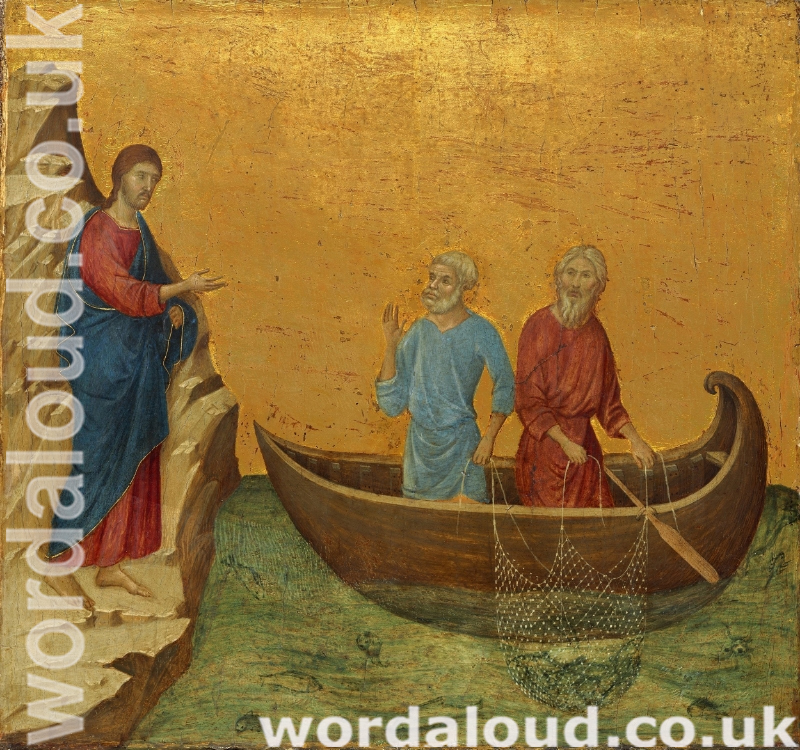
Today, Jesus has decided to walk to Galilee. There is a wonderful sense of lively movement as Jesus moves from place to place during his ministry, as one rounding up the sheep of Israel. Jesus finds Philip and he gives Philip his vocation, saying to him: Follow me. Through Jesus’ lifetime, we read in the Bible of great crowds flocking to Jesus, and of great processional events, as well as the constant travelling with Jesus of his closest companions. There is movement, direction, purposiveness, through which the disciples grow closer and closer to Jesus, their living faith always developing as Jesus fits them to become shepherds of men [ … ]

Saint Gregory’s theology is deeply shaped by the Eastern Christian doctrine of theosis, or divinisation. For Gregory, salvation is not merely juridical or moral but ontological: to be saved is to become by grace what Christ is by nature. When Gregory writes that Christians must examine their thoughts, words, and deeds to see whether they are ‘directed toward Christ’, he is describing a dynamic process of transformation. This process, which begins in baptism and continues throughout life, involves increasing conformity to the divine image. In this sense, Christian perfection is not a static achievement but an unending ascent towards God, as expressed in his Life of Moses [ … ]