Christian Art | George Herbert | The Temple | The Church | Easter
George Herbert | The Temple | The Church | Easter
Rise heart; thy Lord is risen. Sing his praise
Without delayes,
Who takes thee by the hand, that thou likewise
With him mayst rise:
That, as his death calcined thee to dust,
His life may make thee gold, and much more just.
Awake, my lute, and struggle for thy part
With all thy art.
The crosse taught all wood to resound his name,
Who bore the same.
His streched sinews taught all strings, what key
Is best to celebrate this most high day.
Consort both heart and lute, and twist a song
Pleasant and long:
Or since all musick is but three parts vied
And multiplied;
O let thy blessed Spirit bear a part,
And make up our defects with his sweet art.
I got me flowers to straw thy way;
I got me boughs off many a tree:
But thou wast up by break of day,
And brought’st thy sweets along with thee.
The Sunne arising in the East,
Though he give light, and th’ East perfume;
If they should offer to contest
With thy arising, they presume.
Can there be any day but this,
Though many sunnes to shine endeavour?
We count three hundred, but we misse:
There is but one, and that one ever.

George Herbert | The Temple | The Church | Easter
The poem is an expression of praise and resurrection, where the poet calls upon his ‘heart’ to celebrate the Lord’s resurrection and to rise spiritually with Him. The poem opens with a command to the heart to ‘Rise’ in response to the Lord’s resurrection, suggesting a spiritual ascent that mirrors Christ’s victory over death. The poet then emphasizes that, just as Christ’s death reduced the believer to ‘dust’, Jesus Christ’s new life will refine them, transforming them into something valuable and ‘just’, akin to ‘gold’. This allusion to spiritual purification conveys that through the resurrection, believers attain not only forgiveness but a path to becoming more righteous.
The poet next calls upon his ‘lute’, urging it to join in the praise with all its ‘art’. The reference to the ‘cross’ teaching ‘all wood to resound his name’ connects nature and human instruments with divine purpose, as though all creation can participate in proclaiming God’s glory. Similarly, the stretched ‘sinews’ and ‘strings’ taught by Christ’s suffering suggest that Jesus Christ’s sacrifice brings harmony to everything, from the human heart to musical instruments, pointing to a universal resonance with Christ’s resurrection.
In the following stanza, the poet seeks a partnership between ‘heart and lute’, weaving together a ‘song’ that is both ‘pleasant and long’. The phrase ‘pleasant and long’ implies that the celebration is both joyful and enduring, suitable for honoring the resurrection’s eternal significance. Here, the poet suggests that ‘all music is but three parts vied’, likely referencing the Trinity (Father, Son, and Holy Spirit) as the ultimate unity and balance in music. He asks that the Holy Spirit participate in the song to compensate for human deficiencies, underscoring the belief that divine grace completes human effort.
A shift occurs as the poet reflects on the act of gathering ‘flowers to strew thy way’, recalling traditional processions for special occasions, but finds that Christ has risen ‘by break of day’ and brought ‘sweets’ with him. This underscores the idea that the resurrection is an act of divine initiative, beyond human preparation. The sun, ‘arising in the east’, brings light and fragrance, but even these natural phenomena are inferior to Christ’s resurrection. By presenting Christ’s resurrection as far surpassing earthly phenomena, the poet highlights the event’s divine nature.
In the final lines, the poet ponders whether there can be any other ‘day but this’, implying that the resurrection marks the singular, ultimate day. While there are ‘many suns’ that try to shine, they fall short of matching this day. He notes that while humans ‘count three hundred’ days, only ‘one’ truly matters—the day of resurrection, which stands outside ordinary time. This closing line suggests that the resurrection is an eternal event, outside the limitations of temporal measures and pointing to the idea of everlasting life offered through Christ’s triumph over death. The poem as a whole celebrates the resurrection’s transformative impact on both individual believers and all creation, calling for an eternal song of praise.


The poem reflects an inner struggle between rebellion and submission to divine authority, expressing the poet’s desire to resist God but also recognition of the futility of doing so. The first stanza presents the poet’s rebellious spirit, where he admits to wanting to die, fight, or deny God’s influence over him. This opposition to God’s control is portrayed as a natural inclination of the poet’s heart, which he acknowledges as a stronghold that resists divine authority. However, the poet also requests that God tame his heart, recognizing that the ultimate skill or ‘highest art’ of God is to bring even the strongest opposition into submission. This sets the poem’s central theme of rebellion versus surrender [ … ]
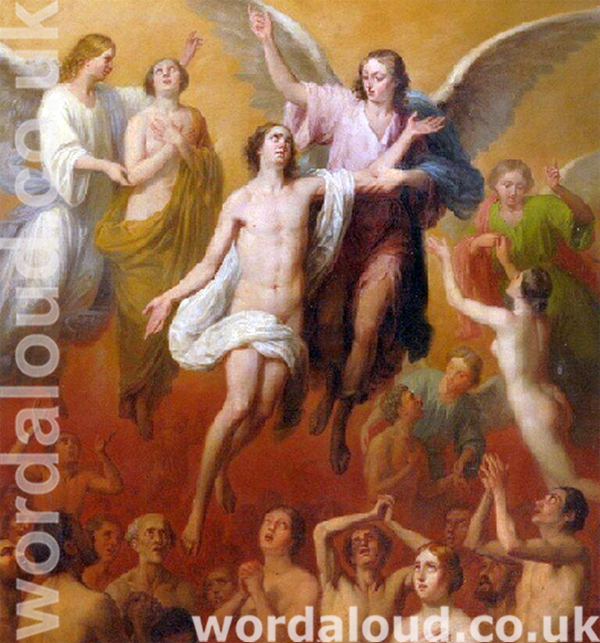
Saint Ambrose interprets death not merely as an end but as a transformative process that begins within the believer’s earthly life. His language of ‘crucifixion’ and ‘death’ does not describe physical demise but spiritual participation in the death of Christ. The Christian is called to manifest Christ crucified in conduct and intention, allowing the power of the cross to reorder the inner life [ … ]

The poem explores the transitory nature of human life and its obligations within the framework of divine order. The poem contrasts rest and action, reflecting on a tension between weariness and demands of purposeful living. The opening line of the poem establishes a choice: to rest or to engage. The speaker’s – Herbert’s soul rejects passivity and expresses a desire to act, reflecting a concern with spiritual stagnation [ … ]