Loading...
George Herbert | The TemplePoems With Jesus | Christian Faith In Poetry

George Herbert | The Temple | The Church | The Church-Floore | Christian Poems | Metaphysical Poetry

George Herbert | Temple | Church Floor

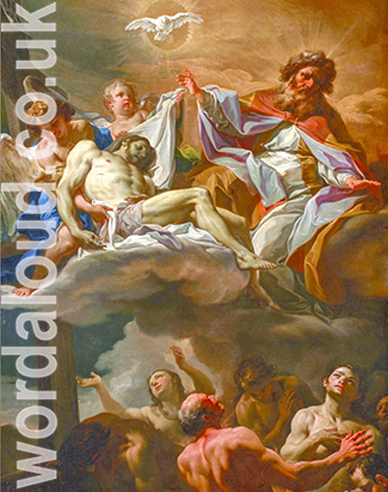
Christian Art | George Herbert | Sepulchre | The Church | The Church-Floore

George Herbert | The Temple | The Church | The Church-Floore

Mark you the floore? that square and speckled stone
Which looks so firm and strong,
Is Patience:

And th’ other black and grave, wherewith each one
Is checker’d all along,
Humilitie:

The gentle rising, which on either hand
Leads to the Quire above,
Is Confidence:

But the sweet cement, which in one sure band
Ties the whole frame, is Love
And Charitie.

Hither sometimes Sinne steals, and stains
The marbles neat and curious veins:
But all is cleansed when the marble weeps.
Sometimes Death, puffing at the doore,
Blows all the dust about the floore:
But while he thinks to spoil the room, he sweeps.
Blest be the Architect, whose art
Could build so strong in a weak heart.

George Herbert | The Temple | The Church | Easter | Christian Poems

Christian Art | George Herbert | The Temple | The Church | The Church-Floore

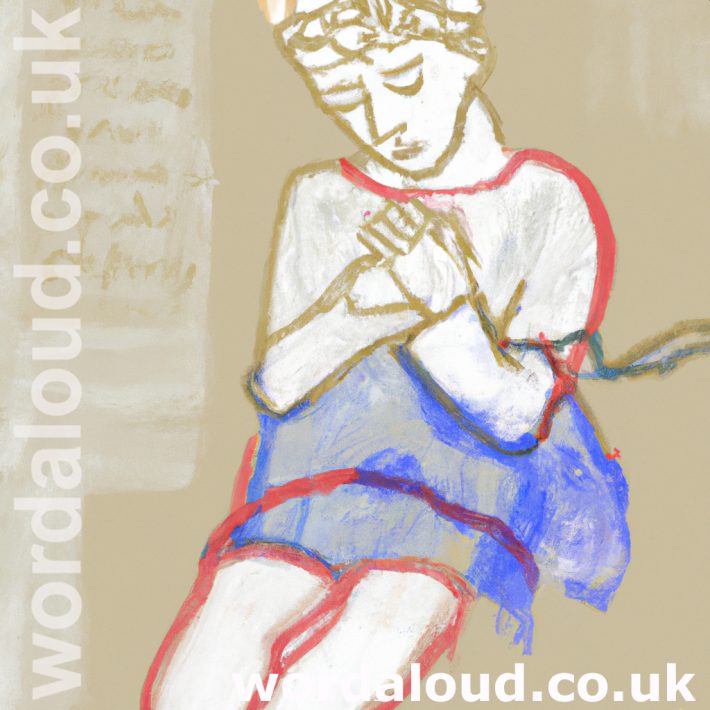
The poem describes a metaphorical interior of a sacred space. This symbolizes a concept of the human heart as a temple built by God. Each element of the architecture serves as an allegory for spiritual virtues, struggles, and the divine influence in maintaining the integrity of the space. The poet weaves a contemplative vision that ties physical imagery to theological themes.

Opening lines of the poem draw attention to the ‘floor’ made of ‘square and speckled stone’, which is identified as ‘Patience’. The firmness of this foundational element suggests patience as a crucial virtue that underpins a stable spiritual life. Alongside this, the ‘black and grave’ stone, representing ‘Humility’, emphasizes its complementary role, grounding the believer in self-awareness and deference to God. These contrasting visual qualities of the two stones reflect the interplay between these virtues, both of which are essential for spiritual balance.

The ‘gentle rising’ of steps leading to the ‘Choir above’ symbolizes ‘Confidence’, suggesting a steady and assured ascent toward communion with God. This confidence is not self-generated but it is part of the divine design guiding the faithful upward. The ‘sweet cement’ binding these elements is identified as ‘Love and Charity’, described as the unifying force that holds the structure together. These virtues are the culmination of divine grace, tying the spiritual framework into a coherent whole.

The poem then introduces challenges faced within this sacred space. Sin is personified as a thief that ‘steals’ into the heart, staining the marble’s ‘neat and curious veins’. However, the image of the ‘marble weeping’ suggests that repentance and divine forgiveness restore the purity of the heart. Similarly, Death is depicted as a disruptive force, ‘puffing at the door’ and scattering dust across the floor. Yet, in an ironic twist, this act of attempted desecration becomes an act of cleansing, as Death inadvertently ‘sweeps’ the space. These moments illustrate the resilience of the divine construction, which transforms external and internal threats into opportunities for renewal.

The final lines of the poem turn to praise for the ‘Architect,’ whose divine ‘art’ has built this temple ‘so strong in a weak heart’. Juxtaposition of strength and weakness encapsulates the poem’s central theme: human frailty becomes a site of divine strength through grace. Use of the term ‘art’ highlights intricate and purposeful nature of God’s work, blending beauty and function in the creation of a heart that can withstand sin and death.

The poem’s structure mirrors its content. The use of tercets, paired with a reflective tone, creates a sense of order and balance, mirroring the architectural metaphors within the text. Vivid imagery and personifications of virtues and challenges invite s to reflect on our spiritual condition and divine presence within our hearts. The poem is a meditation on an interplay of human weakness, divine grace, and transformative power of spiritual virtues. The poem emphasizes the heart as a sacred space continually shaped, cleansed, and upheld by God.

Meditations On The Love Of Jesus Christ | Word Aloud | Prayer And Reflection
  • Psalm 86 KJV | King James Audio Bible | Word Aloud | Oliver Peers | King James Version Psalms

    Gospel Reading: Matthew 11:28-30 ‘Come unto me, all ye that labour and are heavy laden, and I will give you rest. Take my yoke upon you, and learn of me; for I am meek and lowly in heart: and ye shall find rest unto your souls. For my yoke is easy, and my burden is light.’ In this passage, Jesus extends an invitation to all who are weary and burdened. Jesus promises rest and relief, urging us to take his yoke and learn from him. Jesus’ gentle and humble heart offers rest for our souls, emphasizing that his yoke is easy and his burden light. This passage is a reminder of the hope we have in Christ, who offers us rest and peace amid our struggles. Prayer Dear Jesus, In times of uncertainty and despair, I turn to you, the source of all hope. Fill my heart with your hope that transcends understanding. Help me to trust in your promises and to find joy and peace in your presence. May your hope renew my spirit and give me the strength to face each day with confidence and faith. Let your hope shine through me, bringing light to others who are in need. Amen. Personal Reflection What are the situations in your life that seem hopeless? How can you invite Jesus’ hope into these areas? Reflect on a time when you experienced renewed hope through your faith in Christ. Meditation On The Prayer And Gospel Matthew 11:28-30 is a passage that speaks directly to our need for hope and rest. Jesus’ invitation to come to him is extended to all who are weary and burdened, offering a refuge from the struggles of life. This invitation is not just a call to physical rest but a deeper spiritual rest that brings peace to our souls. Jesus understands the burdens we carry and offers a yoke that is easy and a burden that is light. The imagery of a yoke suggests partnership and guidance; by taking on his yoke, we align ourselves with him, allowing him to share our burdens and guide our steps. This partnership is marked by learning from Jesus, whose gentle and humble heart sets an example for us. The promise of rest for our souls is comforting. In a world where we often feel overwhelmed and stressed, Jesus assures us that he is our source of true rest and peace. His rest is not temporary or superficial but a peace that sustains us through life’s challenges. This promise gives us hope, knowing that no matter what we face, we can find solace in Jesus. Reflecting on this passage, we are reminded of the importance of surrendering our burdens to Jesus. It requires trust and faith to let go of our anxieties and allow him to take control. This surrender is an act of faith, acknowledging that Jesus is capable and willing to carry our burdens. As we learn to trust him more, we experience the peace and rest he promises. The hope we find in Jesus is transformative. It renews our spirits and gives us the strength to persevere. This hope is not dependent on our circumstances but on the nature of Jesus and his promises. It is a hope that empowers us to face each day with confidence, knowing that we are not alone. As we embrace this hope, we are called to share it with others. The hope we receive from Jesus is not meant to be kept to ourselves but to be a light for others who are struggling. Through words of encouragement, acts of kindness, and simply being present, we can extend Jesus’ invitation of hope and rest to those around us. By living out this hope, we reflect Christ’s love and bring his light into the world. In practical terms, fostering hope involves daily practices that keep us connected to Jesus. Spending time in prayer, reading Scripture, and being part of a faith community help us to stay grounded in our faith and renew our hope. These practices remind us of Jesus’ promises and keep our focus on him rather than on our circumstances. Prayer Lord Jesus, You are the anchor of my hope. In moments of doubt and despair, remind me of your promises. Fill my heart with your joy and peace, and let your hope overflow in my life. Help me to trust in your plans and to find strength in your presence. May your hope shine in me, guiding me through every trial and illuminating the path ahead. Use me as a beacon of your hope, bringing comfort and encouragement to those in need. Thank you for the gift of your eternal hope. Amen. Jeremiah 29:11 ‘For I know the thoughts that I think toward you, saith the Lord, thoughts of peace, and not of evil, to give you an expected end.’ Blessing May the God of hope fill you with all joy and peace as you trust in Him. May you overflow with hope by the power of the Holy Spirit, and may His hope guide and sustain you in all things. Amen.

  • Jesus On Via Dolorosa | Jesus Carries His Cross

    Saint John Chrysostom, preaching in the late fourth century, sets out a contrast between external honour given to Christ in the liturgy and the practical demands of charity. His central argument is that Christ’s body is not only present in the Eucharist but also in the poor, the hungry, the imprisoned, and the stranger. To neglect the afflicted while adorning the sanctuary is to dishonour Christ himself [ … ]

  • Psalm 72 | KJV | King James Audio Bible | Word Aloud | Oliver Peers | King James Version | Jesus | David

    Psalm 72 is traditionally attributed to King Solomon and is a prayerful expression of the qualities and aspirations for a just and righteous ruler. It can be seen as a guide for leaders and a plea for divine wisdom in governance [ … ]

Search Google Here | A Holy Land Jerusalem Pilgrimage? | A Safari? | An Escape..