

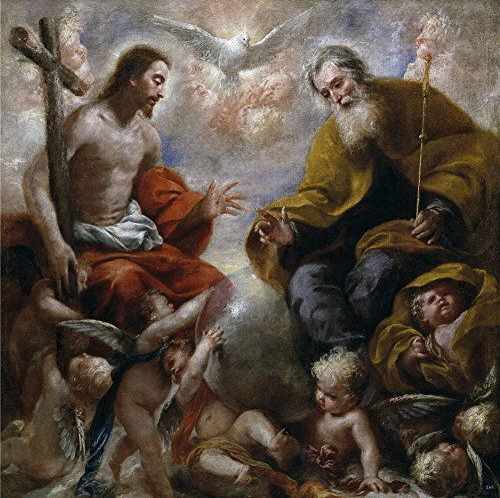
Christian Art | A Boy At Prayer With Jesus And The Holy Spirit At Pentecost | Tongues Of Fire
Office Of Readings | Eastertide Week 6, Wednesday | A Reading From The Sermons Of Pope Saint Leo The Great | The Days Between The Lord’s Resurrection And The Ascension
‘The days between the Lord’s resurrection and the ascension.’
For Saint Leo, the Ascension is not a loss but a profound gain. The Apostles’ joy arises from knowing that in Christ, human nature has triumphed. They are assured of their future glorification, empowered by the Spirit, and commissioned to spread this transformative message.
Thus, the forty days are not a mere epilogue to Easter but a sacred novitiate for the Church’s mission, a time of unveiling the full meaning of the Resurrection.
Not Leisure, But Revelation
Leo begins by asserting that the forty days following the Resurrection were not idle or incidental. Rather, they were filled with ‘great mysteries’ and ‘deep truths’ revealed by Christ. This aligns with Luke’s account (Acts 1:3), where Jesus ‘presented himself alive… by many convincing proofs, appearing to them during forty days and speaking about the kingdom of God’. The period is thus both transitional and transformational: it bridges the historical mission of Christ with the future mission of the Church, mediated by the Apostles.
According to Saint Augustine, these days were critical for confirming the bodily nature of the Resurrection. He insists that ‘He showed them His hands and side not only to confirm their faith, but to show them what kind of body rises from the grave: the same body that died’ (Tractates on John, 121). Leo continues in this vein, affirming that the fear of death is vanquished, and the immortality of the flesh is now revealed—a groundbreaking doctrine in a culture deeply shaped by Greco-Roman ideas of disembodied immortality.
Apostolic Authority And The Church’s Foundation
Leo’s mention of the Holy Spirit being breathed upon the Apostles (John 20:22) foreshadows Pentecost and signifies an intermediate bestowal of peace and authority. Notably, he emphasizes Peter’s primacy—to whom Christ entrusts ‘the keys of the kingdom’ and the ‘care of the flock’. This reflects Leo’s own theology of the Petrine office, articulated clearly in his Tome to Flavian (451), which became foundational to Chalcedonian Christology.
In his ecclesiology, Leo presents Peter as both a symbol of unity and a concrete instrument of authority, a view still held in Catholic doctrine today. As Pope Benedict XVI commented, ‘Saint Peter’s mission continues in the service of unity, truth, and love in the Church.’ (General Audience, June 7, 2006)
Emmaus | From Uncertainty To Illumination
Leo draws our attention to the Emmaus encounter (Luke 24:13–35), where the risen Lord joins two disheartened disciples, rebukes their lack of understanding, and reveals himself through Scripture and the breaking of bread. Leo sees this moment as emblematic of how Christ dispels doubt through divine revelation.
He contrasts this ‘blessed opening of their eyes’ with the tragic ‘opening of the eyes’ in Eden (Genesis 3:7), where Adam and Eve gained knowledge of good and evil but lost innocence and communion. In Emmaus, vision is restored not through disobedience, but through communion—a Eucharistic and scriptural encounter that renews the mind and heart.
Origen, an earlier Alexandrian theologian, made a similar point: ‘The eyes of those who receive the Bread which Jesus blesses are opened, that they may recognize him.’ (Homilies on Luke, 23) Thus, this moment becomes a liturgical and mystical model for the Church.
Christ’s Bodily Resurrection As Proof And Promise
Leo emphasizes that the Lord rose truly, in both body and soul. This echoes Paul’s teaching that Christ is ‘the firstfruits of those who have fallen asleep’ (1 Corinthians 15:20). The Apostles, at first bewildered and fearful, are gradually transformed by Jesus Christ’s physical presence, his words, and his love. By the time of the Ascension, they are not saddened by Jesus’ departure, but filled with joy (Luke 24:52), for they understand that Jesus’ leaving marks not an end, but a glorified beginning.
This theme—the transformation of sorrow into joy—resonates deeply in Leo’s sermon. As Gregory of Nyssa wrote, ‘What was hidden in the humanity of Christ is now revealed in His glorified state.’ (On the Ascension)
Glorification Of Human Nature
Perhaps the most theologically powerful line in the sermon is Leo’s reflection on the elevation of human nature: when Christ ascends, human nature ascends. In Jesus Christ, humanity is lifted ‘above the dignity of all heavenly creatures’, to sit at the right hand of the Father. This is not only a statement about Christ’s divinity but about our participation in the divine nature (cf. 2 Peter 1:4).
This mystery—what the Eastern Church calls theosis or divinization—remains central to Christian eschatology. Leo reminds his listeners that the destiny of the human body is not annihilation, but glorification.
The Catechism of the Catholic Church confirms this teaching:
‘Christ’s Ascension marks the definitive entrance of Jesus’ humanity into God’s heavenly domain… He is the head of the Church, and where the head has gone, the body is called to follow’ (CCC §665–667).

A Reading From The Sermons Of Pope Saint Leo The Great | The Days Between The Lord’s Resurrection And The Ascension
Dearly beloved, those days which intervened between the Lord’s Resurrection and Ascension did not pass by in uneventful leisure, but great mysteries were ratified in them and deep truths were revealed.
In those days the fear of death was removed with all its terrors, and the immortality not only of the soul but also of the flesh was established. In those days the Holy Ghost is poured upon all the Apostles through the Lord’s breathing upon them, and to the blessed Apostle Peter, set above the rest, the keys of the kingdom are entrusted and the care of the Lord’s flock.
It was during that time that the Lord joined the two disciples as a companion on the way, and, to sweep away all the clouds of our uncertainty, reproached them for the slowness of their timid and trembling hearts. Their enlightened hearts catch the flame of faith, and lukewarm as they have been, they are made to burn while the Lord unfolds the Scriptures. In the breaking of bread also their eyes are opened as they eat with him. How much more blessed is that opening of their eyes, to the glorification of their nature, than the time when our first parents’ eyes were opened to the disastrous consequences of their transgression.
Dearly beloved, through all this time which elapsed between the Lord’s Resurrection and Ascension, God’s Providence had this in view, to teach his own people and impress upon their eyes and their hearts that the Lord Jesus Christ had risen, risen as truly as he had been born and had suffered and died.
Hence the most blessed Apostles and all the disciples, who had been both bewildered at his death on the cross and backward in believing his Resurrection, were so strengthened by the clearness of the truth that when the Lord entered the heights of heaven, not only were they affected with no sadness, but were even filled with great joy.
Truly it was great and unspeakable, that cause of their joy, when in the sight of the holy multitude the Nature of mankind went up: up above the dignity of all heavenly creatures, to pass above the angels’ ranks and to rise beyond the archangels’ heights, and to have its uplifting limited by no elevation until, received to sit with the Eternal Father, it should be associated on the throne with his glory, to whose Nature it was united in the Son.

Glossary Of Terms
Ascension – The event of Jesus Christ being taken bodily into heaven, occurring 40 days after the Resurrection.
Theosis – A theological concept (especially in Eastern Christianity) meaning the process by which humans become partakers in the divine nature.
Petrine Primacy – The unique role and authority of Saint Peter and his successors (the popes) as leaders of the universal Church.
Emmaus – The village where two disciples encountered the risen Christ (Luke 24); a key moment of post-Resurrection revelation.
The Forty Days – The period between Easter and the Ascension during which Jesus appeared to his disciples and instructed them.
The Breaking of the Bread – An early Christian term for the Eucharist; refers to the moment Jesus was recognized by the disciples in Emmaus.
Glorification – The final transformation of human nature through resurrection and divine union, exemplified in Christ’s Ascension.
Tome of Leo – A doctrinal letter written by Pope Leo I (the Great) that significantly shaped Christological teachings at the Council of Chalcedon (451 AD).
Christological – Pertaining to the study or doctrine of the nature and person of Jesus Christ.
Divine Nature – The essence of God; to “partake in the divine nature” (2 Peter 1:4) is to share in God’s life through grace.
Prayer With Jesus
Risen and Glorious Lord,
You walked among your disciples for forty days, dispelling doubt, strengthening faith, and opening hearts to the mystery of your victory.
You lifted our nature to heaven, promising that where you have gone, we too may follow.
Give us the joy of the Apostles—the joy that knows you are risen and reigning.
Pour your Spirit into our hearts, that we may live as citizens of heaven while still on earth.
Unite us in faith, in mission, and in the breaking of bread.
We praise you, Christ our King,
seated at the right hand of the Father,
with the Holy Spirit, one God, forever and ever.
Amen.



The Jews – often in the Gospel of John a generic term for those who reject Christ, or those who are so muddled, contentious and sectarian among themselves that they threaten the continuity of themselves in the Law – do not reject Jesus for any good reason. They do so rather because they cling to what precious little they have, within their prison walls, and so they deliberately blind themselves to the universal, and universalizing, truth which Christ brings. Jesus knows this. Nevertheless, through justice, he must give to the Jews this additional opportunity to listen to his teaching and recognize the truth of who he is. We may imagine that Jesus is truly desperate for the people of God to put aside their differences and truly be with God [ … ]

Jesus asks people to think of the usual relations between masters and servants, in which the master shows no gratitude to the servant for his having fulfilled his duties, offering to serve his needs in turn, but rather requires more, that further duties be performed [ … ]

Today’s verses hold a message for those early Christians of the time when the Gospel was being written. Those Christians faced persecution at the hands of the Roman authority. It would have been reassuring for them to hear of how Jesus challenged authority, helping them to find the courage to keep their faith [ … ]
