
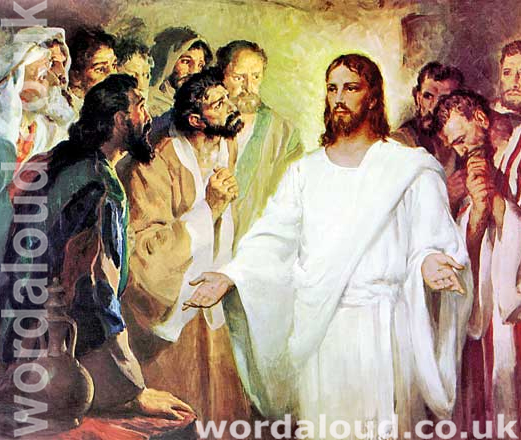
Christian Art | Jesus The Risen Lord Reveals Himself To His Disciples | Jesus’ Wounds
Office Of Readings | Week 31, Sunday, Ordinary Time | A Reading From The Pastoral Constitution On The Church In The Modern World Of The Second Vatican Council | Gaudium Et Spes | On Fostering Peace
‘The promotion of peace.’
The reading from Gaudium et Spes presents one of the most concise theological accounts of peace in the modern magisterium. The Council situates peace not in the suspension of conflict or equilibrium of force but in a moral and spiritual order. Peace, it declares, ‘is the work of justice,’ an expression drawn from Isaiah and later from the tradition of Catholic social thought. Justice here is understood not only as distributive equity but as the right ordering of relationships among persons, societies, and nations according to divine law.
The constitution links peace with the ‘order implanted in human society by its divine founder’. Human history therefore stands under the sovereignty of a moral order that transcends political contingency. Yet peace is never static: it must be ‘built up continually’, because human conditions and institutions evolve, and because the will is impaired by sin. Peace requires both inner discipline — ‘control of the passions’ — and outward vigilance by legitimate authority.
The text develops a social theology of dignity. Peace depends upon the safeguarding of the human person and the willingness of individuals and peoples to trust, cooperate, and share. Brotherhood is described not as sentiment but as a condition for justice itself; it presupposes respect for human dignity and solidarity in both material and spiritual goods.
The Council then moves from ethics to theology. Peace is ‘the fruit of love’, and love transcends what justice can achieve by itself. The peace that human communities seek is an echo of the divine peace manifested in Christ. The ‘Prince of Peace’ reconciles humanity through the cross, abolishing enmity and forming one body. The Spirit of love is the agent of this reconciliation, translating divine unity into human community.
Finally, the passage calls for action. Christians are summoned ‘to live the truth in love’, to join with all genuine peacemakers, and to esteem those who reject violence in defending justice. This summons implies both realism and hope: peace remains a human task, fragile and provisional, yet it participates in the divine act of reconciliation already accomplished in Christ. The building of peace, therefore, is both a moral duty and a participation in the redemptive work of God.

A Reading From The Pastoral Constitution On The Church In The Modern World Of The Second Vatican Council | Gaudium Et Spes | On Fostering Peace
Peace is not the mere absence of war or the simple maintenance of a balance of power between forces, nor can it be imposed at the dictate of absolute power. It is called, rightly and properly, a work of justice. It is the product of order, the order implanted in human society by its divine founder, to be realized in practice as men hunger and thirst for ever more perfect justice.
The common good of the human race is subject to the eternal law as its primary principle, but its requirements in practice keep changing with the passage of time. The result is that peace is never established finally and forever; the building up of peace has to go on all the time. Again, the human will is weak and wounded by sin; the search for peace therefore demands from each individual constant control of the passions, and from legitimate authority untiring vigilance.
Even this is not enough. Peace here on earth cannot be maintained unless the good of the human person is safeguarded, and men are willing to trust each other and share their riches of spirit and talent. If peace is to be established it is absolutely necessary to have a firm determination to respect other persons and peoples and their dignity, and to be zealous in the practice of brotherhood.
Peace is therefore the fruit also of love; love goes beyond what justice can achieve. Peace on earth, born of love for one’s neighbour, is the sign and the effect of the peace of Christ that flows from God the Father. In his own person the incarnate Son, the Prince of Peace, reconciled all men to God through his death on the cross. In his human nature he destroyed hatred and restored unity to all mankind in one people and one body. Raised on high by the resurrection, he sent the Spirit of love into the hearts of men.
All Christians are thus urgently summoned to live the truth in love, and to join all true peacemakers in prayer and work for peace. Moved by the same spirit, we cannot but praise those who renounce violence in defence of rights, and have recourse to means of defence otherwise available to the less powerful as well, provided that this can be done without injury to the rights and obligations of others or of the community.
Christian Prayer With Jesus
God of truth and mercy,
you have made peace the fruit of justice
and love the bond of perfect unity.
Grant that all peoples may seek what makes for peace
and preserve the dignity of every person.
Dispel the pride and fear that divide nations,
and teach us to trust in the strength of your Spirit.
Through your Son, the Prince of Peace,
who reconciled the world to you upon the cross,
may we become builders of the kingdom
where justice and peace shall embrace,
through the same Christ our Lord.
Amen.
Glossary Of Christian Terms
Peace: The right ordering of human relationships in truth and justice; in Christian theology, the reflection of divine harmony revealed in Christ.
Justice: The moral virtue of giving each their due; in social doctrine, the foundation of peace and the expression of respect for human dignity.
Common Good: The sum of social conditions that allow individuals and groups to reach fulfilment more fully and easily; the purpose of political and social life.
Solidarity: The moral and social principle of mutual responsibility and cooperation among peoples; the practice of shared humanity.
Subsidiarity: The principle that higher authorities must support, not absorb, the functions of lower communities; a safeguard for human freedom and dignity.
Reconciliation: The restoration of communion between God and humanity, and among human beings, through Christ’s death and resurrection.
Love (Charity): The divine and theological virtue by which persons seek the good of others for God’s sake; it perfects justice and produces true peace.
Nonviolence: The deliberate renunciation of physical force as a means of resolving conflict; considered valid when it preserves the rights and responsibilities of all.
Eschatology: The theological understanding of history and destiny in light of the ultimate fulfilment of God’s plan; the horizon of lasting peace.




This passage from Lumen gentium, the Dogmatic Constitution on the Church promulgated at the Second Vatican Council, is a profound exposition on the life-giving, unifying and guiding presence of the Holy Spirit in the Church. It articulates not only doctrinal truths about the Spirit’s nature and mission but also gives pastoral encouragement to the faithful to discern and receive the Spirit’s activity in their lives [ … ]

On Holy Thursday, the Church gathers to remember the Last Supper—the evening when Jesus, in a quiet upper room, gave his friends the gift of the Eucharist, and with it, a new covenant sealed in his blood. The reading from Saint Melito of Sardis, a bishop from the second century, helps us understand the deeper meaning of what took place that night and how it connects to the cross and the resurrection that followed [ … ]

This poem is a meditation on gratitude and divine love, exploring relationship between human activity and God’s continuous care. George Herbert reflects on the gifts of life, sight, and the ability to engage in both labour and leisure, attributing them to God’s love. Yet, the central focus is the greater blessing of spiritual vision, symbolized by sight, which God withheld from himself—we may understand reference to Christ’s sacrifice—so that humanity might see its own paths and be redeemed [ … ]
