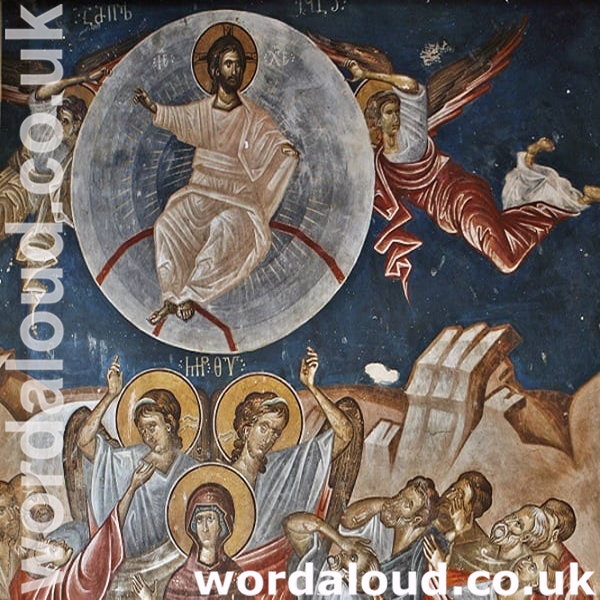
Christian Art | Jesus Christ The King | Ascension
Office Of Readings | Week 34, Friday, Ordinary Time | A Reading From The Sermon Of Saint Cyprian On Mortality | Let Us Put Aside The Fear Of Death And Meditate Upon Immortality
‘Let us put aside the fear of death and meditate upon immortality.’
Saint Cyprian writes in a time of crisis for the early Church—war, plague, persecution, and instability. Yet he refuses to interpret these pressures as cause for panic. Instead, he perceives in them a summons to remember who we truly are: pilgrims whose homeland is not this world but the kingdom of God. His words therefore have a bracing clarity. They strip away illusions and invite the believer into a deeper freedom—freedom from fear, from clinging, from divided loyalties.
- The coherence between our prayer and our life
Cyprian begins by confronting the inconsistency between praying ‘thy will be done’ and yet resisting God when He calls us home. The point is not morbid anticipation of death, but rather the integrity of discipleship. If we truly desire God’s kingdom, then we must desire whatever leads us into it. Fear of death reveals how tightly we still grasp the world. Cyprian urges a conversion of desire: to long for God more than we cling to passing things. - The Christian’s relationship to the world
Cyprian echoes Saint John’s First Letter in his distinction between ‘the world’ as God’s creation—which is good—and ‘the world’ as humanity organised in rebellion and self-love. To love that world is to be torn away from the Father. The warning is not an invitation to disdain creation or human society, but a call to vigilance. The Christian lives within the world yet belongs ultimately to Christ. Cyprian reminds us that our desires must be purified so that our affection is set on God, not swallowed up in the seductions of comfort, ambition, or the illusions of security. - The banishment of fear
Cyprian knows the natural fear of death; he is not naive. Yet he insists that for the Christian this fear is no longer decisive. Christ has gone ahead of us and transformed death from an end into a homecoming. To meditate on immortality is not to escape earthly duties but to place them within their true horizon. When the believer remembers that life is an exile and paradise is home, courage becomes possible. This courage does not come from Stoic resolve but from supernatural hope. - The communion of saints
A particularly tender passage imagines the saints and the departed watching for us, longing for our arrival, rejoicing at our perseverance. Cyprian’s vision is familial rather than abstract: a ‘great crowd of loved ones’, apostles, martyrs, the pure, the merciful—all welcoming the pilgrim into a homeland of peace where there is no more fear. This is Cyprian’s medicine for anxious hearts: not argument, but the warm, living memory of the Church triumphant. - Desire for Christ
The reading culminates in desire—longing for Christ, longing for the kingdom. Cyprian understands that the depth of our desire shapes our capacity to receive. He prays that Christ ‘see this resolve that springs from faith’, because the Lord gives more abundantly to those who long more ardently. Christian life, then, is not merely endurance but yearning: a stretching of the heart toward the One who loved us first.
In all this, Cyprian does not offer escapism, nor a dismissal of the griefs of this life. He offers instead a re-ordering of the heart. Fear of death dissolves not because death becomes pleasant, but because Christ becomes all in all. The world loses its power to terrify when our eyes are fixed on the Father’s house.

A Reading From The Sermon Of Saint Cyprian On Mortality | Let Us Put Aside The Fear Of Death And Meditate Upon Immortality
Our obligation is to do God’s will, and not our own. We must remember this if the prayer that our Lord commanded us to say daily is to have any meaning on our lips. How unreasonable it is to pray that God’s will be done, and then not promptly obey it when he calls us from this world! Instead we struggle and resist like self-willed slaves and are brought into the Lord’s presence with sorrow and lamentation, not freely consenting to our departure, but constrained by necessity. And yet we expect to be rewarded with heavenly honours by him to whom we come against our will! Why then do we pray for the kingdom of heaven to come if this earthly bondage pleases us? What is the point of praying so often for its early arrival if we would rather serve the devil here than reign with Christ?
The world hates Christians, so why give your love to it instead of following Christ, who loves you and has redeemed you? John is most urgent in his epistle when he tells us not to love the world by yielding to sensual desires. Never give your love to the world, he warns, or to anything in it. A man cannot love the Father and love the world at the same time. All that the world offers is the lust of the flesh, the lust of the eyes and earthly ambition. The world and its allurements will pass away, but the man who has done the will of God shall live for ever. Our part, my dear brothers, is to be single-minded, firm in faith, and steadfast in courage, ready for God’s will, whatever it may be. Banish the fear of death and think of the eternal life that follows it. That will show people that we really live our faith.
We ought never to forget, beloved, that we have renounced the world. We are living here now as aliens and only for a time. When the day of our homecoming puts an end to our exile, frees us from the bonds of the world, and restores us to paradise and to a kingdom, we should welcome it. What man, stationed in a foreign land, would not want to return to his own country as soon as possible? Well, we look upon paradise as our country, and a great crowd of our loved ones awaits us there, a countless throng of parents, brothers and children longs for us to join them. Assured though they are of their own salvation, they are still concerned about ours. What joy both for them and for us to see one another and embrace! O the delight of that heavenly kingdom where there is no fear of death! O the supreme and endless bliss of everlasting life!
There, is the glorious band of apostles, there the exultant assembly of prophets, there the innumerable host of martyrs, crowned for their glorious victory in combat and in death. There in triumph are the virgins who subdued their passions by the strength of continence. There the merciful are rewarded, those who fulfilled the demands of justice by providing for the poor. In obedience to the Lord’s command, they turned their earthly patrimony into heavenly treasure.
My dear brothers, let all our longing be to join them as soon as we may. May God see our desire, may Christ see this resolve that springs from faith, for he will give the rewards of his love more abundantly to those who have longed for him more fervently.
Christian Prayer With Jesus
O God,
source of life and giver of immortality,
teach us to long for your kingdom with pure and steadfast hearts.
Free us from the fear that clings to passing things,
and make us ready for your will in all things.
Strengthen our hope,
that we may remember our true homeland
and desire it above all earthly comforts.
Let the witness of the saints encourage us,
and may the love of Christ draw us onward
with holy courage and quiet joy.
Grant that, living as pilgrims in this world,
we may set our hearts on what endures for ever,
and so come, in your mercy,
to the company of the blessed
and the embrace of your eternal peace.
Through Christ our Lord. Amen.
Glossary Of Christian Terms
Will of God – God’s loving purpose for His creation and for each person; what God desires us to embrace and live.
Kingdom of Heaven / Kingdom of God – The reign of God over all things; already present in Christ but fulfilled fully only in eternity.
World (in the negative sense) – Not creation itself, but human society and desire when organised against God, dominated by pride, pleasure, and self-will.
Lust of the flesh / lust of the eyes / earthly ambition – Scriptural phrases describing forms of disordered desire: the pursuit of pleasure, the craving for possessions, and the hunger for glory or power.
Faith – Trust in God and adherence to His truth; the foundation of Christian life and the believer’s ‘root’ and ‘head’.
Exile – A spiritual image for earthly life, emphasising that our true homeland is with God in heaven.
Paradise – The state of perfect communion with God; the heavenly homeland restored by Christ.
Communion of Saints – The unity of the faithful on earth, the souls in purgatory, and the blessed in heaven, joined together in Christ.
Martyrs – Those who witnessed to Christ even unto death; signs of courage and fidelity.
Virgins – Those who consecrated their lives to God through continence and purity of heart.
The Merciful – Christians who lived charity concretely, especially by caring for the poor, turning earthly goods into heavenly treasure.




Reading Mark’s Gospel, we have a wonderful sense of just how active and mobile Jesus’ ministry around Galilee was. The words ‘immediately’ and ‘straightway’ recur again and again. There is joy and purpose in these words. There is the sense of astonishment people experienced listening to Jesus. And there is the touch of danger, the revolutionary energy of Jesus, and the plots of his enemies [ … ]
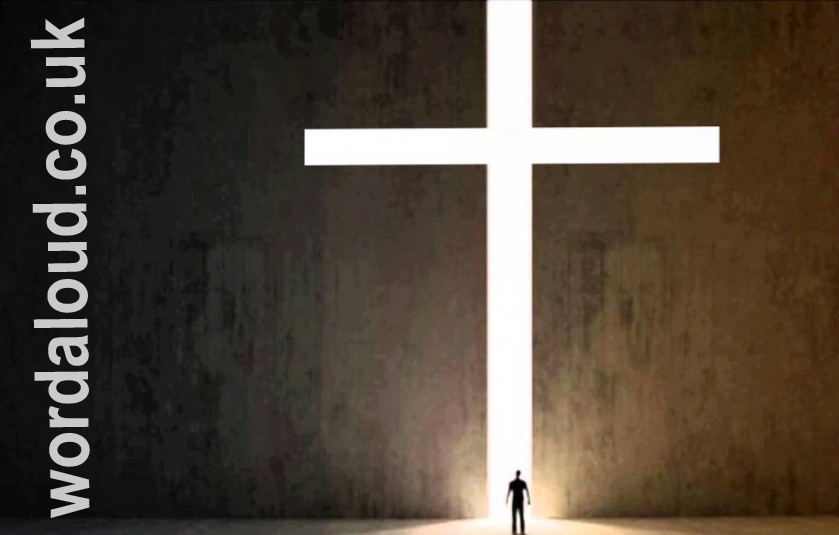
Christ’s journey from Galilee to Jerusalem is an ascent, literally, that occupies the central third of Luke’s Gospel. When the journey begins, it is made explicit that this is a journey toward the cross: ‘And it came to pass, when the time was come that he should be received up, he stedfastly set his face to go to Jerusalem…’ (Luke 9: 51) Christ’s teachings as he and his disciples travel are cued to the sense of steady, deliberate movement toward the Passion [ … ]
In this reading, Saint Jerome offers a layered interpretation of Ecclesiastes, moving from a literal reading of human labour and enjoyment to a more developed spiritual understanding. The text reflects Jerome’s characteristic method: a progression from the observable realities of life to their theological fulfilment in Christ [ … ]