
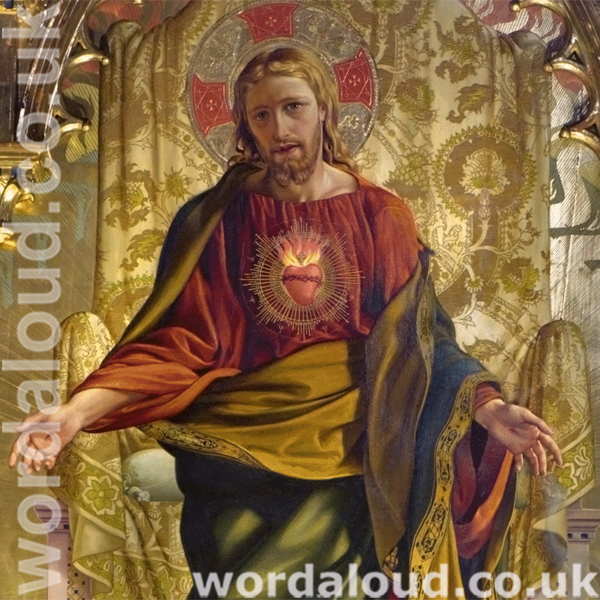
Christian Art | Jesus Christ The King
Office Of Readings | Week 34, Wednesday, Ordinary Time | A Reading From The Homilies Attributed To Saint Macarius | Woe To The Soul Where Jesus Christ Does Not Dwell
‘Woe to the soul where Jesus Christ does not dwell.’
The reading attributed to Saint Macarius is built on a series of striking and sobering images that diagnose the condition of the soul without Christ. The preacher’s language is vivid, even severe, yet always in service of a pastoral aim: to awaken desire for the indwelling Lord who alone restores the soul to beauty.
Macarius begins with biblical history: when God withdrew his favour, Jerusalem was handed over to its enemies, its worship extinguished. This serves as a mirror for the soul. When a person turns away from God’s commandments, the soul becomes similarly desolate—its inner life disrupted, its dignity violated, its original calling disfigured. What was created to be a dwelling-place for God and his angels becomes instead a house without a master: darkened, disorderly, and filled with corruption. The preacher’s bluntness is not cruelty but diagnosis: the soul without Christ cannot retain purity or harmony, for it has lost its light.
The homily then unfolds a series of lamentations—Woe to the path… Woe to the soul… Woe to the house… Each image emphasises abandonment and vulnerability. A path untrodden becomes overrun by beasts; a field untended is choked with weeds; a ship without a pilot is swallowed by the sea. These are not exaggerations but spiritual analogies. Without the Lord walking within the soul, guiding and guarding it, sinful impulses grow wild, passions rise like storms, and the forces that oppose God find easy entry. The preacher wants the listener to sense the utter dependence of the soul on Christ, who alone brings order, peace, and fruitfulness.
But the reading does not end in lament; it turns decisively toward the work of redemption. Christ is portrayed as a divine farmer and king who approaches the devastated terrain of humanity. He ‘puts on’ the garment of flesh and takes up his tool—the cross—using it as a plough to break the hardened ground of the fallen heart. Here Macarius unites incarnation and passion into a single image of restorative labour. Christ removes thorns (evil spirits), uproots weeds (sin), and burns the straw (wickedness). Nothing is left to chance; everything that harms the soul is confronted and destroyed by the crucified Lord.
The result is not merely the removal of evil but the cultivation of good. Into the newly-tilled soil Christ plants ‘a most lovely garden of the Spirit’, a place of sweetness, delight, and abundant fruit. The sermon thus ends with hope: the soul once abandoned becomes, through grace, a garden where the Holy Spirit dwells, and from which God receives the fragrant fruits of virtue.
The message is clear and urgent: without Christ, the soul collapses into chaos; with Christ, it becomes a paradise. The reading warns in order to awaken longing, and it describes Christ’s labour in order to inspire trust. It invites the listener to allow the Lord not only to dwell within but to cultivate, cleanse, and transform the whole inner life.

A Reading From The Homilies Attributed To Saint Macarius | Woe To The Soul Where Jesus Christ Does Not Dwell
When God was displeased with the Jews, he delivered Jerusalem to the enemy, and they were conquered by those who hated them; there were no more sacrifices or feasts. Likewise angered at a soul who had broken his commands, God handed it over to its enemies, who corrupted and totally dishonoured it. When a house has no master living in it, it becomes dark, vile and contemptible, choked with filth and disgusting refuse. So too is a soul which has lost its master, who once rejoiced there with his angels. This soul is darkened with sin, its desires are degraded, and it knows nothing but shame.
Woe to the path that is not walked on, or along which the voices of men are not heard, for then it becomes the haunt of wild animals. Woe to the soul if the Lord does not walk within it to banish with his voice the spiritual beasts of sin. Woe to the house where no master dwells, to the field where no farmer works, to the pilotless ship, storm-tossed and sinking. Woe to the soul without Christ as its true pilot; drifting in the darkness, buffeted by the waves of passion, storm-tossed at the mercy of evil spirits, its end is destruction. Woe to the soul that does not have Christ to cultivate it with care to produce the good fruit of the Holy Spirit. Left to itself, it is choked with thorns and thistles; instead of fruit it produces only what is fit for burning. Woe to the soul that does not have Christ dwelling in it; deserted and foul with the filth of the passions, it becomes a haven for all the vices. When a farmer prepares to till the soil he must put on clothing and use tools that are suitable. So Christ, our heavenly king, came to till the soil of mankind devastated by sin. He assumed a body and, using the cross as his ploughshare, cultivated the barren soul of man. He removed the thorns and thistles which are the evil spirits and pulled up the weeds of sin. Into the fire he cast the straw of wickedness. And when he had ploughed the soul with the wood of the cross, he planted in it a most lovely garden of the Spirit, that could produce for its Lord and God the sweetest and most pleasant fruit of every kind.
Christian Prayer With Jesus Christ
O Christ our King and Gardener of souls,
enter the barren places of our hearts
and make them your dwelling once more.
Plough us with the wood of your holy cross,
tear out the thorns of sin,
and scatter the darkness that hides within.
Plant in us the garden of your Spirit,
that our lives may bear fruit pleasing to you—
faith, gentleness, purity, and love.
Remain our Master, our Pilot, and our Light,
lest we stray into ruin;
and bring us at last into the joy of your eternal kingdom,
you who live and reign forever and ever.
Amen.
Glossary Of Christian Terms
Indwelling
The presence of God within the soul; central to Macarius’ imagery of Christ dwelling, guiding, and cultivating the heart.
Passions
Disordered desires or emotions that can dominate the soul when not governed by grace.
Vices
Habitual sins or corrupted tendencies that take root in the soul when it is untended by God.
Fruit of the Holy Spirit
The virtues and graces—such as love, joy, peace, patience—produced in the soul through the Spirit’s action.
Incarnation
The mystery by which the Son of God took on human flesh; here described as Christ ‘putting on’ suitable clothing to work the soil of humanity.
The Cross as Ploughshare
A metaphor for Christ’s passion as the tool by which he breaks the hardness of the fallen heart and renews it.
Garden of Eden
Symbol of the soul restored to innocence, beauty, and communion with God.
Evil spirits
Spiritual adversaries that seek to influence the soul toward sin; represented as ‘thorns and thistles’.
Desolation
The state of the soul deprived of God’s presence—disordered, darkened, and vulnerable.
Regeneration
The new life bestowed by Christ through grace, transforming the soul into a place of spiritual fruitfulness.




This poem challenges the convention that poetry must rely on embellishment, elaborate imagery, or artifice to be meaningful or beautiful. Herbert begins with rhetorical questions that critique the idea that only fiction or outward, artificial beauty can be the subjects of verse: ‘Who says that fictions only and false hair / Become a verse? Is there in truth no beauty?’ This opening begins the thought of Herbert’s argument that truth and simplicity have their inherent worth in poetry [ … ]

John Donne’s Holy Sonnet 14, beginning, ‘Batter my heart, three-person’d God,’ enacts a struggle between divine grace and human resistance, expressed through forceful imagery and paradox. The speaker does not ask for gentle persuasion but for a radical upheaval of the self. The poem presents a mind at war with itself, aware of divine sovereignty yet bound by sin, seeking liberation through subjugation [ … ]

Saint Ambrose begins by recalling the preparatory instruction given during Lent, using Scripture—particularly the patriarchs and Proverbs—as a moral and spiritual guide. This grounding in sacred history was intended to help catechumens internalise the obedience and faithfulness exemplified by their spiritual ancestors. Ambrose thereby affirms that the path of Christian discipleship is a continuation of God’s covenantal relationship with His people [ … ]
