

Christian Art | Christian Love In Community
Office Of Readings | Week 14, Friday, Ordinary Time | A Reading From The Letter Of Pope Saint Clement I To The Corinthians | Keep God’s Commandments In Love
‘We are blessed if we fulfil the commands of the Lord in the harmony of love.’
Saint Clement I, Bishop of Rome, likely writing around AD 96, addresses this letter to the Corinthian church during a period of turmoil. Corinth was a Roman colony steeped in competition for status and influence, and such cultural factors likely influenced tensions within the Christian community there. The division in question seems to have been caused by a rebellion against duly appointed presbyters, leading to strife and disunity.
Clement’s letter thus serves as an early witness to the Church’s growing sense of structure and order: a shared commitment to ecclesial hierarchy as an extension of apostolic tradition. The concern for maintaining harmony and respect for legitimate authority reflects not only spiritual ideals but also practical responses to factionalism, which threatened the fragile unity of the early Christian communities.
Theology Of Ecclesial Unity And Reconciliation
Clement’s pastoral exhortation centres on the divine gift of love (agape) as the adhesive binding believers together. His plea that Christians seek ‘the good of all, not personal advantage’ anticipates later ecclesiological teachings on the common good of the Church and the corporate nature of salvation.
His call for the leaders of sedition voluntarily to remove themselves — not out of shame but for the sake of peace — reveals a profound pastoral wisdom: that reconciliation is not merely about juridical correction, but about restoring harmony in love.
Moreover, Clement emphasises that true greatness in the Christian community is not about personal honour but humility and willingness to sacrifice for the good of others. This ideal would significantly influence later patristic and conciliar teachings on episcopal service and synodality.
Scriptural Foundations
Clement’s letter is steeped in Scripture, drawing heavily on the Psalms (especially Psalm 32) and teachings of Jesus. His reference to Psalm 32 (‘Blessed are those whose transgressions are forgiven’) reinforces the need for continual repentance, while the repeated exhortation to humility echoes Christ’s own teachings on reconciliation (e.g., Matthew 5:23–24: ‘First be reconciled to your brother…’).
Importantly, Clement alludes to Saint Paul’s earlier letters to the Corinthians, especially addressing factionalism (1 Corinthians 1:10–17), and he places the current schism in continuity with those earlier struggles. By doing so, Clement not only corrects but reconnects the Corinthians to their own apostolic heritage, reminding them that unity is part of their identity as a Church founded by the apostles.
Reception History
Clement’s letter holds a unique place in Church history. Though not included in the New Testament canon, it was read in many early Christian communities alongside the Scriptures and regarded as an authoritative witness to apostolic tradition. The letter provides one of the earliest and clearest articulations of the notion of apostolic succession, ecclesial hierarchy, and the primacy of love as a Christian virtue.
In modern times, Clement’s letter has gained prominence in ecumenical dialogue as an example of how disputes might be addressed within the Church through appeals to shared faith and charity, rather than coercion or exclusion. Clement’s tone of exhortation, rooted in Scripture and pastoral solicitude, continues to resonate as a model for Christian unity and humility.

A Reading From The Letter Of Pope Saint Clement I To The Corinthians | Keep God’s Commandments In Love
Beloved, see what a marvellous thing love is; its perfection is beyond our expression. Who can truly love save those to whom God grants it? We ought to beg and beseech him in his mercy that our love may be genuine, unmarred by any too human inclination. From Adam down to the present time all generations have passed away; but those who were perfected in love by God’s grace have a place among the saints who will be revealed when the kingdom of Christ comes to us. As it is written: Enter your chambers for a little while, until my wrath and anger pass away; and I shall remember a good day and raise you from your graves. We are blessed, beloved, if we fulfil the commands of the Lord in harmonious, loving union, so that through love our sins may be forgiven. For it is written: Blessed are those whose transgressions are forgiven, whose sins are covered. Blessed is the man to whom the Lord imputes not iniquity, and in whose mouth there is no deceit. This is the blessing that has been given to those who have been chosen by God through our Lord Jesus Christ, to whom be glory for ever. Amen.
We should pray then that we may be granted forgiveness for our sins and for whatever we may have done when led astray by our adversary’s servants. And for those who were the leaders of the schism and the sedition, they too should look to the common hope. For those who live in pious fear and in love are willing to endure torment rather than have their neighbour suffer; and they more willingly suffer their own condemnation than the loss of that harmony that has been so nobly and righteously handed down to us. For it is better for a man to confess his sins than to harden his heart.
Who then among you is generous, who is compassionate, who is filled with love? He should speak out as follows: If I have been the cause of sedition, conflict and schisms, then I shall depart; I shall go away wherever you wish, and I shall do what the community wants, if only the flock of Christ live in peace with the presbyters who are set over them. Whoever acts thus would win great glory for himself in Christ, and he would be received everywhere, for the earth is the Lord’s and the fullness thereof. Thus have they acted in the past and will continue to act in the future who live without regret as citizens in the city of God.
Prayer With Jesus
Lord God,
You have called us to be one body in Christ,
united in love and service.
Grant us the humility to seek not our own advantage,
but the good of all your people.
May we be quick to forgive,
generous in love,
and faithful in upholding the peace and unity of your Church.
Strengthen us to act with compassion and courage,
so that your kingdom of justice and mercy may shine through us.
Through Christ our Lord.
Amen.
Glossary Of Christian Terms
Agape: A Greek term for self-giving, unconditional love, often used in the New Testament to describe the love of God and the love Christians are called to show one another.
Apostolic succession: The uninterrupted transmission of spiritual authority from the apostles through successive popes and bishops.
Common good: The good of the whole community, an important principle in Catholic social teaching.
Ecclesial: Pertaining to the Church.
Factionalism: The state of division or conflict between competing groups within a community.
Harmony: In this context, a state of peaceful unity and concord within the Church.
Presbyters: An early Christian term for elders or priests who had leadership roles in the local church.
Schism: A division within the Church that leads to a break in communion and unity.
Scriptural exhortation: A call to action or encouragement that is based on or derived from the teachings of Scripture.




This poem centres on themes of spiritual nourishment and intimate connection between the divine and the individual soul. The poem begins by contrasting superficial wealth, symbolized by ‘rich furniture’ and ‘a wedge of gold’, with the poet’s experience of spiritual fulfilment. Here, material objects hold no power to convey the divine presence. Instead, the poet emphasizes a more personal and humble approach: sustenance provided by Christ in the Eucharist, which enters into the poet ‘by the way of nourishment and strength’. This nourishment implies a steady, almost unseen influence that fills the body and soul, offering rest and inner strength while combating the forces of sin [ … ]

The Greek word apokalypsis means an unveiling or disclosure – apo = from, since; kalypsis = cover, veiled, being hidden. The English title Revelation and the traditional title Apocalypse express the same idea: something which cannot ordinarily be seen is being made known. Revelation does not principally attempt to conceal information within a collection of puzzles; it unveils the true character of the world by showing earthly history from the standpoint of the throne of God and the slain Lamb [ … ]
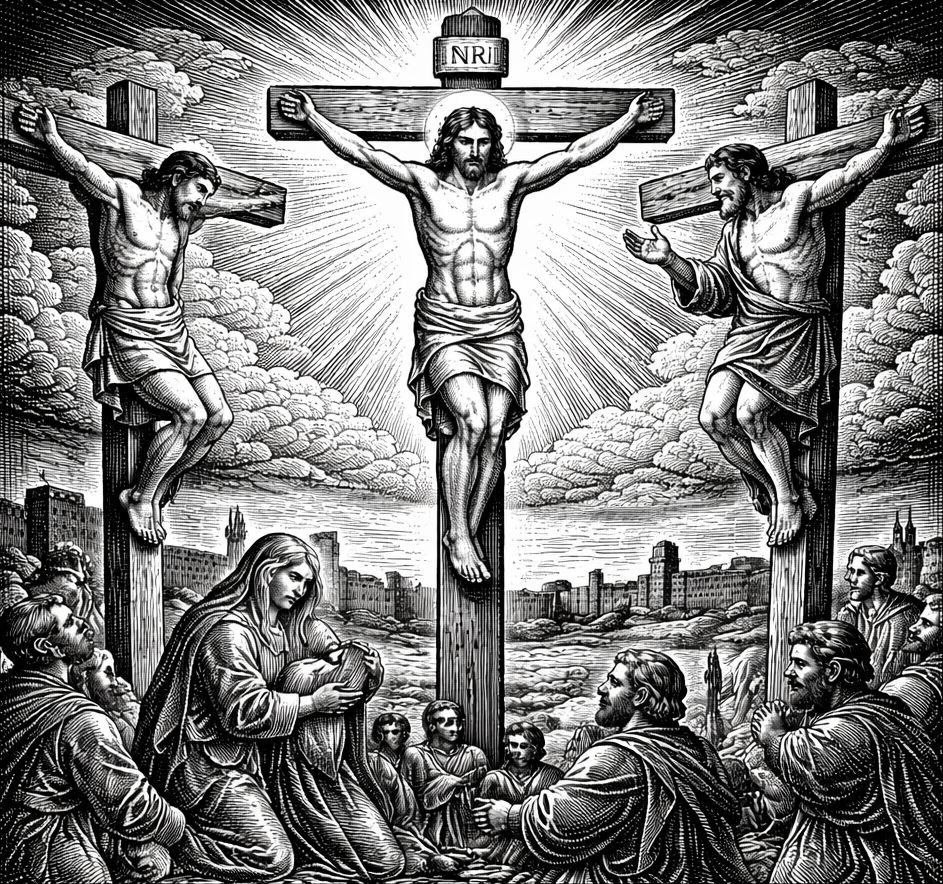
This reading of Saint Gregory of Nyssa presents a concentrated meditation on the orientation of the human mind towards Christ as the condition for true wisdom. The argument is structured around a single governing image: the direction of one’s gaze. To ‘keep one’s eyes fixed’ on Christ is not merely a metaphor for devotion, but a description of the ordering of the whole person [ … ]
