
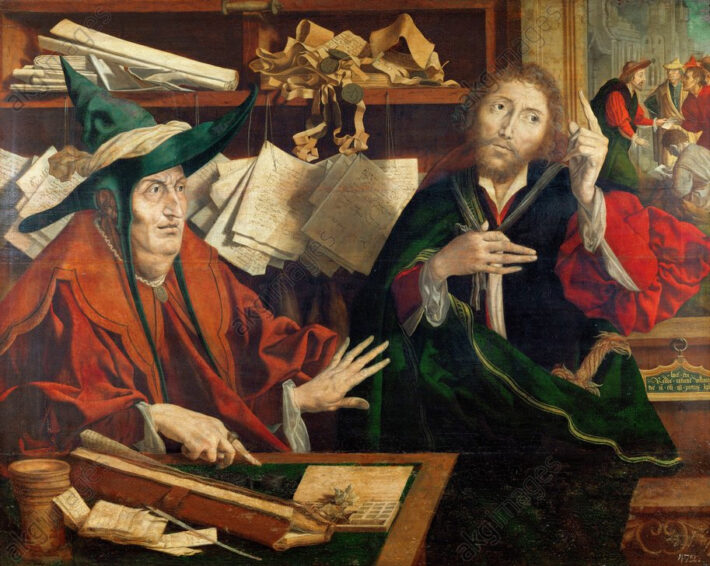
Christian Art | Parables Of Jesus | Parable Of The Unjust Steward | King James Audio Bible KJV
Luke 16: 1-8 | King James Audio Bible KJV | Parables Of Jesus | Week 31 Friday
1 AND he said also unto his disciples, There was a certain rich man, which had a steward; and the same was accused unto him that he had wasted his goods.
2 And he called him, and said unto him, How is it that I hear this of thee? give an account of thy stewardship; for thou mayest be no longer steward.
3 Then the steward said within himself, What shall I do? for my lord taketh away from me the stewardship: I cannot dig; to beg I am ashamed.
4 I am resolved what to do, that, when I am put out of the stewardship, they may receive me into their houses.
5 So he called every one of his lord’s debtors unto him, and said unto the first, How much owest thou unto my lord?
6 And he said, An hundred measures of oil. And he said unto him, Take thy bill, and sit down quickly, and write fifty.
7 Then said he to another, And how much owest thou? And he said, An hundred measures of wheat. And he said unto him, Take thy bill, and write fourscore.
8 And the lord commended the unjust steward, because he had done wisely: for the children of this world are in their generation wiser than the children of light.
Today’s parable may seem to us to be very strange. Fired for corruption, for being wasteful with the rich man’s property, the dishonest steward goes on to compound the error with outright criminality, marking down the debts of the rich man’s debtors in order to secure future favours. And Jesus praises him!
The picture Jesus presents us with is of a very shrewd, very worldly person. Caught out in his dodgy dealing, the steward finds himself in a desperate situation, an emergency. The future has suddenly become completely uncertain, a complete unknown, to him. He races in his mind to discover a solution to his problem, and he is shrewd and a solution presents itself. Having decided what to do, he acts with great energy.
The parable now speaks of the ‘lord’, or ‘master’, praising the dishonest steward. The rich man has receded and we understand now that it is Jesus offering praise. If only, he seems to say, people put as much energy and ingenuity as this thief has shown into their spiritual lives. The children of this world know how to work it to their material advantage. The children of light should similarly make every effort in terms of our faith, our salvation, our witnessing Jesus and growing the Kingdom of God. Perhaps we might think here of the great sense of urgency experienced by Saint Paul, and the phenomenal energy and drive with which he spread God’s word. Such wonderful missionary activities inspire us.
‘What zeal people put into their earthly affairs: dreaming of honours, striving for riches, bent on sensuality! Men and women, rich and poor, old and middle-aged and young and even children: all of them alike. When you and I put the same zeal into the affairs of our souls, we will have a living and working faith. And there will be no obstacle that we cannot overcome in our apostolic works.’ St Josemaria Escriva.
Concluding Prayer | Love Revealed By Jesus Christ
Almighty Father,
let your light so penetrate our minds,
that walking by your commandments
we may always follow you, our leader and guide.
We make our prayer through our Lord.


King James Audio Bible | Endnotes
The Parable of the Unjust Steward challenges conventional wisdom and provides insight into the nature of God’s kingdom.
In the parable, Jesus tells the story of a wealthy man who had a steward who was mismanaging his affairs. The wealthy man calls the steward to account, but instead of waiting to be fired, the steward uses his position to secure his future by reducing the debts owed to his master by the master’s creditors. The master commends the unjust steward for his cunning.
The parable has for many defied interpretation.
Can it be that Jesus teaches that those who are wise in this world, even if they are unjust, will be more successful than those who are righteous but lack wisdom?
In terms of its place in the larger narrative of Jesus’ ministry, the Parable of the Unjust Steward should be considered alongside other teachings of the Gospels, such as the Sermon on the Mount, the prayer of Jesus in the Garden of Gethsemane, the Crucifixion of Jesus, and the Parable of the Prodigal Son.
It is true of course that we are called to deeper understanding of the nature of God, the role of Jesus as the Christ, and the importance of forgiveness and redemption.
One interpretation that might be considered more daring and challenging is the idea that the parable is a critique of the economic system of Jesus’ day. In this interpretation, the steward’s actions are seen not as wise, but as a subversion of the unjust economic system in which he operated.
The wealthy man in the story is seen as representing the oppressive system of wealth and power that dominated the society of Jesus’ time, while the steward is seen as a subversive figure who seeks to subvert the system by reducing the debts owed to his master. In this interpretation, Jesus is not praising the steward for his wisdom, but rather is using the steward as a symbol of resistance against the unjust economic system.
This interpretation of the Parable of the Unjust Steward can be seen as a call to action for Christians to challenge and subvert unjust economic systems, using their resources and gifts to bring about justice and fairness in the world. It is also a reminder of the importance of Christian prayer and the power of the Christian Cross, as tools for seeking justice and resistance against oppression.
In the larger context of Jesus’ ministry, this interpretation of the Parable of the Unjust Steward can be seen as a radical and challenging message for Christians to stand up against unjust systems and to use their resources to bring about change. It is a reminder that Christianity is not just about personal salvation, but also about working to bring about justice and fairness in the world.


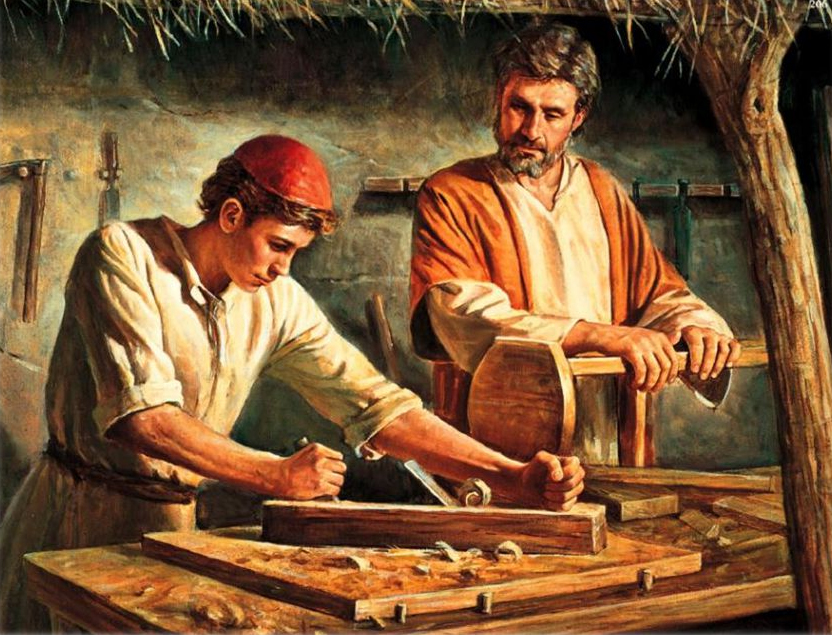
On Tuesday, His Grace turns to the theme of Jesus’ hidden years. His Grace asks the students to consider questions concerning what really happened: ‘Who, for instance, was Joseph? Was he indeed a carpenter, or has Joseph’s true role in the society in which he lived been misconstrued and forgotten to us? Though it be a beautiful, simplifying image to grasp, which offers to us much that is of value in Catholic faith… ‘A wise elder, which carpenter could mean, or a great engineer, an architekton, which in the Greek does not mean carpenter. But carpenter in the Hebrew could mean a wise man…’ His Grace turns the pages of his Bible back and forth, as if to itemize the paucity of information. Then he says: ‘What I think I can say to you with confidence is that it is of profound significance that we simply don’t know what Jesus was doing for most of his earthly life. There are some very different possibilities. One idea cherished by the Church is that Jesus worked with his father Joseph as a carpenter. Another possibility is that Jesus lived and prayed and studied closely with John the Baptist. They were cousins, and very close, almost the same, in age. Luke’s Gospel tells us clearly that Jesus and John knew each other from within the womb before they were born. So there may have been something quite important happening there. You see, we don’t know – it is an impossible mystery to us – just how much Jesus had to learn. This is because, if Jesus knew everything, humanly speaking, even as a tiny baby, then how can we say he is fully human? We simply can’t probe too far into this mystery, but we can draw extraordinary truth and healing from this thought, which becomes of immense relevance in our own lives. Jesus came to know and to understand himself not merely as a son of God, but as God the Son, and so as self-identical with his Father. It is not an adoptive relationship. Jesus is God. Now so much is hidden here. But this is a great gift. If you think about it, how do we come to know that we are loved by God, that we have our relationship with God? What are we born with in here’ – his chest – ‘and what do we have to learn? This is to say, what is gifted to us by other Christians at our baptism? ‘Jesus must have studied, and experienced profound revelation about who and what he truly was, and, so it seems to be, these studies cannot have been confined to the Semitic world. But this is the important point: there is a hiddenness about all of this. No matter which schools and which sects our Lord might have encountered all these years, this to us is as a desert space. What this means is that we can enter into the hidden life of Jesus, and there we can discover our own being with God, our own sonship. Our own particular being loved by God can come to us, if we can enter within this great unknown – into this desert space, where we are loved by Jesus. I firmly believe that there may be a great Lenten mystery in this period of our Lord’s life.’ A Bishop’s Lenten Homily | Extracted From The Gospel According To Tomàs | Faith And Hope And Love And Sexuality | Part 1 A Bishop’s Lenten Homily | Extracted From The Gospel According To Tomàs | Faith And Hope And Love And Sexuality | Part 2 A Bishop’s Lenten Homily | Extracted From The Gospel According To Tomàs | Faith And Hope And Love And Sexuality | Part 3 A Bishop’s Lenten Homily | Extracted From The Gospel According To Tomàs | Faith And Hope And Love And Sexuality | Part 4 | King James Audio Bible | KJV A Bishop’s Lenten Homily | Extracted From The Gospel According To Tomàs | Faith And Hope And Love And Sexuality | Part 5 A Bishop’s Lenten Homily | Holy Week | Extracted From The Gospel According To Tomàs | Faith And Hope And Love And Sexuality | Part 6

We have known the Father through the Son. Indeed, Jesus now tells the disciples that they have actually seen God the Father. This is the vision of faith, and of our knowledge, as Jesus tells us that he is in the Father and the Father in him. The unknowable, in this life to our natural senses, has become a knowable truth of faith [ … ]

Saint Augustine begins by asserting that our lives on earth should center on the praise of God because this is what we shall do eternally in heaven. His well-known anthropology, articulated in the Confessions (Book I), declares, ‘You have made us for yourself, O Lord, and our hearts are restless until they rest in you.’ In this restlessness, Augustine sees a divine gift: a yearning that trains us for heaven. The joy of praising God is not merely a future reward but a present discipline that forms the soul in divine love [ … ]