
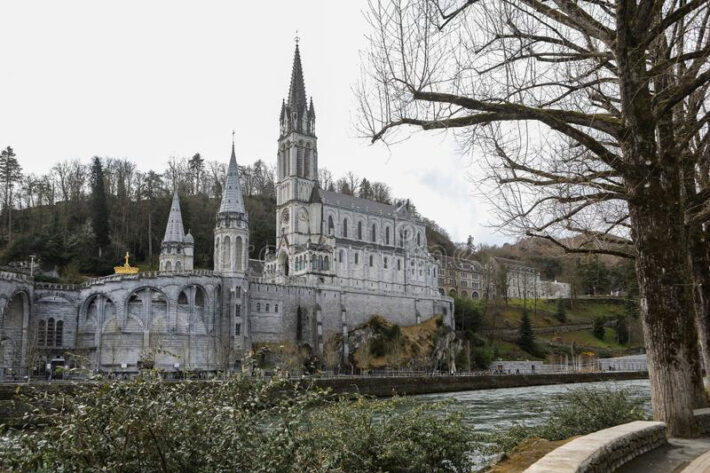
We were at Lourdes before we crossed the Pyrenees. This lies back in the days when I wanted a clean faith, a vertical faith, where I could just be me, and nothing to do with home. Later, I have come to know, and quite to like, that modern Catholicism’s splashed all over the blessed place, a more womany religion, and perhaps that is its secret heart. Fundamentally vulgar, squalid, domestic, this, necessarily, was an attempt to share. All manner of things. All manner of stuff and business. Normally, the rule is, Mum and I talk through the dog: Samson’s very happy to see you. Samson was missing you. Oh look, Samson’s giving you his paw. That’s how we share most directly. That’s how we confer such mutual feeling and human emotion. I had wanted to share a lot, but we never did – not directly. Now this delicate matter of Catholic faith… Well, here at least was a respectable institution, a solid thing you could put a name to… A brand you could trust. Which she might ‘get’ thereby. In order to share – possibly. (‘This is my son…’) We were close once, when there was no need to say anything.
She always was a bit make-believe. She used to dilute Dad’s brandy – so did I – hidden behind Dad’s books – a male equivalent of the sort of thing she read. (He gave me his PIN when he wanted more so I’m not saying I didn’t do that.) All part of a package. Like prawns and fillet steak and the fucking Range Rover. Back in the days before the music of the eighties became sentimental, and Mum found Ron.
It is hard not to think Mum didn’t like adulthood. Or not mine – not greater adulthood yet to be uncovered – not an implicit rejection in the will to explore. As for my blundering impressions – haphazard impressions – one’s bumping one’s head against adulthood… Delinquent years – which ran contrary to monetary stability and, apropos manliness, natural modes.
Perhaps it was that life floated now. Life pottered – and that was an end to it. Buoyant – light as salt-froth. She seemed an electron-field about a rare and more beautiful element. An end, perhaps, of too much impermissible-evidence, and make-believe, smoothing and quickly recovering and covering under. There, there. Just a little spot of the old DV. I watched her once in the unionized hell of an infant class and what with that on the one hand and the rest of it… Life pottered – the hurtness kissed away. It was always the little things, and they more than adequately soothed life’s troubles. We burnt a lot of petrol, and it wasn’t like driving, at this speed, on these roads. We cruised. And we had never before been to Auntie Grace’s new house down in Malaga.
So at Lourdes, there is the long, somatic thump of the processional; they sing toward a state of religious-incontinence. An hypnoidal state. Mum and I carried our lanterns. We played that game – together. It was a thing to be a part of. A crowd event – a mass rally. A new way of walking the old cliffs – son-and-Mum things.
This was more than an echo of an action – those days in that Jurassic landscape – Dorset. It was not simply to repeat that we were doing this. I, Tomàs, ached – and I didn’t know and I don’t know how to read anything deep into Mum. For that restored connection. So at the end of the day it seems best to take her only on her own terms as a woman. In terms of what simply communicates as a woman.
Mum’s van was brand-new. Her ‘motor-home’ – a transit-van conversion. Because she couldn’t drive the old one: it was too wide and in her head she couldn’t encompass it. This was just a van – you could drive it hell-for-leather. It wasn’t very nice inside – plastic-browns, the loo-closet seeming to dominate, and with no real storage space, though it was custom-built. We slept in bad conditions, known as campsites. The van was too high to get into any city car-parks. We had to park up – so we’d be settled – then get the bus to go anywhere, or walk the long walk – always the dog in mind, who was skittish in those days. And a taxi, a cab, in a wrecked country, costs about the same as a room for a night.
I was drinking far too much, mostly beer, so that wasn’t comfortable either. When I had to get up in the middle of the night – get some clobber on – try and do it as quietly as possible for the sake of the game – fall over the dog – find the door – navigate a shanty town to get where the bogs were. The motor-home loo was all wrong. A thing of leaky women and personal space declined. And socially-marked words like ‘toilet’. And good taste, and refined sensitivities. And adolescent needs and adolescent behaviours. I wasn’t generally mucking in with the spirit of things.
I should have taken the tent. My midlife-crisis grunge-pod. And let my hair down and my jeans rot… My happy-traveller! But why? (Why the rage? Why so obstreperous? Why such difficultly…? Why refuse the love?) It required my, Tomàs’s, absolute certain destruction while Mum was Sellotape.
Only quite recently, and for life’s second half, did I come to know Jesus. I was on my own, living in London, in a house. Newly unemployed – England had crashed – so there weren’t any moral brakes. I had the thought and stepped into it, hand half over my eyes.
This was not a complete innovation. For me, the possibility of faith stretches back and back again unto the cusp of childhood and into my teenage years. But I forced the point, became external, and – all despite churning insides, as a kind of deeper gut-morality – I seemed to be getting away with it.
It was nice at Lourdes. I’d been here once before, with the Archdiocese, helping out with the sick people, whom they call malades. Dressing them, putting them to bed, mopping up, helping them scream when they should have used a hoist, and wheelchair duties. All replete with middle-class men in white and a troupe of posh boys – these in their teenage years already in the order of – I forget the name. Posh boys in contrast to the state-maintained teenagers also there.
That was the height of summer, though when the weather broke there were hailstones like nothing I’d seen. The sky broke and hammered them. The sun had been dazzling only a moment before. And everyone raced, first battered, now miserably drenched, to cover-up the sick people and race them, having borne no umbrellas, to places of safety. They all scuttled in different directions, like a terrorist-attack, though here was a line of cafés with their awnings out over the road’s edge. I can only remember the teenagers scurrying with their wheelchairs while they didn’t know what to do and had no compass desperately. Lank and imperfectly accomplished hair dragged. And I can only see the horror on their faces. They were driving them around like cattle – themselves in teenage pain and shielding their faces. In their wheelchairs, they could only endure.
I and my malade John watched the scene from the cover of a street-side café. John’s was a lime and lemonade, because, and for myself a cold beer. And here’s a thing: Trevor was there. It is odd to see him as he was then. Though there is still an unknown mess of outer-London (zone 5 – north-west) all balled up inside… He – Trev could hardly speak. Even undercover, the hailstones ricocheted, and we grew cold and damp.
I wasn’t nervous taking Mum there. My heart burst vividly. (I wanted to show.) We’d stopped at a half dozen places on the way down France, and it was really far too early in the year to be doing that. Most sites weren’t really open. It was muddy. It was better at Lourdes – with the drainage at the site we found.
I desired to show her. She’d like the cheery make-believe. (It passes through the mother’s line: otherwise wouldn’t be heritable.) The gypsy-gothic might be right up her street. So this me is you… I suspect there might also have been a measure of: keep my boy safe.
I, then, remembered the mornings on top of the hospital, when John liked to be wheeled up to it, in the lift, to watch the sunrise, and he was happy there, no longer able to smoke, as the light rose so quietly into the air through the Pyrenees. And Mary in the queue for the cold baths, when she was still a ‘she’ through some human construction. I did that as well, though it seemed off-message to lower your pants, get naked, with these three uniformed – aproned attendants, in the compartment, who dipped you in and hoiked you out. Cold shock therapy. It was a long rusty hut where we all queued waiting for processing – praying. The attendants wrap a cloth about you, then you’re meant to say a prayer to a little statue – it was probably supposed to be Mary. They catch you in their arms for the assisted half-plunge. I knew – like magic – Mum would get this sort of thing – not actually in the bath-block. Charming, like the candles, it could decorate her narrative. Look, you see, it was as if her son said might have said to her; it’s not so bad.
The site we parked-up in was just up a road into the hills past the sanctuary – on the other side. This turned out to be a good find. The sanctuary was but a brisk stroll below, though there were doubts as to whether the back gate would be open or closed at night. But then, and this was the thing, mere footsteps above, and I consulted the map, pre- either of us owning smart-phones, to insist on its discovery, lay the forest. Well, we had Samson, the new woof, who was about eighteen months by this stage, and about the most nervy Labrador, who had to be kept in a harness rather than on a lead, and we crept up the side of the road, which wound, and sure enough. Here, then, were the dog walks. This, then, the other main offering for two days. Here a place of happiness! Perfect scenes are dog walks.
You could have camped in that forest forever and never been found. Hidden away and had adventures. Judging by the map on the board, at the entrance to the forest from the road, we only walked a tiny, truncated bit of it, a whale’s tale in a long infinity-loop, which in itself was a long walk and took an hour. Mum walked steadily though having got to an age where she sort of yomped. (Her only son not happy at all with these shifting powers and hip-replacement possibilities.) It ran for miles – anyway. The dog kept close, always an eye on you.
We wore traveller clothes. It seemed a monumental elevation, as the river churned seemingly so very far beneath, while forest hush was better than silence. The mountains stacked above felt powerful. Once, a car drove by – a little old tinny thing. Mum was pretty much always yelling after the new dog, and I feared for the health implications, in case she gave herself a stroke doing this. It seemed more trouble storing up – it seemed, after Ron, death was everywhere. Granny had knocked herself off her legs, with a stroke, shouting after a dog, pretty much by Mum’s age. Samson ignored her, anyway, and wasn’t running off. There was no need to bother about him. But, I thought, you can’t tell them anything, once they get stuck in a certain behaviour. You can’t break the loop – . Stubborn they are – old. A mind clenched.
The rosary procession begins on the cusp of evening. Mum and I bought candles in their spell-bound lantern hoods – scrolled prayers. It’s an extraordinary thing to witness. The emotional impact is intense. There is the great lit façade of the gipsy-gothic church and its outreached tendrils, lobster-like, and the runway around which the pilgrims walk, or they are wheeled in carts – rickshaws – which are called voitures. Mum and I raised the glowing lanterns at the Ave, Ave, Ave Maria… The weirdly forgettable mantra of the verses’ bass refrain held the beat of an old rave: Immaculate Mary! Our hearts are on fire. That title so wondrous / Fills all our desire… Digging – depth and undertow. Hero-Mary! Courage! Reminiscent of dance, and bodies, in the solar-plexus. Nagging-bass. Compulsive-undertow.
Toward the end, the float goes through the crowd, with the statue of Mary on. Then you kind of look away – distracted by your own emotion, absorbed by the crowd – and the statue re-appears, elevated on the upper level, as an illuminated body. That’s like a rave, like one of many revelations, when you’ve danced the drugs up and the horns blow. For seconds you feel you’ve made her – the magic, the illuminated body – as that light blows inside. Your way of thinking has compacted with ritual in progress. Especially with the surprise, almost there is nothing outside this act.
What follows is strange. That odd, quiet dispersal, when everyone’s had his fill – it worked. A difference is, this experience has been all focused on one thought, fixated on the statue. It is positivistic. You’re in company but not in an eye-to-eye sense pulling each other up, creating anew a fresh-made moment, from the body-up, whereby the hierarchy only can be said to have constituted technical support.
With Mum, it was pleasant to walk through these satisfied people, and glazed-looks catching faces as they self-congratulated, self-admired, having for a slow and ascending hour climbed the ladder, and then as the party dispersed away from everyone.
Mum and I walked back along the river, away from the town and toward the back gate. The sound of the water had bubbles and pockets in it. We didn’t speak. We were even honestly contemplative. It was like a friend playing his fingertips over your face. It sort-of in a way refilled the people we sort-of were. The grass was drenched wet and musky-sweet. It smelled green and woodland smells washed over us. Pine-scent, and the river-contained, and soil, penned-animals waiting the time to be unconstrained, mountain spring.
I went to confession the next day, in the enclosure, to a priest who might have been a Redemptorist, to apologize to God for the way I was treating her.
We stayed that one day extra, then we crossed the Alps.




Saint Gregory of Nyssa, a 4th-century Cappadocian Father and key architect of early Christian theology, offers in this Eastertide reading a profound and poetic meditation on the transformative power of the Resurrection. Rooted in the joy of Easter, the sermon explores the cosmic and personal implications of Christ’s rising from the dead. Gregory’s theology is deeply mystical, sacramental, and steeped in scriptural imagery, and this piece reveals the vast scope of the Christian vision of renewal [ … ]

This reading from the Pastoral Constitution on the Church in the Modern World reflects on human activity, especially work and social engagement, and places it within a clear theological framework. The Council seeks to affirm the value of human action while clarifying its proper orientation and limits [ … ]
Psalm 39 is a contemplative reflection on the fleeting nature of human existence. Attributed to King David, this psalm delves into themes of silence, self-control, and brevity of life in face of God’s eternal nature [ … ]
