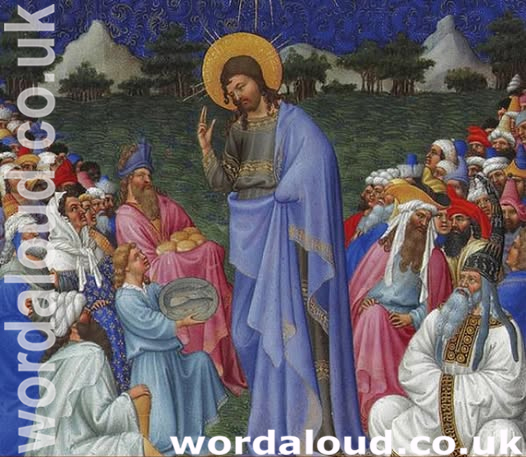
Christian Art | Life Of Jesus | Bread Of Heaven | Jesus Feeds The Multitude
Office Of Readings | Week 21, Monday, Ordinary Time | A Reading From Commentary Of Saint Thomas Aquinas On Saint John’s Gospel | The Remnant Of Israel Shall Be Fed
‘The remnant of Israel shall be led to pasture.’
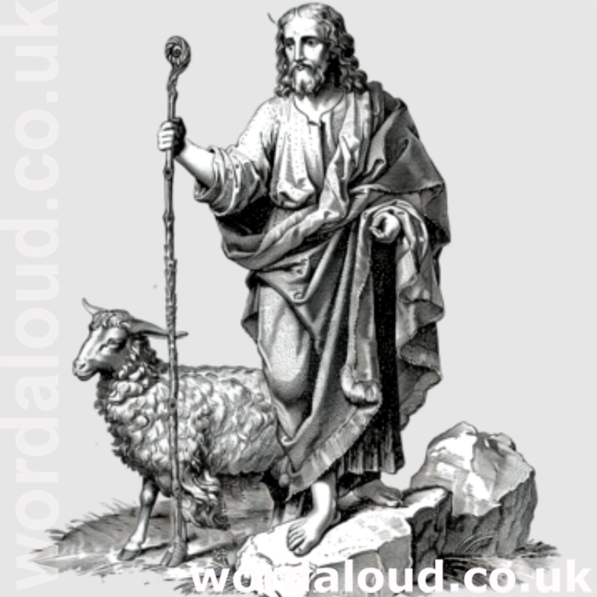
Saint Thomas Aquinas meditates on Christ’s self-revelation as the Good Shepherd (John 10:11). This image, deeply rooted in Scripture, conveys both pastoral care and sacrificial love. It recalls the Old Testament tradition of God as shepherd of Israel (e.g. Ps 23:1; Ez 34:11–16) and the prophetic promise that God would raise up faithful shepherds after His own heart (Jer 3:15).
The commentary unfolds in several steps. First, Aquinas highlights Christ as the one who both leads and feeds his flock. He is not only a teacher but the source of nourishment, giving himself in the Eucharist as ‘spiritual food’ and ‘his own body and blood.’ In this way, the image of shepherding is elevated beyond ordinary pastoral care into a sacramental reality: Jesus Christ sustains his people with himself.
Secondly, Christ is identified as both the shepherd and the gate. Aquinas explains that Christ ‘enters through himself’ because he reveals the Father through his own being; he alone is the mediator by which humanity finds true happiness. No other figure—prophet, apostle, or saint—can claim this title absolutely. They bear witness to the light, but Christ is the light itself (John 1:9).
Yet Christ shares his pastoral office with others: Peter, the apostles, and all bishops are appointed as shepherds within the Church. Their ministry, however, is only authentic if it participates in Christ’s own charity. Aquinas stresses that charity is the distinguishing mark of the true shepherd. Without charity, pastoral authority is insufficient; only love for the flock makes shepherding Christ-like.
A third theme concerns the self-sacrifice of the shepherd. Christ contrasts the good shepherd with the hireling: one cares for the flock’s good, the other only for himself. Aquinas interprets Christ’s words not as a command that all bishops literally die for their flock, but as a principle: when the salvation of souls is at risk, the shepherd must be willing to risk even his life. Spiritual good outweighs bodily life, and authentic pastoral ministry requires this readiness to sacrifice.
Finally, Aquinas links this to the Christian vocation more broadly: Christ’s laying down of his life becomes the pattern for all disciples. The flock itself is called to learn from the shepherd, so that mutual love and sacrificial service mark the whole body of Christ.
This reading draws together Christ’s unique role as shepherd, the participation of the Church’s ministers in his care, and the universal call to charity and self-giving.

A Reading From Commentary Of Saint Thomas Aquinas On Saint John’s Gospel | The Remnant Of Israel Shall Be Fed
I am the Good Shepherd. Surely it is fitting that Christ should be a shepherd: for just as a flock is guided and fed by a shepherd, so the faithful are fed by Christ with spiritual food and with his own body and blood. The Apostle said: You were once like sheep without a shepherd, but now you have returned to the guardian and ruler of your souls. The Prophet has said: As a shepherd he pastures his flock.
Christ said that the shepherd enters through the gate and that he is himself the gate as well as the shepherd. Then it is necessary that he enter through himself. By so doing, he reveals himself, and through himself he knows the Father. But we enter through him because through him we find happiness.
Take heed: no one else is the gate but Christ. Others reflect his light, but no one else is the true light. John the Baptist was not the light, but he bore witness to the light. It is said of Christ, however: he was the true light that enlightens every man. For this reason no one says that he is the gate; this title is Christ’s own. However, he has made others shepherds and given that office to his members; for Peter was a shepherd, and so were the other apostles and all good bishops after them. Scripture says: I shall give you shepherds according to my own heart. Although the bishops of the Church, who are her sons, are all shepherds, nevertheless Christ refers only to one person in saying: I am the Good Shepherd, because he wants to emphasise the virtue of charity. Thus, no one can be a good shepherd unless he is one with Christ in charity. Through this we become members of the true shepherd.
The duty of a good shepherd is charity; therefore Christ said: The good shepherd gives his life for his sheep. Know the difference between a good and a bad shepherd: the good shepherd cares for the welfare of his flock, but the bad shepherd cares only for his own welfare.
The Good Shepherd does not demand that shepherds lay down their lives for a real flock of sheep. But every spiritual shepherd must endure the loss of his bodily life for the salvation of the flock, since the spiritual good of the flock is more important than the bodily life of the shepherd, when danger threatens the salvation of the flock. This is why the Lord says: The good shepherd lays down his life, that is, his physical life, for his sheep – this he does because of his authority and love. Both, in fact, are required: that they should be ruled by him, and that he should love them. The first without the second is not enough.
Christ stands out for us as the example of this teaching: If Christ laid down his life for us, so we also ought to lay down our lives for our brothers.
Christian Prayer With Jesus Christ
Lord Jesus Christ,
you are the Good Shepherd,
who leads us to life and feeds us with your own body and blood.
Grant that your Church may be guided in charity,
and that all pastors may be faithful to your example of self-giving love.
Teach us also to lay down our lives in service of one another,
so that in following you we may find the gate of eternal joy.
Amen.
Glossary Of Christian Terms
Good Shepherd: Title of Christ from John 10:11, signifying his role as leader, protector, and sacrificial redeemer of his people.
Gate: In John 10:7, Christ describes himself as the gate for the sheep, meaning the unique access point to salvation and communion with God.
Charity: In Christian theology, the highest form of love, the love of God and of neighbour in God. For Aquinas, charity is the defining mark of true shepherding.
Hireling: Term from John 10:12 describing a false shepherd who serves only for personal gain and abandons the flock in danger.
Eucharist: The sacrament in which Christ gives his body and blood as food for the faithful, fulfilling the shepherd’s role of feeding the flock.
Pastoral office: The ministry of guiding, teaching, and caring for the faithful, exercised by bishops and priests as a participation in Christ’s own shepherding.


Psalm 43 is a cry for divine intervention, justice, and guidance. This psalm is often considered an extension of Psalm 42, sharing similar themes and emotions. Together, they reflect the deep spiritual struggles and longing of the psalmist [ … ]

Tomàs is in trouble. If truth is love and love is truth, then the Church is wrong. A time in seminary…
Saint Augustine addresses the duty of pastors to speak the truth even when that truth provokes resistance, and he warns the flock to distinguish between authoritative teaching and faulty example. He draws on Ezekiel’s imagery of negligent shepherds and on the watchman motif (Ezekiel 3:17–21): a pastor who fails to warn sinners bears responsibility for their ruin; a pastor who speaks the prophetic word but the people ignore it has done his duty [ … ]