Christian Art | Easter To Pentecost
Office Of Readings | Eastertide Week 6, Friday After The Ascension | A Reading From The Sermons Of Pope Saint Leo The Great | The Lord’s Ascension Increases Our Faith
‘The Lord’s ascension increases our faith.’
The Solemnity of the Ascension celebrates not only the glory of Christ returning to the Father, but also the exaltation of human nature in him. In his sermon, Saint Leo the Great, Pope and Doctor of the Church, offers a profound vision: Christ’s bodily ascension does not mean absence, but a deeper, more universal presence—one that strengthens faith, renews hope, and stirs charity.
The Ascension As Culmination Of The Paschal Mystery
Leo opens by linking the joy of Easter with the joy of the Ascension. Where Easter proclaims the triumph over death, Ascension reveals the glorification of humanity. In Jesus Christ, our ‘poor human nature’ is carried beyond the angels into the presence of the Father. This theological affirmation echoes Ephesians 1:20–23 and Hebrews 4:14, which portray Christ as the High Priest who enters the heavenly sanctuary on our behalf.
Leo situates the Ascension within the order of divine acts: Incarnation, Passion, Resurrection, and Ascension. Each step is necessary for our salvation. By ascending with the human body he assumed, Jesus elevates human nature and prepares a place for us (cf. John 14:2).
‘It is upon this ordered structure of divine acts that we have been firmly established.’ — Leo the Great
From Sight To Sacrament | A Shift In Presence
One of Leo’s most powerful assertions is that Christ’s visible presence has passed into the sacraments. This points to a sacramental theology in which the faithful are no longer to seek Christ in bodily form but encounter him in faith through the Eucharist, the Scriptures, the Church, and the poor. This anticipates medieval and modern Eucharistic theology—particularly Aquinas’ understanding of the Real Presence—and resonates with Vatican II’s Sacrosanctum Concilium, which teaches that Christ is present in the liturgy in multiple modes, including the priest, the Word, and the sacrament.
This ‘passing into the sacraments’ does not diminish Christ’s presence but multiplies and universalizes it. Christ is no longer bound to one time and place but becomes spiritually present to all people through the Church.
‘Such fidelity could never be born in our hearts… if our salvation lay only in what was visible.’ — Leo the Great
Strengthening Faith, Hope And Charity
Leo’s focus then shifts to the fruits of this new mode of presence. By leaving sight behind, Jesus Christ calls the Church into a more mature faith—one that trusts in the unseen. Jesus’ ascension strengthens the theological virtues:
- Faith—no longer dependent on physical sight but enlightened from above;
- Hope—in the promise that where the Head has gone, the Body will follow (cf. Colossians 3:1-4);
- Charity—which is not diminished by Christ’s absence but kindled through his Spirit.
Leo remarks that this faith would sustain Christians through every form of suffering and persecution, including ‘fetters, exile, hunger, fire, beasts’. His reference to martyrs—men and women, boys and girls—reminds us that faith in the ascended Christ was not abstract, but a lived and costly commitment, as seen in the early Church.
This is not escapism; it is eschatological realism—a faith rooted in the future that shapes our present.
From Weakness To Witness | The Transformation Of The Apostles
Leo offers a brilliant pastoral insight: the apostles, who fled in fear at Christ’s passion, now rejoice at his departure. Why? Because now they perceive not only the resurrected Jesus but the glorified Christ, seated at the right hand of the Father. No longer hindered by the limitations of human perception, their minds are elevated to spiritual understanding.
Here, Leo anticipates later mystical theology: God is more intimately known not by sensory experience but by spiritual discernment and contemplative union. Christ’s absence becomes the condition for a deeper presence—just as darkness allows us to see the stars.
This echoes Augustine’s insight: ‘You ascended before our eyes, and we turned back grieving, only to find you in our hearts.’
‘They were able to fix their minds on Christ’s divinity… no longer needing contact with his tangible body.’ — Leo the Great
Theological Climax | Christ’s Divinity And Our Destiny
Leo’s final point brings us to the summit of Christian hope: the glorified Christ is now more fully present to us in his divinity than when he was with the apostles in the flesh. This does not diminish the Incarnation, but reveals its purpose: that we might ascend with Christ by grace.
Leo echoes the teaching of Chalcedon (451)—which he influenced directly—that Christ is one Person in two natures, divine and human. The Ascension does not split this unity but perfects it. Christ remains one with the Father and one with us.
And so, in him, our destiny is assured. As Saint Athanasius put it, ‘God became man that man might become god.’
A Reading From The Sermons Of Pope Saint Leo The Great | The Lord’s Ascension Increases Our Faith
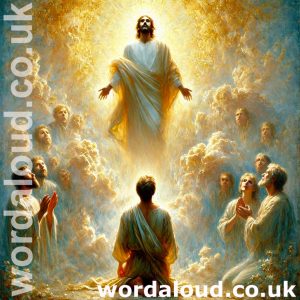
At Easter, beloved brethren, it was the Lord’s resurrection which was the cause of our joy; our present rejoicing is on account of his ascension into heaven. With all due solemnity we are commemorating that day on which our poor human nature was carried up, in Christ, above all the hosts of heaven, above all the ranks of angels, beyond the highest heavenly powers to the very throne of God the Father. It is upon this ordered structure of divine acts that we have been firmly established, so that the grace of God may show itself still more marvellous when, in spite of the withdrawal from men’s sight of everything that is rightly felt to command their reverence, faith does not fail, hope is not shaken, charity does not grow cold.
For such is the power of great minds, such is the light of truly believing souls, that they put unhesitating faith in what is not seen with the bodily eye; they fix their desires on what is beyond sight. Such fidelity could never be born in our hearts, nor could anyone be justified by faith, if our salvation lay only in what was visible.
And so our Redeemer’s visible presence has passed into the sacraments. Our faith is nobler and stronger because sight has been replaced by a doctrine whose authority is accepted by believing hearts, enlightened from on high. This faith was increased by the Lord’s ascension and strengthened by the gift of the Spirit; it would remain unshaken by fetters and imprisonment, exile and hunger, fire and ravening beasts, and the most refined tortures ever devised by brutal persecutors. Throughout the world women no less than men, tender girls as well as boys, have given their life’s blood in the struggle for this faith. It is a faith that has driven out devils, healed the sick and raised the dead.
Even the blessed apostles, though they had been strengthened by so many miracles and instructed by so much teaching, took fright at the cruel suffering of the Lord’s passion and could not accept his resurrection without hesitation. Yet they made such progress through his ascension that they now found joy in what had terrified them before. They were able to fix their minds on Christ’s divinity as he sat at the right hand of his Father, since what was presented to their bodily eyes no longer hindered them from turning all their attention to the realisation that he had not left his Father when he came down to earth, nor had he abandoned his disciples when he ascended into heaven.
The truth is that the Son of Man was revealed as Son of God in a more perfect and transcendent way once he had entered into his Father’s glory; he now began to be indescribably more present in his divinity to those from whom he was further removed in his humanity. A more mature faith enabled their minds to stretch upward to the Son in his equality with the Father; it no longer needed contact with Christ’s tangible body, in which as man he is inferior to the Father. For while his glorified body retained the same nature, the faith of those who believed in him was now summoned to heights where, as the Father’s equal, the only-begotten Son is reached not by physical handling but by spiritual discernment.
Glossary Of Terms
Ascension – The event in which Jesus was taken up into heaven, body and soul, forty days after his resurrection (Acts 1:9).
Sacraments – Visible signs instituted by Christ to give grace; after the Ascension, they mediate his presence.
Chalcedon – The ecumenical council (451 AD) that defined the two natures of Christ in one divine person.
Theological Virtues – Faith, hope, and charity; infused by God and central to Christian life.
Eschatological – Relating to the end times, final things, and the ultimate destiny of humanity.
Mystical Theology – The theology of divine union, emphasizing interior knowledge of God.
Real Presence – The doctrine that Christ is truly and substantially present in the Eucharist.
Martyrdom – The suffering or death of a witness to Christ; early Christians bore this testimony through faith.

Prayer
Lord Jesus Christ, our risen and ascended King,
you have not abandoned us,
but have gone before us to prepare a place for us.
Lift our eyes to heaven,
that we may seek what is above,
where you are seated in glory with the Father.
Increase in us the faith that believes without seeing,
the hope that endures through every trial,
and the charity that draws others to your heart.
Make us living sacraments of your presence,
bold in witness and joyful in love.
Grant that we, who are your Body on earth,
may one day ascend to where you dwell,
and be one with you forever,
who live and reign with the Father and the Holy Spirit,
God, forever and ever. Amen.




In listening to these Gospel verses, questions present themselves. We might ask both why the children are brought to Jesus to be blessed, and why then the disciples rebuke the people bringing the children. We try to see within this scene [ … ]
In the Garden of Gethsemane, the presence of the angel becomes a symbol of divine comfort and support during Jesus’ moment of utmost agony. As Jesus withdrew a stone’s cast away from his disciples and fell on the ground to pray, sweating blood, the world’s sins and crucifixion-horror pressed heavily upon him [ … ]

Origen reflects on the petition ‘Thy kingdom come’ as a request not for an external spectacle but for an interior reality. He begins with Christ’s teaching that the kingdom does not arrive with visible signs, for it is ‘within us and in our hearts’. With this, Origen redirects attention away from expectation of outward change and towards the inner life in which God’s reign is established through grace. The prayer for the kingdom is therefore a prayer for transformation: that God’s life may take root, grow, and reach its intended fullness within the believer [ … ]