
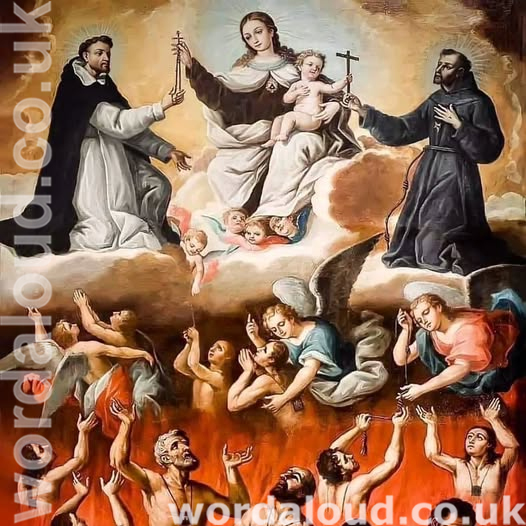
Christian Art | Prayer For All Christian Souls | Purgatory | Christian Faith
Office Of Readings | Week 32, Monday, Ordinary Time | A Reading From A Homily Of A Second-Century Author | Let Us Confess Our Faith In God By Deeds
‘Let us confess our faith in God by deeds.’
This second-century homily continues the moral and theological emphasis of the early Church’s preaching: faith must be embodied in life. The anonymous author moves beyond profession to practice, showing that confession of Christ is meaningful only when it takes visible form in conduct. The text reveals a Christianity that is neither speculative nor merely devotional but practical, ethical, and communal.
The homily opens by celebrating divine mercy as the source of enlightenment. Humanity, once enslaved to ‘dead gods’, now knows the living Father through Christ. The movement is from ignorance to knowledge, from idolatry to truth. Knowledge of the Father is inseparable from confession of the Son, for ‘no one comes to the Father except through him’. Faith is thus relational and obedient: to acknowledge Christ is to enter into the knowledge of God himself.
The preacher draws upon Christ’s own words — ‘Everyone who acknowledges me, I will acknowledge before my Father’ — to stress the reciprocity between confession and salvation. Yet he insists that confession is not a verbal act alone. Lip service without obedience is hollow; genuine acknowledgment is shown in deeds. This moral realism echoes the Gospel warning: ‘Not everyone who says to me, Lord, Lord, will enter the kingdom of heaven.’ Faith, in this homily, is therefore active fidelity — an alignment of heart, speech, and behaviour.
A catalogue of virtues follows, grounded in mutual love: chastity, mercy, kindness, compassion, and generosity. The rejection of envy, covetousness, and slander is presented not as moralism but as the necessary expression of belief in a God who is love. The preacher’s tone is communal; the Christian life is shared effort, marked by care for one another. Faith manifests itself in social harmony and moral integrity.
The image of athletic competition shapes the closing section. The Christian life is likened to a race or contest in which perseverance and discipline are required. This reflects both Pauline imagery and the Greco-Roman world’s fascination with the games. To ‘enter the lists’ is to take one’s faith seriously — not as a passive inheritance but as an active striving for the crown that does not fade. Failure to ‘keep the rules’ carries moral and eschatological consequence; fidelity to baptism and endurance in virtue are the marks of true discipleship.
The reading concludes with sober realism. The Christian’s contest demands vigilance and integrity, for divine judgement is the ultimate test. The imagery of fire and the undying worm recalls the moral seriousness of early Christian exhortation — salvation is not presumed but pursued. Yet beneath the stern tone lies a deep sense of mercy: the God who calls believers to strive is the same God who has already enlightened and strengthened them through Christ.
This text captures an early synthesis of theology and ethics: confession of faith is both creed and conduct. To know God through Christ is to live according to that knowledge, and to do so publicly, steadfastly, and with hope of the incorruptible crown.

A Reading From A Homily Of A Second-Century Author | Let Us Confess Our Faith In God By Deeds
Great is the mercy that Jesus Christ has shown us. The first benefit that we owe to his mercy is that we who are living do not sacrifice to dead gods or worship them, but have, through Christ, attained a knowledge of the Father. What else is knowledge of the Father but the recognition of his through whom this knowledge comes to us? He himself declares: Everyone who acknowledges me, I in my turn will acknowledge in the presence of the Father. This then will be our reward if we acknowledge him through whom we have been saved. But how shall we show that we acknowledge him? By doing what he says, by not disobeying his commands, and by honoring him not only with our lips but with our whole heart and our whole mind. For he says in Isaiah: This people pays me lip service, but its heart is far from me.
Let us not only call him Lord, for that will not save us. Not everyone who says to me, Lord, Lord, will be saved, he warns, but only the man who does what is right. So then, brothers, let us show our faith in him by our deeds, by loving one another, by not committing adultery, by not finding fault with one another, or being envious. Instead, let us be chaste, merciful and kind. We should also have compassion for one another, and not be covetous. We have to prove that we believe in him by performing such actions as these and by avoiding whatever is contrary to them, since we fear God rather than men. Should we fail to do so, we have the Lord’s warning: If you do not keep my commandments, even though I had pressed you to my heart, I will thrust you away from me and say to you: Out of my sight, you whose deeds are evil; you are complete strangers to me.
Therefore, my brothers, let us enter the lists in the knowledge that the contest is imminent. Many men travel far to contend for a crown that soon fades, yet not all of them win, but only those who have strained every nerve and completed fairly. Let us so contend that we may all be crowned. Let us run a straight course in the race of the Christian life, setting out in great numbers to take part in it, and then striving for the crown with all our might. Even if we are not all able to win, at least let us draw near to victory.
Now we must surely know that even when the contest is for a wreath that lasts but a day, if anyone is found to be breaking the rules, he is flogged and driven off the racecourse. What do you suppose, then, will be the fate of the man who breaks the rules in the contest of the Christian life? Of those who have not kept the seal of their baptism unbroken Scripture says: The worm does not die and the fire is never extinguished. They will be a spectacle to all men.
Christian Prayer With Jesus
Lord Jesus Christ,
you have called us out of ignorance into the knowledge of the Father.
Grant that our faith may not be in words only,
but in deeds of love, mercy, and endurance.
Strengthen us for the contest of life,
that we may run the race set before us
and bear your likeness in our conduct and in our hearts.
Keep pure within us the seal of baptism,
and when our striving is done,
receive us among those who have persevered in faith.
To you, who live and reign with the Father and the Holy Spirit,
one God, forever and ever.
Amen.
Glossary Of Christian Terms
Acknowledgment – The open confession or profession of faith in Christ, implying both verbal and moral assent.
Ascent (of the soul) – The turning of the human mind and will toward divine truth; intellectual and spiritual movement toward God.
Baptismal seal – A traditional image for the indelible spiritual mark conferred by baptism, signifying belonging to Christ.
Chastity – Moral integrity in the use of one’s body; self-control in accord with faith and charity.
Contest (ἀγών) – An image drawn from ancient athletics, symbolising the moral struggle and perseverance required of Christians.
Confession – Public or personal acknowledgment of Christ, especially through faith expressed in action.
Covetousness – Excessive desire for possessions or status; contrasted with generosity and contentment.
Faith (πίστις) – Trust in God revealed in Christ, which necessarily expresses itself in obedience and moral action.
Idolatry – Worship of created things in place of the Creator; used here as a symbol of ignorance and false security.
Lip service – Outward expression of devotion without inward conviction or consistent practice.
Mercy – Divine compassion that restores humanity from ignorance and sin; also a moral virtue exercised toward others.
Race (of faith) – The moral and spiritual journey of the believer toward salvation; drawn from Pauline metaphor.
Seal – A mark of ownership or authenticity; in early Christianity, a symbol of baptismal identity and perseverance.
Virtue – A stable disposition to act rightly; the habitual form of faith made visible in life.



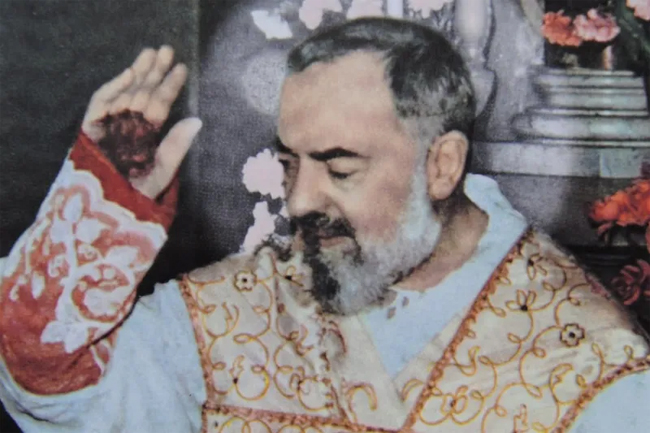
Padre Pio, also known as Saint Pio of Pietrelcina, was an Italian Capuchin friar who lived from 1887 to 1968. He is renowned for his piety, his stigmata, and his gift of healing, and has become a beloved figure in the Christian world. Born into a devout Catholic family in Pietrelcina, Italy, Padre Pio felt a calling to the priesthood from a young age. He entered the Capuchin order in 1903 and was ordained a priest in 1910. He spent much of his life as a humble friar, dedicated to prayer, the sacraments, and the service of others. Padre Pio’s most famous spiritual gift was the stigmata, the visible wounds of Christ that he bore on his hands, feet, and side. He experienced this phenomenon for over 50 years, from 1918 until his death in 1968. While some were skeptical of his wounds, many believed them to be a sign of his profound union with Christ and his participation in the suffering of the crucified Christ. In addition to his stigmata, Padre Pio was also known for his gift of healing. Many people came to him seeking physical, emotional, and spiritual healing, and he prayed over them, sometimes prescribing special devotions or treatments. While some were healed miraculously, others did not experience a physical cure, but nonetheless found comfort and peace through his intercession. Padre Pio’s life was marked by his devotion to God and his love for others. He spent long hours in prayer, often in the presence of the Blessed Sacrament, and had a deep appreciation for the power of the Eucharist. He also had a special love for the Virgin Mary, whom he called his ‘Heavenly Mother’, and encouraged others to pray the Rosary. Today, Padre Pio is venerated as a saint by the Catholic Church, and his influence has spread far beyond Italy. He is remembered for his holiness, his humility, and his profound union with Christ, as well as for his compassion and concern for the sick and suffering. Christians of all denominations continue to look to him as a model of faith and devotion to God. Prayer To Saint Padre Pio | A Prayer For Healing Saint Padre Pio is renowned for his gift of healing, which he used to help countless people throughout his life. He believed in the power of prayer and the importance of placing our trust in God, even in the face of illness and suffering. In James 5:16, we are reminded that ‘the prayer of a righteous person is powerful and effective’. Padre Pio’s life was a testament to the truth of this verse, as he interceded for those who came to him seeking physical, emotional, and spiritual healing. One of the most striking examples of Padre Pio’s healing ministry was the case of Gemma Di Giorgi, a young girl who had been diagnosed with a life-threatening illness. Her parents brought her to Padre Pio, who prayed over her and blessed her with the sign of the cross. To the amazement of her doctors, Gemma’s condition began to improve, and she was eventually healed completely. In addition to physical healing, Padre Pio also believed in the importance of emotional and spiritual healing. He often spoke of the need for repentance and conversion, and encouraged his followers to turn to God with contrite hearts. In Luke 5:31-32, Jesus tells the Pharisees, ‘It is not the healthy who need a doctor, but the sick. I have not come to call the righteous, but sinners to repentance.’ Padre Pio understood that true healing involves not only the body, but also the soul. For those who are in need of healing, whether physical, emotional, or spiritual, Saint Padre Pio can serve as a powerful intercessor. He believed in the importance of prayer and the power of God’s grace to heal even the most difficult of cases. Through his intercession, we can ask God for the strength and courage to face our illnesses and our struggles, knowing that we are never alone and that God’s healing love is always with us. So let us pray: ‘Saint Padre Pio, you who had a deep faith in God and a profound love for your fellow human beings, we turn to you in our time of need. We ask for your intercession on behalf of all those who are sick and suffering, that they may be healed in body, mind, and spirit. We ask that you pray for us, that we may have the strength and courage to face our illnesses and our struggles with faith and hope, knowing that God is with us always. We trust in God’s love and mercy, and in the power of prayer to bring healing and wholeness to all who seek it. Saint Padre Pio, pray for us, and lead us to the healing grace of God. Amen.’ Prayer To Saint Padre Pio | A Prayer For Peace Saint Padre Pio was a man of peace, who lived his life in the service of God and his fellow human beings. He believed that peace was not merely the absence of conflict, but a state of inner harmony that could only be achieved through a deep and abiding relationship with God. In John 14:27, Jesus tells his disciples, ‘Peace I leave with you; my peace I give you. I do not give to you as the world gives. Do not let your hearts be troubled and do not be afraid.’ Padre Pio understood the importance of this peace, and dedicated his life to helping others find it. One of the ways that Padre Pio fostered peace was through his ministry of reconciliation. He encouraged those who came to him to confess their sins and seek God’s forgiveness, knowing that this was the first step towards inner peace. In Matthew 5:9, Jesus says, ‘Blessed are the peacemakers, for they will be called children of God.’ Padre Pio believed that this was not just a call to be a mediator in conflicts between […]

The parable teaches us that we must be ready, because we do not know when Christ will come to us, for the final account of our lives. This is a warning, edging our lives with the unpredictable. One positive effect of this parable is that it helps us to remain alert to the present moment. While it is easy to allow our thoughts to drift from where we are here and now, to recall the past, to worry or hope for the future, or to slip into daydreams and fantasy altogether, it is when we bring our attention to this very moment of time that we find sharpness, significance, and vibrancy in our life. We may realise just how extraordinary this great gift of life truly is, and feel empowered to live well and offer ourselves wholly to God. When we are attentive to this moment in time we may walk with Jesus [ … ]

The poem explores themes of human frailty, sin, repentance, and divine mercy. The poem reflects on the brevity and vulnerability of life, contrasting human weakness with the power of God’s compassion. The poet, Herbert, begins by confessing the greatness of his sin and acknowledging the fleeting nature of human existence. The image of life as a ‘quick flower’ or ‘momentary bloom’ emphasizes this transience. Life is presented as something that is constantly ‘undressing’ or stripping away, ultimately leading toward death, which is depicted as the inevitable destination [ … ]
