
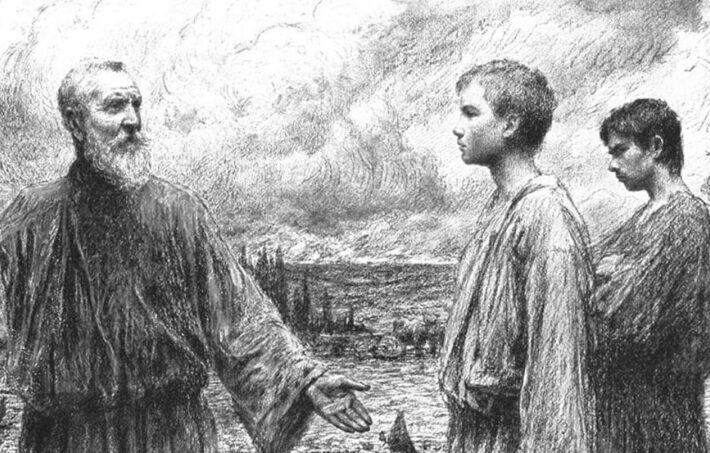
Christian Art | King James Audio Bible KJV | Parables Of Jesus | Daily Bible Verses Advent
Matthew 21: 28-32 | King James Audio Bible | Daily Bible Verses Advent Week 3 Tuesday | Parables Of Jesus
28 ¶ But what think ye? A certain man had two sons; and he came to the first, and said, Son, go work to day in my vineyard.
29 He answered and said, I will not: but afterward he repented, and went.
30 And he came to the second, and said likewise. And he answered and said, I go, sir: and went not.
31 Whether of them twain did the will of his father? They say unto him, The first. Jesus saith unto them, Verily I say unto you, That the publicans and the harlots go into the kingdom of God before you.
32 For John came unto you in the way of righteousness, and ye believed him not: but the publicans and the harlots believed him: and ye, when ye had seen it, repented not afterward, that ye might believe him.
The parable of the two sons is clearly, and explicitly, an attack by Jesus upon the chief priests and the elders of the Jewish people. In the parable, Jesus places before the Jewish authorities an astonishingly blunt analogy of their rejection of God the Father and of Jesus. There is no room for quibbling or intellectual sophistry here: one son does what his father wants; the other says he will and then doesn’t.
The scribes and the Pharisees boast of their faithfulness to God’s Law. They ostentatiously parade their sanctimony, visibly and publicly adopting the elaborated trappings of the Law, indeed they are sticklers for the ritual observances of the Law, and yet their religiosity is hollow; they serve themselves, they line their own pockets, they relish their status and authority; they are far from loving adherence to God. They say they will go to work in the vineyard, and yet they do not.
The first son whom the father approaches initially refuses to serve him. Then he repents. Having sinned, he experiences a change of heart and goes to do the work his father has asked of him. Jesus is saying to all of us: It doesn’t matter if you have sinned; I came to call you. When we repent of our past refusals of the will of the Father, when we leave behind that past frame of mind and give ourselves to what God wants us to be and do, then God’s forgiveness is ours and it is total.
The prostitutes and tax collectors (publicans) heard the call to righteousness proclaimed by John the Baptist, and Jesus sits down to dinner with them and they hear him. And so then, when they have repented, their past doesn’t matter any more; they are with God and the kingdom of heaven can now be theirs. Not so the scribes and the Pharisees.
It is as if, by hanging out with those beyond legitimate ‘good’ society, by rejecting the social mores of the day and by opening himself up to the accusation of his being a glutton and a wine-bibber, Jesus has pointed a finger at established authorities, at orthodoxy, and has stretched out his arms instead to human-kind. It is as if Jesus has said, when the rules of your society are wrong, when your society is wrong, then reject those rules and reject that society. Perhaps he found those on the edge to be the least contaminated, even as they seemed most to sin, and so most ready for renewal in the Blood of the Lamb.
‘It belongs to God to help us and deliver us from all trouble… God protects the humble man and delivers him; the humble he loves and consoles; to the humble he inclines himself; on the humble he bestows abundant grace; and, after he has been brought low, he raises him up to glory. To the humble man he reveals his secrets, and sweetly draws and invites him to himself.’ The Imitation of Christ
Audio Bible KJV | Endnotes
We Are All Sinners | We Can All Ask: ‘Pray For Me A Sinner’
In the parable, the first son initially refuses to do his father’s will, but he later changes his mind and obeyes his father, while the second son says he would obey but does not.
The parable highlights the reality of human sinfulness. Everyone has sinned and fallen short of God’s standards (Romans 3:23), and it is only through repentance and faith in Jesus Christ that we can be reconciled to God and receive forgiveness of sins (Acts 3:19).
Jesus often associated with sinners and outcasts, much to the chagrin of the religious authorities of his time. Jesus recognized the humanity in all people, including those who had strayed from God’s path, and welcomed them with open arms when they repented and turned to Him.
In our own time, this message remains relevant. It is easy to fall into the trap of self-righteousness and to judge others based on outward appearances or actions. However, we are all sinners in need of God’s grace, and it is only through repentance and faith in Jesus Christ that we can receive salvation.
In fact, it is through our acknowledgement of our sins that, as the Prodigal Son, we are called home.




Gospel Reading: Matthew 25:35-36 (KJV) ‘For I was an hungred, and ye gave me no meat: I was thirsty, and ye gave me no drink: I was a stranger, and ye took me not in: Naked, and ye clothed me not: I was sick, and ye visited me not: I was in prison, and ye came unto me not.’ Reflection on the Gospel In these verses, Jesus speaks about compassion and how our actions towards others reflect our love for Jesus. Jesus teaches us that by caring for those in need, we are also caring for Jesus. This passage challenges us to look beyond ourselves and extend kindness and mercy to those around us. Prayer Heavenly Father, I come to you asking for a heart filled with compassion. Help me to see others through your eyes, to feel their pain, and to be moved to action. Teach me to love and care for those who are suffering, just as Jesus did. Let my actions reflect your love and bring comfort to those in need. Thank you for your endless compassion and grace. In Jesus’ name, I pray. Amen. Personal Reflection I think about a time when I was in need and someone showed me compassion. How did it make me feel? Now, I consider a time when I had the opportunity to help someone else. How did my actions impact them? Compassion is more than just feeling sympathy for others; it is about taking action to alleviate their suffering. By practicing compassion, I bring God’s love into the world. Meditation On The Prayer And Gospel Compassion begins with recognizing the humanity in others and responding with love and kindness. Jesus’ words in Matthew 25:35-36 remind me that my treatment of others is a reflection of my relationship with Jesus. This is not only a call to action but an invitation to embody God’s love in my daily life. As I meditate on this prayer, I remember the story of the Good Samaritan. Despite being a stranger, the Samaritan showed great compassion to a wounded traveler, demonstrating the kind of love Jesus calls me to show. This story illustrates that true compassion knows no boundaries and is driven by love. I think about those in my community who are in need. I visualize their faces and hold them in my thoughts. I imagine Jesus standing with me, encouraging me to extend compassion and kindness. I feel the warmth of Jesus’ love as I commit to making a difference in their lives. Compassion is not just about grand gestures but also about small acts of kindness that can transform someone’s day. It involves listening, understanding, and being present for others. As I practice compassion, I become a vessel of God’s grace, reflecting Jesus’ love to those around me. Prayer Lord Jesus, thank you for your example of compassion. Help me to follow your footsteps and show love to those in need. Grant me the strength and courage to act with kindness and mercy. Fill my heart with empathy and understanding, and let your love be evident in all that I do. Amen. Scripture Reading: Colossians 3:12 (KJV) ‘Put on therefore, as the elect of God, holy and beloved, bowels of mercies, kindness, humbleness of mind, meekness, longsuffering;’ Blessing May the compassion of God fill my heart and guide my actions. May His grace empower me to show love and kindness to those in need. Go forth in His love, extending mercy and compassion to all you meet. Amen.

Saint Ambrose of Milan offers a mystagogical catechesis—a reflection on the meaning of the rites that follow Christian baptism. Delivered during the Easter Octave, these instructions were addressed to the newly baptized, known as neophytes, and aimed to deepen their understanding of the sacramental mysteries they had just experienced. Ambrose’s theology is sacramental, scriptural, and symbolic, drawing deeply from the liturgical tradition and the imagery of Scripture to reveal the hidden grace of the sacraments [ … ]

Christ offers himself to the people as the good shepherd, recalling a favourite theme of Old Testament prophecy. Priests and kings are so described, and indeed God is spoken of as a shepherd, as we hear, for example, in Psalm 23: THE Lord is my shepherd; I shall not want [ … ]