
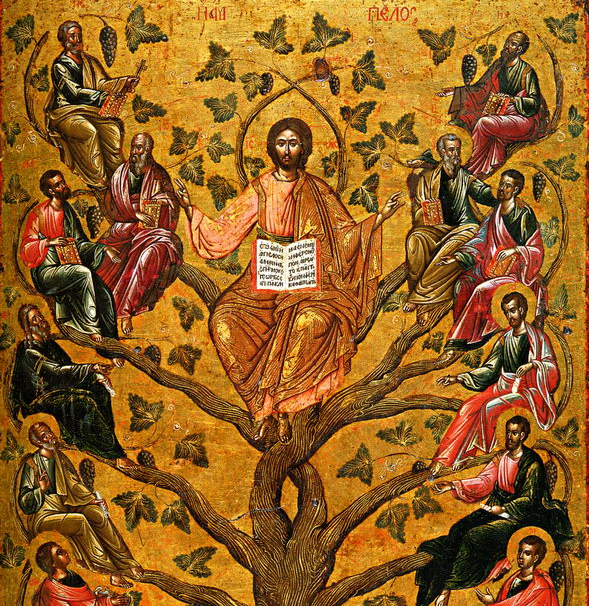
Christian Art | Easter To Pentecost | Jesus Is The True Vine
John 15: 1-8 | King James Audio Bible | Daily Verses
I AM the true vine, and my Father is the husbandman.
2 Every branch in me that beareth not fruit he taketh away: and every branch that beareth fruit, he purgeth it, that it may bring forth more fruit.
3 Now ye are clean through the word which I have spoken unto you.
4 Abide in me, and I in you. As the branch cannot bear fruit of itself, except it abide in the vine; no more can ye, except ye abide in me.
5 I am the vine, ye are the branches: He that abideth in me, and I in him, the same bringeth forth much fruit: for without me ye can do nothing.
6 If a man abide not in me, he is cast forth as a branch, and is withered; and men gather them, and cast them into the fire, and they are burned.
7 If ye abide in me, and my words abide in you, ye shall ask what ye will, and it shall be done unto you.
8 Herein is my Father glorified, that ye bear much fruit; so shall ye be my disciples.
In the Old Testament, the chosen people of Israel have been compared to a vine. We may think, for example, of Isaiah’s Song of the Vineyard (Isaiah 5:1-7 – Audio Bible Verses Spoken Word), in which God complains that, despite the care he has lavished upon it, his vineyard has only produced wild grapes:
NOW will I sing to my wellbeloved a song of my beloved touching his vineyard. My wellbeloved hath a vineyard in a very fruitful hill:
2 And he fenced it, and gathered out the stones thereof, and planted it with the choicest vine, and built a tower in the midst of it, and also made a winepress therein: and he looked that it should bring forth grapes, and it brought forth wild grapes.
3 And now, O inhabitants of Jerusalem, and men of Judah, judge, I pray you, betwixt me and my vineyard.
4 What could have been done more to my vineyard, that I have not done in it? wherefore, when I looked that it should bring forth grapes, brought it forth wild grapes?
5 And now go to; I will tell you what I will do to my vineyard: I will take away the hedge thereof, and it shall be eaten up; and break down the wall thereof, and it shall be trodden down:
6 And I will lay it waste: it shall not be pruned, nor digged; but there shall come up briers and thorns: I will also command the clouds that they rain no rain upon it.
7 For the vineyard of the Lord of hosts is the house of Israel, and the men of Judah his pleasant plant: and he looked for judgment, but behold oppression; for righteousness, but behold a cry.
In Matthew’s Gospel, Jesus uses this imagery of the vineyard in his parable of the tenants, who injure and murder the messengers of the lord of the vineyard, this signifying the rejection of Jesus by the Jews and the call to the Gentiles to follow Christ. Here Jesus develops our understanding of the symbolism, explaining that he is the true vine and that, to be fruitful in our lives, and to receive the gift of eternal life, we as the branches must be joined to him. In short, we can do nothing without him. Jesus is the air that we breathe. Our very existence is through Christ.
We are to abide in Christ, and to welcome and rejoice in Christ as he enters to abide in us. Through this, Christians then become part of one body. Our faith, then, goes beyond our private experience of God; it is communal, each member of Christ’s body, the Church, working for the good of others, and exhorting one another to greater faith.
The vine, Jesus tells us, is good only if it bears fruit. It is not fit for carpentry. Should a branch not bear fruit, it is then only fit to be burned. Through the parable, we are additionally taught that through pruning we may be brought to bear more fruit. Jesus speaks here of the ways in which we may suffer for our faith, and of sacrifices that may be entailed. Through this discipline of faith, we may come to full fruition in Christ Jesus.
‘Have you not heard the Master himself tell the parable of the vine and the branches? Here we find consolation. He demands much of you, for you are the branch that bears fruit. And he must prune you… to make you bear more fruit. Of course, that cutting, that pruning, hurts. But afterwards, what richness in your fruits, what maturity in your actions.’ St Josemaria Escriva
King James Audio Bible | Endnotes
I Am The Vine And Ye Are The Branches | The Word Of Jesus In The Gospels
John 15: 1-8 is a beautiful and profound passage in which Jesus uses the metaphor of a vine and its branches to describe the intimate relationship between himself and his disciples.
This metaphor of the vine and the branches is rich with meaning. One of the most important aspects of this metaphor is the idea of unity and interdependence. Just as the branches of a vine cannot survive without being connected to the main vine, so too must we be connected to Christ in order to bear spiritual fruit.
Saint Augustine wrote about the metaphor of the vine and the branches in his commentary on John’s Gospel. He emphasized the importance of staying connected to Christ, writing, ‘If we do not abide in Him, we are withered; but if we abide in Him, we bring forth much fruit.’ Saint Augustine also noted that the vine metaphor is a powerful image of the Church, in which Christ is the head and we are the members.
Martin Luther, founder of the Protestant Reformation, wrote about the vine and branches in his commentary on John’s Gospel. He highlighted the importance of faith in Christ as the means by which we are connected to the vine. Luther wrote: ‘Faith alone is the power that unites us to Christ, and this is the reason why faith is so highly praised in Scripture.’
In addition to unity and faith, the metaphor of the vine and branches also speaks to the process of spiritual growth and purification. Jesus says that every branch that bears fruit is pruned by the Father so that it may bear even more fruit. This process of pruning can be painful, but it is necessary for spiritual growth.
Catholic theologian Saint Thomas Aquinas wrote about the idea of spiritual purification in his Summa Theologica. He argued that the process of purification is necessary for us to become more like God, writing, ‘By purifying the soul, we become more like God, who is perfectly pure.’
Abide In Me And I In You | Spiritual Commitment With Jesus
Jesus goes on to say, ‘Abide in me, and I in you. As the branch cannot bear fruit of itself, except it abide in the vine; no more can ye, except ye abide in me. I am the vine, ye are the branches: He that abideth in me, and I in him, the same bringeth forth much fruit: for without me ye can do nothing.’
These words of Jesus speak to the importance of abiding in Jesus, of remaining in Jesus’ presence and cultivating a deep and intimate relationship with him. When we abide in Christ, we allow his life to flow through us, and we become fruitful in our spiritual lives. Without him, we can do nothing.
17th century Anglican bishop Jeremy Taylor wrote: ‘Abiding in Christ is not a single act of faith, but a continued course of holy living, begun and maintained by faith, hope, and charity.’
Catholic mystic Saint John of the Cross wrote about the importance of abiding in Christ in his book, The Ascent Of Mount Carmel. He wrote: ‘To abide in Christ means to be united to Him in such a way that one lives in Him and He lives in one. This is the essence of spiritual life.’
In order to abide in Christ, we must cultivate a relationship with him through prayer, study of his Word, and participation in the sacraments. We must also seek to live in obedience to His commands, as Jesus says in John 15:10, ‘If ye keep my commandments, ye shall abide in my love; even as I have kept my Father’s commandments, and abide in his love.’
When we abide in Jesus, in the Word, in his words, we experience Jesus’ love, his joy and peace in our lives. We become more like Jesus and are able to bear fruit for his kingdom. As we reflect on these words of Jesus, may we be encouraged to deepen our relationship with Jesus and to abide in his love.




The reading for the Fourth Sunday of Lent (Laetare Sunday) reflects key themes from Saint Augustine’s theology, especially his understanding of Christ as the ‘way, the truth, and the life’ (John 14:6). Saint Augustine frequently emphasized the journey of the soul toward God, a journey that requires divine grace to overcome sin and spiritual blindness. His doctrine of illumination—whereby human understanding is enlightened by God—resonates in this reading, as he speaks of Christ as the light that heals spiritual blindness and leads believers to truth [ … ]

George Herbert’s poem explores humanity’s relentless pursuit of knowledge and mastery over the natural world, juxtaposing these achievements with the failure to recognize and embrace God’s immediate presence. The poem is structured around vivid images of human ingenuity, drawing on the astronomer, diver, and chemist (or ‘chymick’) as archetypes of humanity’s intellectual and physical endeavors. Yet, beneath these triumphs lies a critique: the neglect of the divine, who resides ‘at hand’ rather than in the distant realms humanity seeks to conquer [ … ]

The poem centres on a reflection of sin and redemption, using a natural metaphor to illustrate the poet’s spiritual journey. In the opening lines, the poet likens himself to someone who stands at the edge of a dark, shadowy grove but looks beyond it toward the sky. This image suggests the poet’s desire to move past his sins, as represented by the grove, and seek out the purity and grace symbolized by the open sky above. Rather than remaining fixated on his wrongdoings, he wishes to direct his gaze toward salvation [ … ]
