Loading...
Daily Bible Verses | The Gospel Of Saint LukeKingdom Of Heaven | Kingdom Of GodThrough The Year | The Gospels | Bible Verse Of The Day

Daily Bible Verses | The Day Of Christ’s Coming | King James Audio Bible KJV | Apocalypse | Love Revealed By Jesus Christ

Daily Bible Verses | The Day Of Christ’s Coming

Christian Art | Parousia | Apocalypse | The Second Coming | King James Audio Bible

Luke 17: 26-37 – Week 32 Ordinary Time, Friday (King James Audio Bible KJV, Spoken Word)

26 And as it was in the days of Noe, so shall it be also in the days of the Son of man.
27 They did eat, they drank, they married wives, they were given in marriage, until the day that Noe entered into the ark, and the flood came, and destroyed them all.
28 Likewise also as it was in the days of Lot; they did eat, they drank, they bought, they sold, they planted, they builded;
29 But the same day that Lot went out of Sodom it rained fire and brimstone from heaven, and destroyed them all.
30 Even thus shall it be in the day when the Son of man is revealed.
31 In that day, he which shall be upon the housetop, and his stuff in the house, let him not come down to take it away: and he that is in the field, let him likewise not return back.
32 Remember Lot’s wife.
33 Whosoever shall seek to save his life shall lose it; and whosoever shall lose his life shall preserve it.
34 I tell you, in that night there shall be two men in one bed; the one shall be taken, and the other shall be left.
35 Two women shall be grinding together; the one shall be taken, and the other left.
36 Two men shall be in the field; the one shall be taken, and the other left.
37 And they answered and said unto him, Where, Lord? And he said unto them, Wheresoever the body is, thither will the eagles be gathered together.

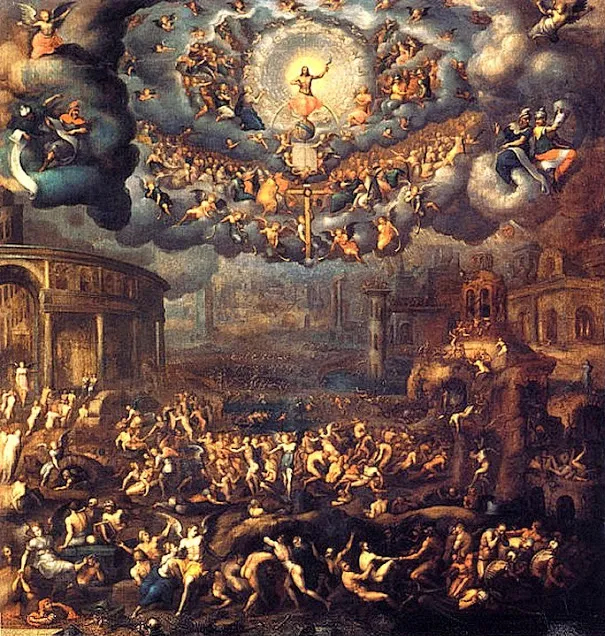
Jesus continues to speak to his listeners about the apocalyptic coming of the Son of Man. Using a highly elevated, figurative language, laden with symbol and metaphor, Jesus describes the second coming, or Parousia, which marks the end of this period of history and the inauguration of the new age, the days of the Son of man; it is a scene of sudden, violent destruction and transformation, and a scene of judgement.

Jesus tells us that his coming will be unexpected and catch many unawares. He speaks of how everyday life continued right up to the moment of crisis in the time of Noah and of Lot, the normality of the daily routine suddenly giving way to destruction, when people are judged.

There is a stark warning that some of those who have lived in close proximity, sharing their lives with each other, will be taken and others left. We may recall the parable of the wise and foolish virgins. There the key issue is watchfulness, preparedness; here the choice may seem frighteningly arbitrary. We are perhaps to assume that there is an inward quality to some that others have not admitted. The verse, ‘Whosoever shall seek to save his life shall lose it; and whosoever shall lose his life shall preserve it,’ might suggest that those who value the things of this life above all lose eternal life, while those who are detached from worldly goods have a life in heaven.

Jesus, clearly, did not intend these apocalyptic saying to foretell the imminent physical destruction of the world. He may be speaking of the destruction of Jerusalem in the year AD 70, and the scene of unspeakable carnage there, which ripped the heart from Jewish society, religion and culture. It is Christian belief that there will be an end, a final coming of the Son of man. This to many of us may be to think in terms of unimaginable time-frames – and indeed a plurality of categories, as time pertains to God and to Man.

More immediately, we understand through Christ’s eschatological discourses the imminence of the coming of Christ in our lives right now, and the complete transformation we experience when we open our hearts, our minds, our souls, and cry, Come, Lord Jesus! Here there is urgency, our own eager calling to Jesus being a response to Jesus’ fervent desire to establish his Kingdom within us. Here also the fear of destruction is answered.

Eternal Father, loving God,
Who made us from the dust of earth,
Transform us by the Spirit’s grace,
Give value to our little worth. 

Prepare us for that day of days
When Christ from heaven will come with might
To call us out of dust again,
Our bodies glorified in light. 

O Godhead, here untouched, unseen,
All things created bear your trace;
The seed of glory sown in man
Will flower when we see your face. 

Prayer Before The Cross Of Jesus | Gospel | Christian Prayer

Meditations On The Love Of Jesus Christ | Bible Verses | Reflections On The Gospel | Prayer With Jesus
  • Saint Padre Pio | Love Revealed By Jesus Christ

    Padre Pio, also known as Saint Pio of Pietrelcina, was an Italian Capuchin friar who lived from 1887 to 1968. He is renowned for his piety, his stigmata, and his gift of healing, and has become a beloved figure in the Christian world. Born into a devout Catholic family in Pietrelcina, Italy, Padre Pio felt a calling to the priesthood from a young age. He entered the Capuchin order in 1903 and was ordained a priest in 1910. He spent much of his life as a humble friar, dedicated to prayer, the sacraments, and the service of others. Padre Pio’s most famous spiritual gift was the stigmata, the visible wounds of Christ that he bore on his hands, feet, and side. He experienced this phenomenon for over 50 years, from 1918 until his death in 1968. While some were skeptical of his wounds, many believed them to be a sign of his profound union with Christ and his participation in the suffering of the crucified Christ. In addition to his stigmata, Padre Pio was also known for his gift of healing. Many people came to him seeking physical, emotional, and spiritual healing, and he prayed over them, sometimes prescribing special devotions or treatments. While some were healed miraculously, others did not experience a physical cure, but nonetheless found comfort and peace through his intercession. Padre Pio’s life was marked by his devotion to God and his love for others. He spent long hours in prayer, often in the presence of the Blessed Sacrament, and had a deep appreciation for the power of the Eucharist. He also had a special love for the Virgin Mary, whom he called his ‘Heavenly Mother’, and encouraged others to pray the Rosary. Today, Padre Pio is venerated as a saint by the Catholic Church, and his influence has spread far beyond Italy. He is remembered for his holiness, his humility, and his profound union with Christ, as well as for his compassion and concern for the sick and suffering. Christians of all denominations continue to look to him as a model of faith and devotion to God. Prayer To Saint Padre Pio | A Prayer For Healing Saint Padre Pio is renowned for his gift of healing, which he used to help countless people throughout his life. He believed in the power of prayer and the importance of placing our trust in God, even in the face of illness and suffering. In James 5:16, we are reminded that ‘the prayer of a righteous person is powerful and effective’. Padre Pio’s life was a testament to the truth of this verse, as he interceded for those who came to him seeking physical, emotional, and spiritual healing. One of the most striking examples of Padre Pio’s healing ministry was the case of Gemma Di Giorgi, a young girl who had been diagnosed with a life-threatening illness. Her parents brought her to Padre Pio, who prayed over her and blessed her with the sign of the cross. To the amazement of her doctors, Gemma’s condition began to improve, and she was eventually healed completely. In addition to physical healing, Padre Pio also believed in the importance of emotional and spiritual healing. He often spoke of the need for repentance and conversion, and encouraged his followers to turn to God with contrite hearts. In Luke 5:31-32, Jesus tells the Pharisees, ‘It is not the healthy who need a doctor, but the sick. I have not come to call the righteous, but sinners to repentance.’ Padre Pio understood that true healing involves not only the body, but also the soul. For those who are in need of healing, whether physical, emotional, or spiritual, Saint Padre Pio can serve as a powerful intercessor. He believed in the importance of prayer and the power of God’s grace to heal even the most difficult of cases. Through his intercession, we can ask God for the strength and courage to face our illnesses and our struggles, knowing that we are never alone and that God’s healing love is always with us. So let us pray: ‘Saint Padre Pio, you who had a deep faith in God and a profound love for your fellow human beings, we turn to you in our time of need. We ask for your intercession on behalf of all those who are sick and suffering, that they may be healed in body, mind, and spirit. We ask that you pray for us, that we may have the strength and courage to face our illnesses and our struggles with faith and hope, knowing that God is with us always. We trust in God’s love and mercy, and in the power of prayer to bring healing and wholeness to all who seek it. Saint Padre Pio, pray for us, and lead us to the healing grace of God. Amen.’ Prayer To Saint Padre Pio | A Prayer For Peace Saint Padre Pio was a man of peace, who lived his life in the service of God and his fellow human beings. He believed that peace was not merely the absence of conflict, but a state of inner harmony that could only be achieved through a deep and abiding relationship with God. In John 14:27, Jesus tells his disciples, ‘Peace I leave with you; my peace I give you. I do not give to you as the world gives. Do not let your hearts be troubled and do not be afraid.’ Padre Pio understood the importance of this peace, and dedicated his life to helping others find it. One of the ways that Padre Pio fostered peace was through his ministry of reconciliation. He encouraged those who came to him to confess their sins and seek God’s forgiveness, knowing that this was the first step towards inner peace. In Matthew 5:9, Jesus says, ‘Blessed are the peacemakers, for they will be called children of God.’ Padre Pio believed that this was not just a call to be a mediator in conflicts between […]

  • Christian Community | Boy At Prayer | Eucharist | Jesus

    Blessed Isaac opens with a profound image: just as a human head and body form a single person, so too does Christ—head and Church—form a single, unified reality. This vision reflects a central doctrine of Christian theology: ‘Totus Christus’, or ‘the whole Christ’. The head is Jesus, born of the Virgin Mary; the body is the Church, composed of all who are joined to him in faith and baptism [ … ]

  • Psalm 74 KJV | King James Audio Bible | Word Aloud | Oliver Peers | King James Version

    Psalm 74 is a plea for divine intervention during a period of devastation and spiritual turmoil. The psalmist expresses deep distress over the destruction of sacred places and the apparent abandonment of God’s people. This psalm is a call for God’s assistance and a reflection on the covenant between God and God’s chosen people [ … ]

Search Google Here | A Holy Land Jerusalem Pilgrimage? | A Safari? | An Escape..