Christian Art | Scribes Accuse Jesus
Mark 3: 22-30 – Week 3 Ordinary Time, Monday (Audio Bible KJV, Spoken Word)
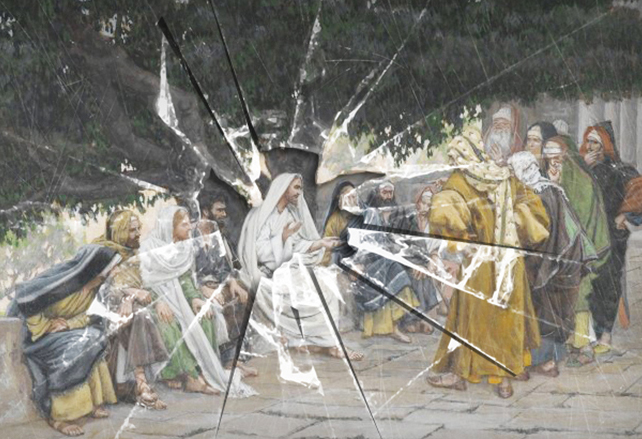
22 ¶ And the scribes which came down from Jerusalem said, He hath Beelzebub, and by the prince of the devils casteth he out devils.
23 And he called them unto him, and said unto them in parables, How can Satan cast out Satan?
24 And if a kingdom be divided against itself, that kingdom cannot stand.
25 And if a house be divided against itself, that house cannot stand.
26 And if Satan rise up against himself, and be divided, he cannot stand, but hath an end.
27 No man can enter into a strong man’s house, and spoil his goods, except he will first bind the strong man; and then he will spoil his house.
28 Verily I say unto you, All sins shall be forgiven unto the sons of men, and blasphemies wherewith soever they shall blaspheme:
29 But he that shall blaspheme against the Holy Ghost hath never forgiveness, but is in danger of eternal damnation:
30 Because they said, He hath an unclean spirit.
As Jesus’ popularity grows, so too do those opposing voices ranged against him. Jesus has worked saving miracles, and now the scribes come from Jerusalem declare that this has not been holy work but rather diabolical. This sounds to modern day listeners to be absurd, although we might wonder at Jesus’ manner as he exorcised demons, and bear in mind that his friends and family thought he had lost his wits and was beside himself. Certainly, the intention of the scribes is to find fault and seize on anything they can to try to vilify Jesus. They are looking to reject the good news and are happy to pervert the truth if they feel by doing so they may harm Jesus.
Jesus proves by his words in reply that he is perfectly compos mentis and that the scribes’ accusations are self-evidently nonsensical. Can Satan cast out Satan? Is Satan divided against himself, at war with himself, tearing himself apart? In which case, Satan must fail; his time must be coming to an end, as evil consumes itself. Of course, what is happening is that one stronger than Satan is here. Christ has come to liberate mankind from bondage to Satan. There will be salvation.
The scribes see Beezebub/Beelzebul, meaning the god of the flies/the god of excrement – excrement the word used by the Jews to describe pagan sacrifices. They are right to know that evil is a force in this world, but in saying that Jesus’ miracles are the work of the devil, they are themselves in the grip of evil and they blaspheme. As Jesus tells the scribes: ‘[H]e that shall blaspheme against the Holy Ghost hath never forgiveness, but is in danger of eternal damnation.’ This is what the scribes have done, in refusing to give God the glory for the miracles of healing. In so doing, they close their hearts against the Holy Spirit, and so they refuse God’s grace.
Now is the judgment of this world: now shall the prince of this world be cast out.
And I, if I be lifted up from the earth, will draw all men unto me. (John 12: 31-32)
Concluding Prayer
King of heaven and earth, Lord God,
rule over our hearts and bodies this day.
Sancify us,
and guide our every thought, word and deed
according to the commandments of your law,
so that now and for ever
your grace may free and save us.
We make our prayer through our Lord.

Audio Bible KJV | Endnotes
Scribes Accuse Jesus
In Mark 3: 22-30, the scribes accuse Jesus of casting out demons by the power of Beelzebub, the prince of demons. This accusation marks a pivotal moment in the ministry of Jesus and raises important theological questions about the nature of evil and the power of God.
The scribes, who were experts in Jewish law and tradition, were highly critical of Jesus’ teachings and actions. They saw Jesus as a threat to their authority and were quick to accuse Jesus of blasphemy and other transgressions. In this instance, the scribes accuse Jesus of working with the devil, claiming that ‘He hath Beelzebub, and by the prince of the devils casteth he out devils’ (Mark 3:22, KJV).
Jesus responds to their accusation with a powerful argument, pointing out the logical inconsistency of their claim: ‘And if Satan rise up against himself, and be divided, he cannot stand, but hath an end.’ (Mark 3:26, KJV) Jesus goes on to affirm that it is only by the power of God that he is able to cast out demons: ‘Verily I say unto you, All sins shall be forgiven unto the sons of men, and blasphemies wherewith soever they shall blaspheme: But he that shall blaspheme against the Holy Ghost hath never forgiveness, but is in danger of eternal damnation.’ (Mark 3:28-29, KJV)
The Church has traditionally understood the sin against the Holy Ghost as a willful and persistent rejection of the grace of God, which ultimately leads to the loss of salvation. Protestant theologians have interpreted this passage in different ways, with some arguing that it refers to a specific historical situation in which the scribes were rejecting the witness of the Holy Spirit through Jesus’ miracles, and others seeing it as a warning against the danger of persisting in unbelief.
Regardless of the precise interpretation of this passage, one thing is clear: the power of God is greater than the power of evil. As Jesus said: ‘No man can enter into a strong man’s house, and spoil his goods, except he will first bind the strong man; and then he will spoil his house.’ (Mark 3:27, KJV) By casting out demons, Jesus was demonstrating his authority over the forces of darkness and his power to set people free from sin and bondage.
This theme of spiritual warfare is a recurring motif throughout the Bible, from the story of Adam and Eve in the Garden of Eden to the book of Revelation/Apocalypse, which speaks of a final victory over the powers of darkness. As the apostle Saint Paul wrote: ‘For we wrestle not against flesh and blood, but against principalities, against powers, against the rulers of the darkness of this world, against spiritual wickedness in high places.’ (Ephesians 6:12, KJV) In the face of such opposition, it is crucial to remember that our ultimate hope lies not in human strength or wisdom, but in the power of God, who is able to do far more than we can ask or imagine (Ephesians 3:20).
The story of the scribes accusing Jesus raises important questions about the nature of evil and its relationship to God. In the Christian tradition, evil is often understood as a distortion or corruption of the good that God has created. As theologian Saint Augustine of Hippo famously wrote: ‘Evil has no positive nature; but the loss of good has received the name evil.’ (City Of God, Book 11, Chapter 9)
This understanding of evil as a privation of the good is important because it underscores the fundamental goodness of creation and the power of God to redeem even the most broken and fallen aspects of it. As the apostle Saint Paul wrote: ‘For we know that all creation has been groaning as in the pains of childbirth right up to the present time. And we believers also groan, even though we have the Holy Spirit within us as a foretaste of future glory, for we long for our bodies to be released from sin and suffering.’ (Romans 8:22-23, NLT)
This hope for the ultimate redemption of creation is at the heart of the Christian Gospel, which proclaims that in Christ, God has overcome the power of sin and death and has inaugurated a new creation in which all things will be made new (2 Corinthians 5:17; Revelation 21:5). This hope sustains us in struggles and trials of this life.
In light of these biblical and theological reflections, the story of the scribes accusing Jesus challenges us to examine our own hearts and minds and to ask ourselves where we are placing our trust and hope. Are we relying on our own strength and understanding, or are we surrendering ourselves to the power and grace of God? Are we seeking to overcome evil with good, or are we contributing to the darkness in our own ways?
As the apostle Saint John wrote: ‘Light shines in the darkness, and darkness has not overcome it.’



In listening to these Gospel verses, questions present themselves. We might ask both why the children are brought to Jesus to be blessed, and why then the disciples rebuke the people bringing the children. We try to see within this scene [ … ]

The reading expresses Saint Ignatius’ faith in Jesus Christ as he was escorted to Rome for Christian martyrdom, to be torn apart by wild beasts in the Coliseum. One crucial point of the reading to take away is that Saint Ignatius expresses possible doubt in his own confidence to go through with his martyrdom with courage. He prays that his fellow Christians might support him through prayer to enable him to embrace his witness – his martyrdom – to Jesus Christ and to Christian faith [ … ]

In this poem, Herbert expresses a yearning for divine grace to enliven and sustain his spiritual life. Herbert begins by admitting a sense of spiritual stagnation, stating, ‘My stock lies dead, and no increase / Doth my dull husbandry improve.’ Here, Herbert characterizes his inner resources or spiritual vitality as unproductive, and he attributes this lack to his own insufficient efforts, likened to a ‘dull husbandry’, or poor cultivation. This admission reveals Herbert’s dependence on external, divine intervention for renewal, as he implores grace to ‘drop from above’ [ … ]