
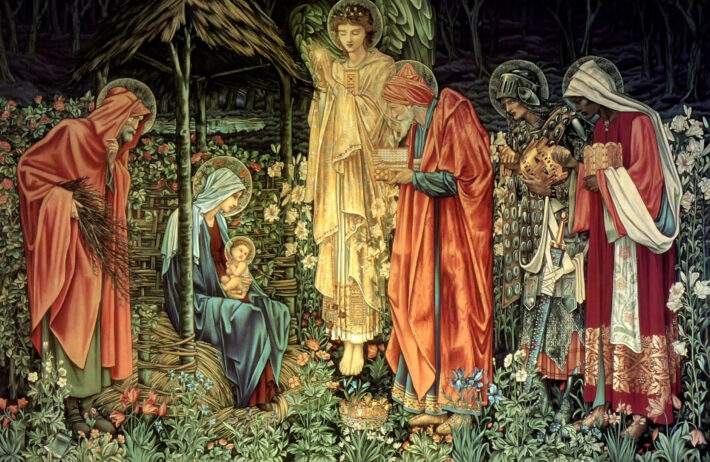
Christian Art | Epiphany Of The Lord | King James Audio Bible KJV
What Is The Epiphany Of The Lord? | King James Audio Bible KJV
The Epiphany of the Lord, also known as Epiphany or Theophany, is a Christian feast day that celebrates the revelation of God incarnate as Jesus Christ. It is observed on January 6 in many Western Christian churches, and on the Sunday between January 2 and 8 in Eastern Christian churches.
The word “epiphany” comes from the Greek word “epiphaneia,” which means “manifestation” or “appearance.” In the Christian tradition, the Epiphany is considered to be the day when the divinity of Jesus was revealed to the world through the visit of the Magi, also known as the three wise men or kings, who brought gifts to the newborn Jesus.
The Epiphany is a major feast day in the liturgical calendar of the Catholic Church, the Eastern Orthodox Church, and many Protestant denominations. It is a time for Christians to remember and celebrate the revelation of Jesus as the Son of God and the saviour of the world. It is also a time to reflect on the meaning of Christ’s incarnation and the significance of the Magi’s visit as an expression of the universality of Jesus’ message and the inclusivity of God’s love.
See also Epiphany Of The Lord – Meditation And Reflection
Who Were The Magi – The Three Kings Or Three Wise Men?
The Magi, also known as the three wise men or three kings, are mentioned in the New Testament of the Bible in the account of the birth of Jesus. According to the Gospel of Matthew, they were “wise men from the East” who came to Jerusalem in search of the newborn king of the Jews.
The Magi were guided to Jesus by a star, and when they arrived, they offered him gifts of gold, frankincense, and myrrh. According to tradition, the Magi were wise and learned men who studied the stars and were skilled in the interpretation of dreams. They are often depicted as kings in artistic representations of the Nativity, and their visit is seen as a symbol of the universality of Jesus’ message and the inclusivity of God’s love.
There is little information about the Magi in the Bible, and their identities have been the subject of much speculation and debate among scholars. Some traditions hold that the Magi were kings from distant lands, while others suggest that they were priests or astrologers. The Magi are revered as important figures in the Christian tradition, and their visit to the newborn Jesus is celebrated on the feast day of the Epiphany.
See also: Journey Of The Magi | T.S. Eliot | Audio | Christian Poems | Word Aloud:
What Were The Names Of The Magi?
According to tradition, the three Magi who visited Jesus were named Caspar, Melchior, and Balthazar. These names were not mentioned in the Bible, but they appear in later writings and artistic representations of the Nativity.
Caspar is traditionally depicted as an elderly man with a white beard, and is often associated with the gift of gold. Melchior is usually portrayed as a middle-aged man with a reddish beard, and is associated with the gift of frankincense. Balthazar is typically depicted as a young man with a dark beard, and is associated with the gift of myrrh.
The names and identities of the Magi are not mentioned in the Bible, and there is no further historical evidence to confirm the details of their visit to Jesus. The names and traditions surrounding the Magi have developed over time through prayer and artistic interpretation.
What Is The Significance Of The Gifts Of The Magi?
The gifts of the Magi, also known as the three wise men or three kings, are mentioned in the New Testament of the Bible in the account of the birth of Jesus. According to the Gospel of Matthew, the Magi brought gifts of gold, frankincense, and myrrh to the newborn Jesus.
The significance of the gifts is largely symbolic and has been the subject of much interpretation and discussion over the centuries. Gold is a precious metal that has long been associated with kings and royalty, and it is thought that the gift of gold may have symbolized Jesus’ status as the King of the Jews. Frankincense is an aromatic resin used in the production of incense and perfume, and it is often associated with spirituality and holiness. The gift of frankincense may have symbolized Jesus’ divine nature and his role as a spiritual leader. Myrrh is a resin extracted from trees that was commonly used in ancient times for its medicinal properties and as a component of perfumes and incense. The gift of myrrh may have symbolized Jesus’ suffering and death, as it was also used as a burial spice.
What Was The Star Followed By The Three Wise Men?
The nature of the star that is said to have guided the Magi, the three wise men or three kings, to the birthplace of Jesus is not clearly described in the Bible and has been the subject of much speculation and debate among scholars.
The Gospel of Matthew, which is the only New Testament gospel that mentions the star, describes it as a “star in the east” that “went before them, till it came and stood over where the young child was” (Matthew 2:2). Some interpreters have understood this to be a literal celestial object, such as a supernova or a comet, while others have seen it as a symbolic or miraculous manifestation.
There have been many attempts throughout history to identify the star with a specific astronomical event or phenomenon, such as the appearance of a comet or the alignment of certain planets. However, there is no scientific or historical evidence to support any of these theories, and it is ultimately impossible to know for certain what the star was or how it led the Magi to Jesus.
In the Christian tradition, the star is often seen as a divine sign or a miracle, and it is understood to be a symbol of the revelation of Jesus as the Son of God and the saviour of the world.
Are There Other Historical Accounts Of Herod’s Massacre Of The Innocents?
The massacre of the innocents is an event described in the New Testament of the Bible as having occurred after the birth of Jesus. According to the Gospel of Matthew, King Herod the Great, who ruled Judea in the first century, ordered the killing of all male children in Bethlehem and its vicinity who were two years old or younger, in an attempt to eliminate the newborn Jesus, whom he believed to be a threat to his throne.
The massacre of the innocents is not mentioned in any other historical accounts from the time period, and there is no independent verification of the event. Some scholars have suggested that the story may be based on a historical event that was later embellished or that it is a purely symbolic narrative with no basis in fact. Others have argued that the massacre of the innocents may have been a historical event that has been overlooked or suppressed in the historical record.
How Old Was Jesus When Visited By The Magi?
According to the New Testament of the Bible, Jesus was visited by the Magi, the three wise men or three kings, when he was a newborn baby. The Gospel of Matthew states that they came to Jerusalem in Search Of The Newborn “King Of The Jews” And That They Followed A Star That Led Them To The Place Where Jesus Was Born (Matthew 2:1-2).
It is not clear exactly how old Jesus was at the time of the visit of the Magi, but he was likely less than two years old, as this is the age of the male children who were supposedly killed by King Herod in an attempt to eliminate the newborn Jesus (Matthew 2:16). Scholars suggest that Jesus was born around the years 6-4 BC, based on historical and astronomical evidence. The exact date of Jesus’ birth is not known with certainty.
For How Long Were Jesus And Mary And Joseph In Egypt?
According to the New Testament of the Bible, Jesus, his mother Mary, and his adoptive father Joseph fled to Egypt to escape the wrath of King Herod the Great, who was attempting to kill the newborn Jesus. The Gospel of Matthew, which is the only New Testament gospel that mentions this event, states that an angel of the Lord appeared to Joseph in a dream and warned him to flee to Egypt with Mary and Jesus, where they would be safe from Herod’s persecution (Matthew 2:13-15).
It is not stated in the Bible for how long Jesus, Mary, and Joseph stayed in Egypt, but it was likely for a relatively short period of time. After King Herod’s death, the angel appeared to Joseph again in a dream and told him that it was safe to return to Palestine, and so he took Mary and Jesus back to their homeland (Matthew 2:19-20).
How Is The Epiphany Celebrated In Modern Christendom?
There are many different ways in which the Epiphany is celebrated in modern Christendom, depending on the specific traditions and practices of different churches and denominations. Some common elements of the celebration of the Epiphany include:
- Worship services and prayers: Many churches hold special services or Masses on the Epiphany to celebrate the revelation of Jesus as the Son of God and the savior of the world. These may include prayers, hymns, and readings from the Bible.
- Processions: In some traditions, the Epiphany is marked by processions in which participants carry statues or icons of the Magi, who are revered as important figures in the Nativity story.
- Blessing of water: In the Eastern Orthodox Church, the Epiphany is also known as the Feast of the Baptism of Christ, and it is celebrated with the blessing of water. This may involve the immersion of a cross in a body of water, the pouring of holy water over the heads of believers, or the distribution of blessed water to the faithful.
- Gift-giving: In some countries, the Epiphany is a time for gift-giving, similar to Christmas in other parts of the world. This tradition is often associated with the gifts that the Magi are said to have brought to the newborn Jesus.
- Special meals: Many people celebrate the Epiphany by gathering with friends and family to share special meals or treats, such as traditional baked goods like the Epiphany cake, or galette des rois in France.
The celebration of the Epiphany is an opportunity for Christians to remember and celebrate the revelation of Jesus as the Son of God and the saviour of the world, and to reflect on the significance of this event for the faith.




This reading from the Pastoral Constitution on the Church in the Modern World addresses the human concern with the subject of death. It approaches the subject not only as a biological event but as a spiritual and existential mystery that touches the deepest questions about meaning, identity, and destiny [ … ]

This poem reflects an intense and deeply personal experience of spiritual desolation, longing, and eventual hope for renewal. Herbert describes a state of spiritual barrenness, where prayer seems to fail in reaching God, leaving the soul in turmoil and disarray. The journey unfolds through an exploration of frustration, despair, and a heartfelt plea for divine intervention [ … ]

The poem presents an image of a fallen soldier in the snow, as his comrades try to move him into the sun in hopes of reviving him. This act becomes a metaphor for futile efforts of better-humanity to counteract ridiculous war and death. The poem juxtaposes the soldier’s past experiences of the sun’s warmth and life-giving qualities with the current reality of his lifeless state, highlighting stark contrast [ … ]
