
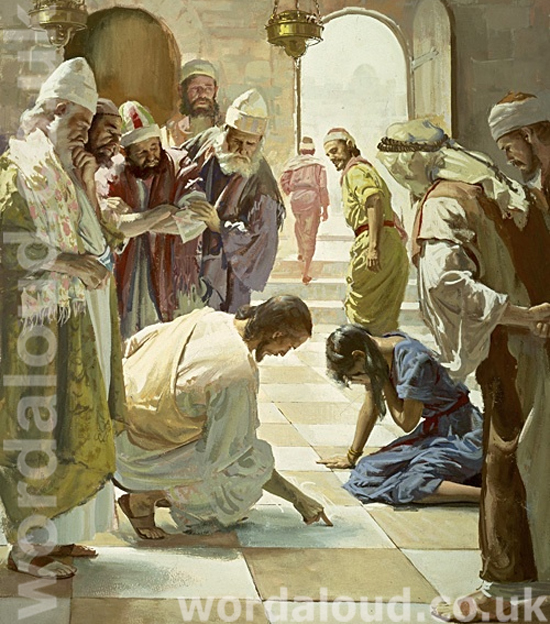
Christian Art | Life Of Jesus | Jesus Forgives The Woman Taken In Adultery | Go And Sin No More
Office Of Readings | Week 21, Tuesday, Ordinary Time | A Reading From The Homilies Of Saint John Chrysostom | Temptations Of The Devil | Paths Of Repentance
‘The five ways of repentance.’
In this passage, Saint John Chrysostom sets out five distinct ‘paths’ by which Christians may repent of sin. His approach is notable for its simplicity and accessibility. He does not treat repentance as a single act confined to sacramental confession or to extraordinary ascetical practice, but as a set of daily habits open to every believer, regardless of wealth or circumstance.
The first path is the acknowledgement of sin. Chrysostom draws upon Scripture to show that confession before God is itself a form of acquittal: Isaiah declares, ‘Tell your sins, and you will be acquitted,’ (Is 43:26) while the psalmist affirms that admission of guilt is met with forgiveness (Ps 32:5). Chrysostom presents this act not as self-condemnation for its own sake, but as a way of preventing further sin. By allowing one’s conscience to accuse the self, the believer forestalls the greater accusation of divine judgement.
The second path is forgiveness of others. Here Chrysostom recalls the words of Christ in the Sermon on the Mount: ‘If you forgive others their trespasses, your heavenly Father will also forgive you.’ (Mt 6:14) Repentance is not only vertical—between God and the individual—but also horizontal, involving reconciliation with one’s neighbour. By urging believers to release resentment and anger, Chrysostom situates repentance within the life of the community, linking personal forgiveness to divine pardon.
The third path is prayer. For Chrysostom, repentance is expressed through sincere and concentrated prayer from the heart. While he does not elaborate at length here, his wider writings make clear that prayer is both an appeal for mercy and a means of reordering the soul towards God. Repentance is not merely regret for the past but a turning towards God in the present, sustained through prayer.
The fourth path is almsgiving. Chrysostom frequently spoke about wealth and poverty in his preaching, and his inclusion of almsgiving reflects his conviction that the use of material goods is bound up with salvation. Acts of generosity, particularly towards the poor, are understood not only as moral duties but as a way of loosening the hold of sin. In giving alms, the believer participates in God’s own mercy, and thus finds pardon.
The fifth path is humility. To illustrate this, Chrysostom recalls the publican of Jesus’ parable (Lk 18:9–14), whose humility brought justification despite the absence of notable deeds. Here repentance is framed as a disposition of the heart, an attitude of truthfulness before God, which by itself can outweigh the weight of sin.
Chrysostom insists that these five paths are open to all. None requires wealth or special status. Even the poor can forgive, pray, humble themselves, and confess. He highlights the example of the widow’s mite (Mk 12:41–44), showing that even almsgiving is measured not by amount but by intention. Repentance is thus presented as an inclusive calling, rooted in everyday actions.
The passage concludes with a reference to Holy Communion. The aim of repentance is not only moral improvement but reconciliation with God, enabling the believer to approach the Eucharist worthily. Repentance restores health to the soul, preparing it to share in the sacramental life of the Church.
Chrysostom’s scheme of five paths is both practical and theological. It reflects biblical teaching, especially the commands of Jesus in the Gospels. It also reflects the pastoral context in which he preached, where repentance was not an abstract concept but a pressing need for Christian communities navigating sin, division, and inequality. By setting out varied and accessible means of turning back to God, Chrysostom provides a framework that integrates personal responsibility, community life, prayer, and sacramental participation.
A Reading From The Homilies Of Saint John Chrysostom | Temptations Of The Devil | Paths Of Repentance
Shall I list the paths of repentance? There are certainly many of them, many and various, and all of them lead to heaven.
The first path is the path of condemnation of sins. As Isaiah says, Tell your sins, and you will be acquitted. And the Psalmist adds: I said ‘I will bear witness against myself before the Lord,’ and you forgave the guilt of my sin. So you, too must condemn the sins you have committed. Condemn them, and that condemnation will excuse you in front of the Lord, since whoever condemns the sins he has committed will be slower to commit them next time. Stir up your own conscience to be your accuser – so that when you come before the judgement-seat of the Lord no-one will rise up to accuse you.
This is the first path of repentance but the second is in no way inferior to it in excellence. It is to forget the harm done to us by our enemies, to master our anger, to forgive the sins of those who are slaves together with us. As much as we do this, so much will our own sins against the Lord be forgiven. So this is the second path to the expiation of our sins. As the Lord says, Yes, if you forgive others their failings, your heavenly Father will forgive you yours.
Would you like to know the third path of repentance? It is prayer: fervent prayer, sincere and focused prayer, prayer coming from the depths of the heart.
If you want to know the fourth path, I will tell you: it is the giving of alms. It has great power.
And finally, if someone acts with modesty and humility, that path is no less effective as a way to deprive sin of its substance. Look at the publican, who had no good deeds to speak of. In place of good deeds he offered humility, and the huge burden of his sins fell away.
So now I have shown you the five paths of repentance. First, condemnation of sins. Second, forgiving the sins of those near us. Third, prayer. Fourth, almsgiving. Fifth, humility.
So do not be idle, but every day advance along all these paths at once. They are not hard paths to follow. Poverty is no excuse for not setting out on the journey. Even if you are destitute you can do all these things: put aside anger, carry humility in front of you, pray hard, condemn your sins. Poverty is no obstacle – not even to that path of penitence that demands money: that is, almsgiving. Remember the story of the widow’s mite.
Now we have learnt the right way to heal our wounds, let us apply these remedies. Let us regain true health and confidently receive the blessings of Holy Communion. Thus we may come, filled with glory, to the glory of Christ’s kingdom, and receive its eternal joys through the grace, mercy and kindness of our Lord Jesus Christ.
Christian Prayer With Jesus Christ
Lord Jesus Christ,
You are the Good Physician of our souls.
Grant us the grace to walk daily along the paths of repentance:
to acknowledge our sins with honesty,
to forgive those who wrong us,
to seek you in prayer,
to give generously to those in need,
and to live with humility before you.
Heal our wounds and restore us to your friendship,
that we may approach your table with confidence
and share in the joy of your kingdom,
where you live and reign with the Father and the Holy Spirit,
one God, forever and ever.
Amen.
Glossary Of Christian Terms
Repentance – Turning back to God with sorrow for sin, accompanied by a change of heart and life.
Condemnation of sins – The act of acknowledging and taking responsibility for one’s sins before God.
Forgiveness – Releasing resentment or anger towards others; for Christians, a condition of receiving God’s forgiveness.
Prayer – Communication with God, here understood as sincere, heartfelt dialogue expressing repentance and seeking mercy.
Almsgiving – The giving of material aid to the poor; a traditional expression of mercy and a means of detaching from sin.
Humility – A truthful recognition of one’s dependence on God and limitation before him; opposed to pride.
Publican – In the New Testament, a tax collector; in the parable of Luke 18:9–14, the humble publican is justified before God.
Widow’s mite – A small offering given by a poor widow (Mk 12:41–44), praised by Jesus as greater than the larger sums given by the wealthy because it was all she had.
Holy Communion – The sacrament in which Christians receive the Body and Blood of Christ, uniting them to him and to one another.



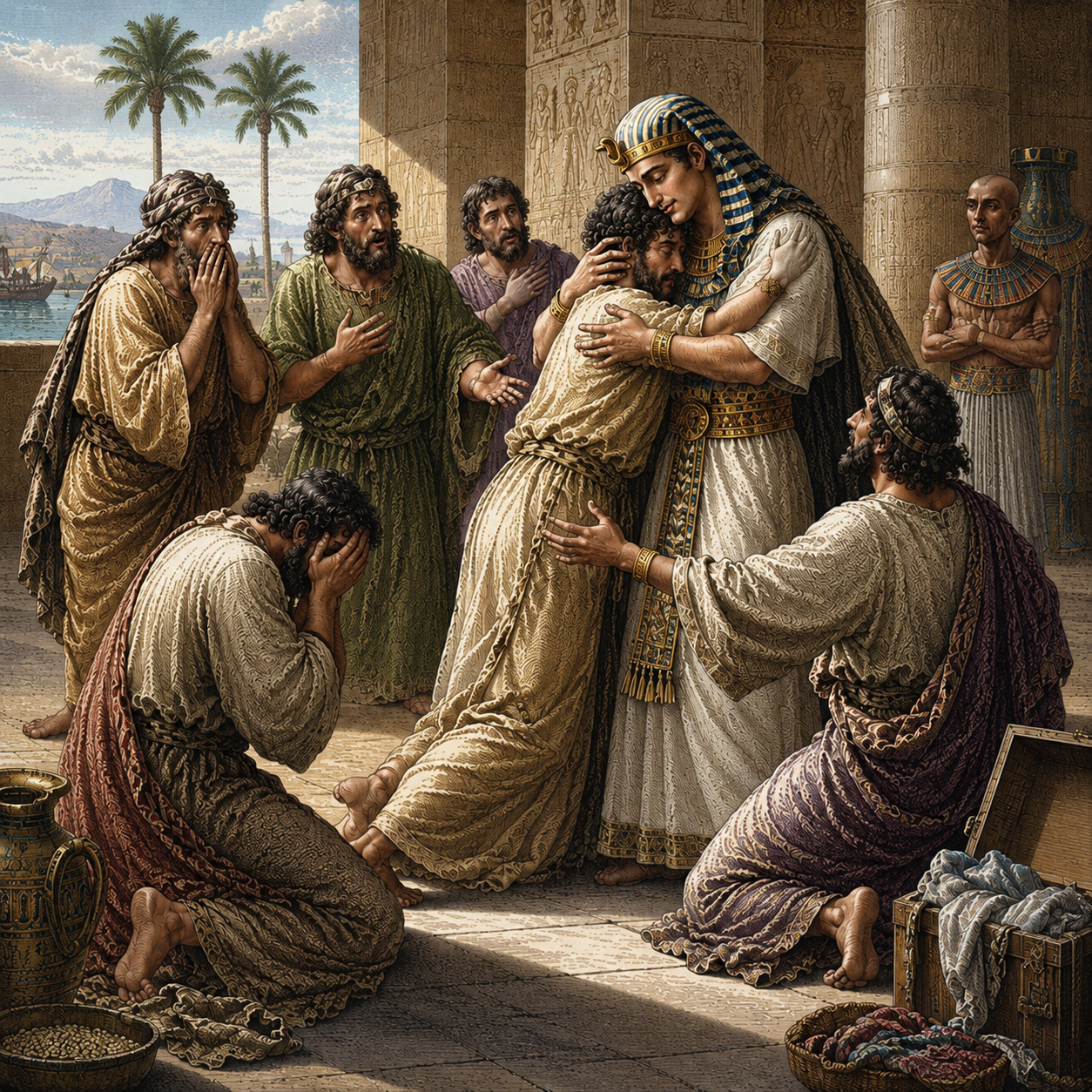
The story of Joseph begins within a family already marked by division. Genesis has traced generations shaped by rivalry, favouritism, deception and estrangement. The conflict between Cain and Abel established early the destructive force of jealousy between brothers. Later narratives repeat similar patterns in different forms: Isaac and Ishmael, Jacob and Esau, Leah and Rachel. By the time Joseph appears, the family of Jacob already carries deep instability within itself [ … ]
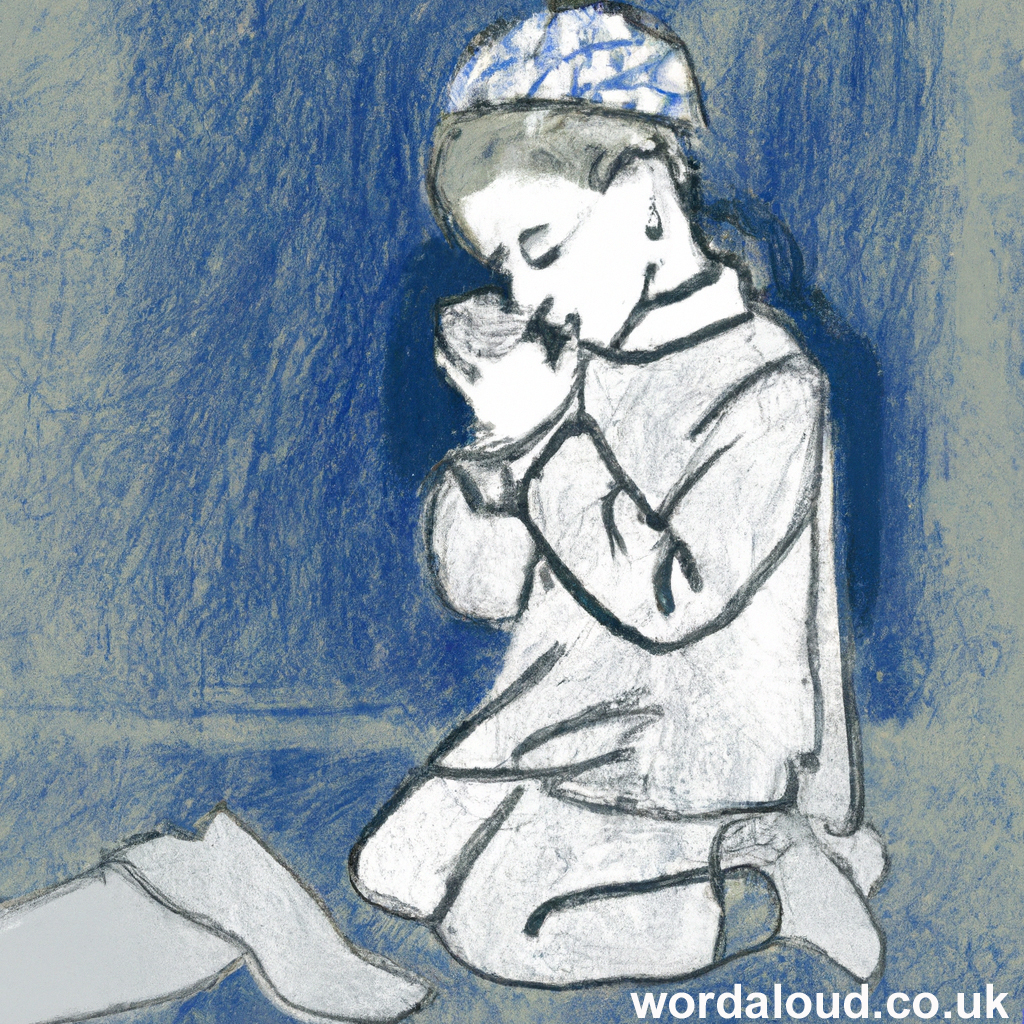
Psalm 26 declares innocence and an earnest request for divine scrutiny and vindication. It represents a heartfelt commitment to living a life characterized by integrity and righteousness as perceived by the Lord [ … ]

Saint Ambrose’s reflection on Psalm 44 (/Vg. 43) considers what might be one of the most persistent experiences in spiritual life: the feeling that God has turned away. Rather than offer abstract consolation, Saint Ambrose interprets this experience through the lens of faith, Scripture, and theology. His aim is to show that even when God seems absent, he remains present in a real and transformative way [ … ]
