
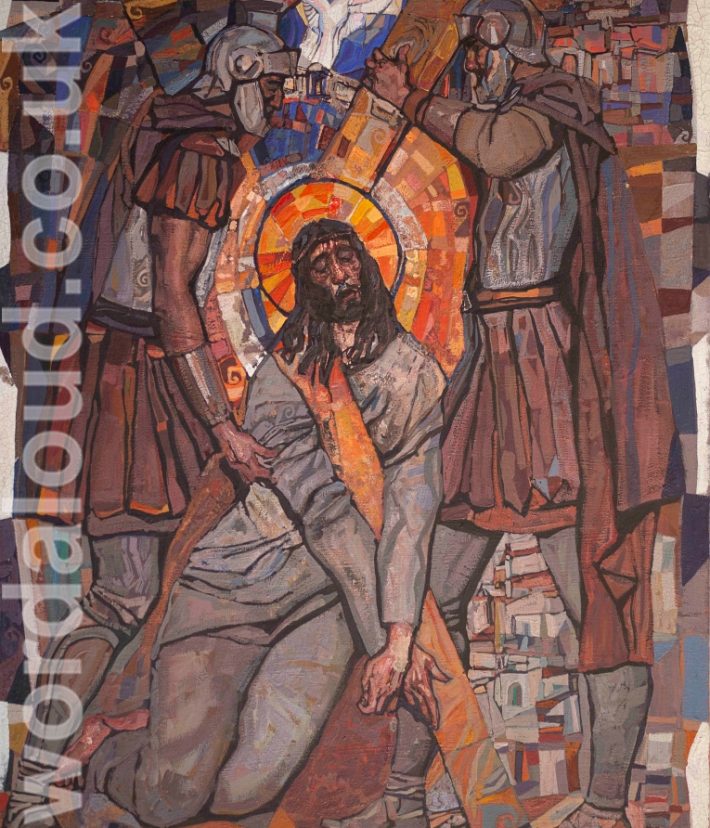
Christian Art | Via Dolorosa | Jesus Falls For The Second Time
Office Of Readings | Week 22, Tuesday, Ordinary Time | A Reading From The Imitation Of Christ | The Truth Of The Lord Endures For Ever
‘The truth of the Lord endures for ever.’
In this reading, the soul is brought face to face with the reality of divine judgement. The author begins with a description of God’s holiness and majesty in contrast to human frailty: ‘even the heavens are not pure in your sight.’ This recalls the words of Job’s friend Eliphaz: ‘Behold, God puts no trust in his holy ones, and the heavens are not pure in his sight.’ (Job 15:15) The implication is that if even angels are judged, mortals cannot presume on their own strength or goodness.
The reference to angels who ‘fell from heaven’ evokes the tradition of the rebellion of Satan and his followers (cf. Isaiah 14:12; Revelation 12:7–9). Likewise, the mention of stars falling from heaven reflects biblical imagery of cosmic collapse associated with judgement (Mark 13:25). This descent is contrasted with the humility of the believer who acknowledges his weakness: ‘I, mere dust, what should I expect?’ The text invites the reader to accept dependence upon God, since without divine preservation human effort is unstable and prone to collapse.
The image of those once ‘fed with the bread of angels’ turning instead to the husks of swine alludes to Psalm 78(77):25, which speaks of Israel being nourished with ‘the bread of angels’ in the wilderness, and to the parable of the prodigal son who longed to eat the husks given to pigs (Luke 15:16). Here, grace neglected leads to corruption; the nourishment of divine wisdom may be abandoned in favour of what is degrading.
The passage then shifts from images of sin and instability to a recognition of God’s sustaining action. Holiness, wisdom, and strength are only fruitful when upheld by God: ‘If you forsake us, we sink and perish; but if you visit us, we rise up and live again.’ This echoes Psalm 80(79):18–19: ‘Give us life, and we will call on your name. Restore us, O Lord God of hosts.’ The Christian life is therefore pictured as a continual reliance on God’s visitation and grace.
The closing reflections concern the vanity of human pride. Flesh is clay in the hands of its Maker (cf. Isaiah 64:8), unable to glorify itself apart from God. Empty words and human flattery cannot move the one whose heart is rooted in truth, since truth is identified with God himself (John 14:6). The passage concludes with the affirmation from Psalm 117(116):2, ‘The truth of the Lord endures for ever.’ This short psalm of universal praise assures the reader that God’s truth is not subject to decay, unlike the instability of human glory.
Thus the text calls the hearer to humility, vigilance, and dependence on God’s sustaining presence, warning against pride and empty speech while holding fast to the enduring stability of divine truth.

A Reading From The Imitation Of Christ | The Truth Of The Lord Endures For Ever
You thunder your judgements upon me, O Lord; you shake all my bones with fear and dread, and my soul becomes severely frightened. I am bewildered when I realise that even the heavens are not pure in your sight.
If you discovered iniquity in the angels and did not spare them, what will become of me? The stars fell from heaven, and I, mere dust, what should I expect? Those whose works seemed praiseworthy fell to the depths, and I have seen those who once were fed with the bread of angels take comfort in the husks of swine.
There is no holiness where you have withdrawn your hand, O Lord; no profitable wisdom if you cease to rule over it; no helpful strength if you cease to preserve it. If you forsake us, we sink and perish; but if you visit us, we rise up and live again. We are unstable, but you make us firm; we grow cool, but you inflame us.
All superficial glory has been swallowed up in the depths of your judgement upon me.
What is all flesh in your sight? Can the clay be glorified in opposition to its Maker?
How can anyone be stirred by empty talk if his heart is subject in the truth to God?
If a man is subject to truth, possession of the whole world cannot swell him with pride; nor will he be swayed by the flattery of his admirers, if he has established all his trust in God.
For those who do nothing but talk amount to nothing; they fail with their din of words, but ’the truth of the Lord endures for ever’.
Christian Prayer With Jesus Christ
Lord, you are our strength and our stability. Without you we fall, but in your presence we are raised to life. Preserve us from pride and vanity, and keep us rooted in your truth which endures for ever. Teach us to depend wholly upon your mercy, so that our words may be few and our hearts steadfast in you. Through Christ our Lord. Amen.
Glossary Of Christian Terms
Judgements – Here refers to God’s searching discernment of human hearts and actions, not merely punishments.
Iniquity – Moral wrongdoing or sin.
Stars fell from heaven – Biblical imagery signifying the downfall of angels or rulers (cf. Isaiah 14:12; Mark 13:25).
Bread of angels – A title for the manna given to Israel in the desert (Psalm 78:25), seen spiritually as God’s nourishing word or grace.
Husks of swine – From the parable of the prodigal son (Luke 15:16), symbolising spiritual poverty and degradation.
Clay and its Maker – A biblical metaphor (Isaiah 64:8) expressing the dependence of human beings upon God the Creator.
Flattery – Empty or insincere praise, contrasted with the firmness of truth.
The truth of the Lord endures for ever – A line from Psalm 117(116):2, emphasising the permanence of God’s faithfulness in contrast to human instability.



Psalm 149 is an exultant call to praise, inviting the congregation of the faithful to celebrate God’s glory and justice. The psalm intertwines themes of worship, divine favour, and the execution of judgment [ … ]
We are asked to consider the truth about ourselves and to consider the truth of freedom: what does it really mean for us to be free? [ … ]

Today’s Gospel verses again speak of the conflict between Jesus and the scribes and Pharisees, and again we sense the verses reflecting the breaking away of Christianity from Judaism, and the tensions in the aftermath of the fall of Jerusalem. Jesus’ rebuke of the scribes and Pharisees, the lawyers, is stinging. Jesus associates them with the history of murder of the righteous through Scripture, from the first murder of Abel to the murder of Zechariah, a prophet who died by stoning in Jerusalem around the year 800 BC because he accused the Jewish people of being unfaithful to God’s law (cf. 2 Chronicles 24: 20-22) [ … ]
