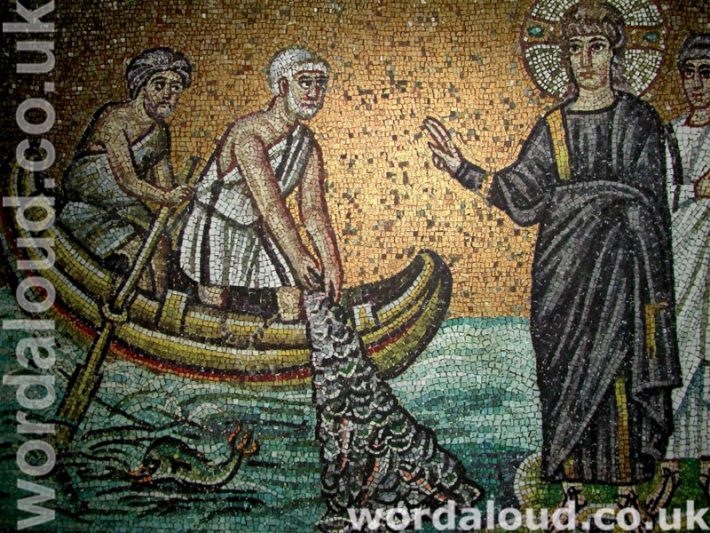
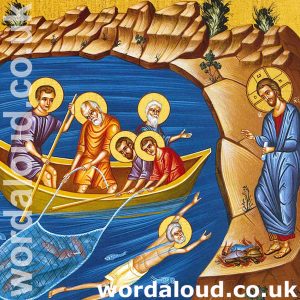
Christian Art | Jesus Calls The Fishermen To Be His Disciples And Fishers Of Men
Office Of Readings | Week 30, Friday, Ordinary Time | A Reading From The Works Of Baldwin Of Canterbury | The Word Of God Is Living And Active
‘The word of God is both living and powerful.’
Baldwin of Canterbury’s reflection centres on the divine Word as the active presence of God in creation, revelation, and redemption. His argument develops from the scriptural assertion that “the Word of God is living and powerful, sharper than any two-edged sword.” The Word, identified with Christ himself, is not merely speech or symbol but a reality that possesses life, communicates life, and effects change.
Baldwin first considers the Word in its eternal relation to the Father. It is “living” because it shares the divine life: the Father has given the Word life in himself, as he has life in himself. This expresses the eternal generation of the Son — the Word is not created but proceeds from the living God and therefore participates fully in the divine nature. To say that the Word “is life” rather than simply “is alive” distinguishes it from created beings; it is both source and principle of all vitality.
The Word’s power is then shown in its creative and redemptive work. It was through this Word that the world came into being, and through it the world is governed and restored. Baldwin joins the theology of creation to the theology of salvation: the same Word that called creation from nothing now calls humanity from death to life. When the Word was revealed in time through the apostles’ preaching, it carried the same divine efficacy. The human act of speaking the Word became the instrument through which divine power acted. Preaching, for Baldwin, is not the communication of information but a participation in the living energy of God. The outward sound of the preacher’s voice is joined to the inward action of grace in the listener’s heart.
The image of the “two-edged sword” expresses the Word’s penetrating discernment. It divides truth from falsehood and lays bare the thoughts of the heart. Baldwin interprets this as the spiritual power of Christ’s presence: the Word searches, judges, and renews the inner person. The “piercing” of the Word is not destructive but transformative — the incision by which false attachments are cut away so that new life may enter.
Throughout, Baldwin’s thought rests on the conviction that divine speech is always effective. God’s Word does not return empty but accomplishes what it declares. It acts in creation, in history, in the Church, and in the interior life of the believer. Thus, to encounter the Word is to be drawn into the living activity of God himself — the power that gives life, the truth that reveals, and the presence that renews.
A Reading From The Works Of Baldwin Of Canterbury | The Word Of God Is Living And Active
The word of God is both living and powerful and much more piercing than a two-edged sword. The word of God is plainly shown in all its strength and wisdom to those who seek out Christ, who is the word, the power and the wisdom of God. This word was with the Father in the beginning, and in its own time was revealed to the apostles, then preached by them and humbly received in faith by believers. So, the word is in the Father, as well as on our lips and in our hearts.
This word of God is living; the Father gave it life in itself, just as he has life in himself. For this reason it not only is alive, but it is life, as he says of himself: I am the way, the truth and the life. Since he is life, he is both living and life-giving. For, as the Father raises up the dead and gives them life, so also the Son gives life to those he chooses. He is life-giving when he calls the dead from the grave and says: Lazarus, come forth.
When this word is preached, in the very act of preaching it gives to its own voice, which is heard outwardly, a certain power which is perceived inwardly, so much so, that the dead are brought back to life and by these praises the sons of Abraham are raised from the dead. This word then is alive in the heart of the Father, on the lips of the preacher, and in the hearts of those who believe and love him. Since this word is so truly alive, undoubtedly it is full of power.
It is powerful in creation, powerful in the government of the universe, powerful in the redemption of the world. For what is more powerful, more effective? Who shall speak of its power; who shall make all its praises heard? It is powerful in what it accomplishes, powerful when preached. It does not come back empty; it bears fruit in all to whom it is sent.
It is powerful and more piercing than any two-edged sword when it is believed and loved. For what is impossible to the believer? What is difficult for a lover? When this word is spoken, its message pierces the heart like the sharp arrows of a strong man, like nails driven deep; it enters so deeply that it penetrates to the innermost recess. This word is much more piercing than any two-edged sword, inasmuch as it is stronger than any courage or power, sharper than any shrewdness of human ingenuity, keener than all human wisdom, or the subtlety of learned argument.
Christian Prayer With Jesus
Lord Jesus Christ, eternal Word of the Father,
you speak life where there is death,
truth where there is confusion,
and peace where there is discord.
Grant that your Word may dwell richly in us,
cutting away all that obscures your light,
and opening our hearts to the knowledge of the Father.
May your voice, once heard in creation and now in your Church,
awaken faith, strengthen obedience,
and renew the face of the earth.
For you live and reign with the Father and the Holy Spirit,
one God, now and for ever.
Amen.
Glossary Of Christian Terms
Word (Logos): A term drawn from Greek philosophy and Johannine theology, referring to the divine self-expression of God; in Christian doctrine, it identifies the Son, the second Person of the Trinity.
Efficacy: The capacity of a divine action or word to bring about the reality it signifies; an essential feature of God’s speech in Scripture and sacrament.
Incarnation: The taking of human nature by the eternal Word in the person of Jesus Christ; the entry of divine life into human history.
Revelation: God’s act of making himself known, whether through creation, Scripture, or the living Word.
Preaching (kerygma): The public proclamation of the Word of God, understood not merely as instruction but as participation in divine power.
Two-edged sword: A biblical image for the discerning and penetrating action of the Word, which divides truth from falsehood and reveals the heart.
Grace: The active presence and operation of God in the human person; the inward effect of the preached Word.
Discernment: The process by which the Word unveils motives, intentions, and the direction of the soul in relation to God.
Providence: The ordering and sustaining activity of God in the world, through which the Word governs creation and redemption.
Theology of the Word: The study of the Word’s presence in Scripture, creation, and the believer; a central theme in medieval and patristic theology.



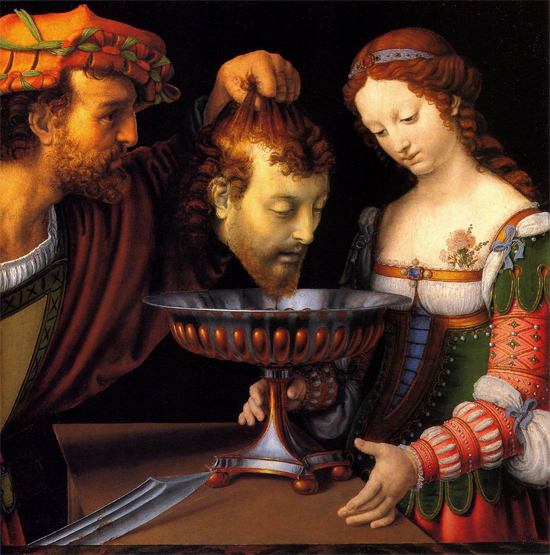
Today’s Gospel verses provide great insight into the political constitution of Jesus’ homeland during the lifetime of Jesus. Herod the tetrarch, Herod Antipas, is in charge, a client of the Roman Empire and son of Herod the Great. He governed Galilee and Perea. He was married, according to the Jewish historian Flavius Josephus, to a daughter of an Arabian king, but lived in concubinage with Herodias, his brother’s wife [ … ]

In Jericho, we approach the end of Jesus’ journey. It was in Jericho that the long road of exodus of forty years in the desert ended. For Jesus and his fellow pilgrims, this is the last stage before the ascent to Jerusalem. Jesus’ mission on Earth is soon to be complete [ … ]
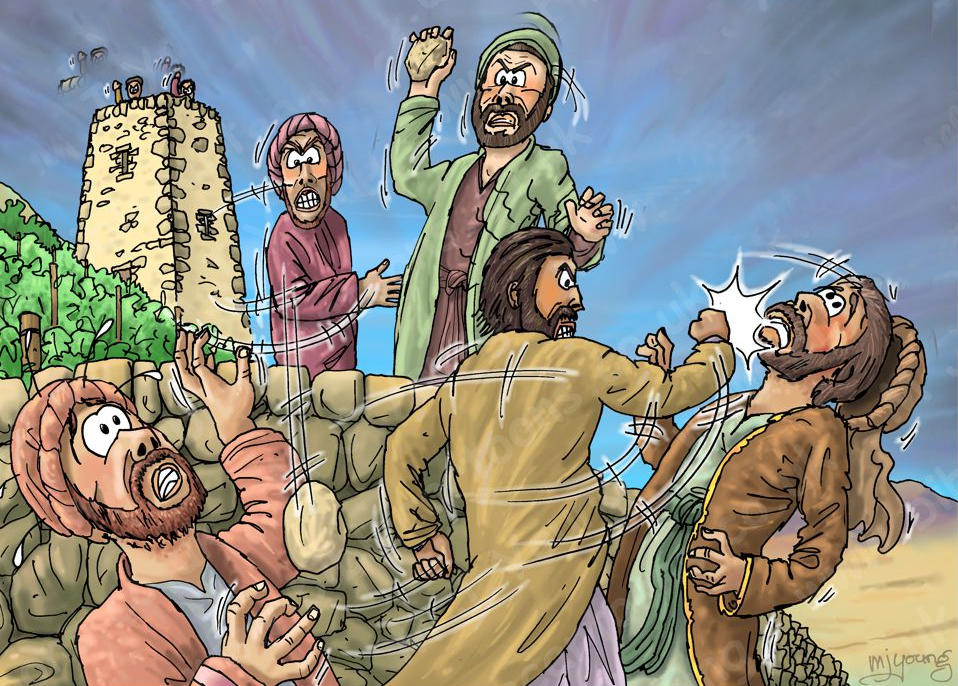
Jesus offers the parable of the wicked tenants as part of a larger discourse in which he responds, in the Temple, to the challenge of the scribes and the elders of the people concerning his authority. The parable leads the entrenched Jewish authorities to see the truth for themselves and yet still to reject the truth about themselves. Though their lives could have been enlightened by the parable, they refuse conversion and rather seek to arrest Jesus. They have the option to choose good; they choose evil [ … ]