
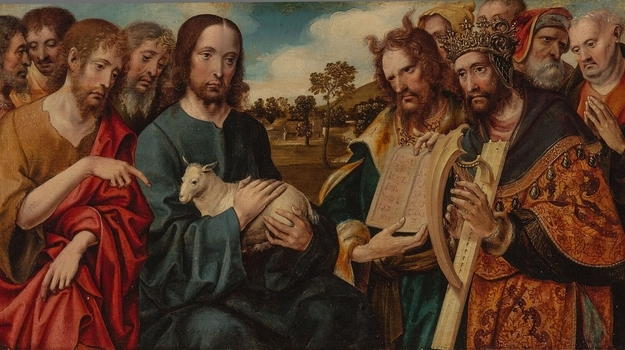
Christian Art | Easter To Pentecost
John 10: 22-30 | King James Audio Bible | Daily Verses
22 ¶ And it was at Jerusalem the feast of the dedication, and it was winter.
23 And Jesus walked in the temple in Solomon’s porch.
24 Then came the Jews round about him, and said unto him, How long dost thou make us to doubt? If thou be the Christ, tell us plainly.
25 Jesus answered them, I told you, and ye believed not: the works that I do in my Father’s name, they bear witness of me.
26 But ye believe not, because ye are not of my sheep, as I said unto you.
27 My sheep hear my voice, and I know them, and they follow me:
28 And I give unto them eternal life; and they shall never perish, neither shall any man pluck them out of my hand.
29 My Father, which gave them me, is greater than all; and no man is able to pluck them out of my Father’s hand.
30 I and my Father are one.
The Feast of the Dedication commemorates the episode in Jewish history, as recorded in Maccabees, when, in the year 165 BC, after he had liberated Jerusalem from the control of the Seleucid kings of Syria, Judas Maccabeus cleansed the Temple of the profanations of Antiochus Epiphanes. Falling toward the end of the year, it is also known as the Festival of Lights, because it was the custom to place lamps, signifying the Law, in the windows of houses.
The Jews ask Christ if he is the Messiah, but it is not an honest question seeking to find the truth. Jesus has already spoken truthfully to the people, and he has given them signs of his divinity, performed in his Father’s name.
We remember that in John’s Gospel the word ‘Jews’ is often synonymous with the authorities in the Temple, the scribes, the chief priests, the Pharisees, those with vested interests.
It is the Temple authorities who have distorted the Law, such as to make God’s house a place of trade, in effect a market place, and who themselves cannot see the truth of Jesus as he offers himself openly before them, while they have also led others, whom they should shepherd, to such blindness.
There are people who seek to fit Jesus into their own preconceptions of how the Messiah should be, who refuse the gift of grace, who refuse belief, and so who cannot be with Jesus, really through their own choice, who give themselves over to death instead of life everlasting.
Jesus returns to the parable of the good shepherd. Through grace, his sheep hear and recognize Jesus the good shepherd’s voice.
Through grace and through prayer, we have belief, and we have mutual knowledge and understanding of Jesus. Often this is not an easy journey, but we see and we listen, and so we find our true shepherd.
Jesus now speaks of his union with his Father. In these Bible verses, Jesus explains that we have been given to him by the Father. Through Jesus’ complete obedience to his Father’s will, in fulfilling the great plan of our salvation, Jesus shows himself to be the Son of the Father, and the Father and the Son to be two persons, distinct, yet of one substance: I and the Father are one.
This great truth develops through the course of John’s Gospel. Earlier Jesus proclaimed that God was his Father, thereby angering the Jewish authorities by making himself equal with God, which to them was a blasphemy worthy of death. There will be further revelations of this mystery at the Last Supper – see John 13-17. And right from the start of John’s Gospel, we contemplate the mystery of Christ’s divinity and his relationship with God the Father: ‘In the beginning was the Word, and the Word was with God, and the Word was God.’ Christ is the perfect revelation of God. He is truth incarnate.
‘Listen to what the Lord says: “You see in me your body, your limbs, your organs, your bones, your blood. If you are afraid of what belongs to God, why do you not love that which is your own? If you run away from your Lord, why do you not run back to your kinsman?
‘“Perhaps you are afraid because of the greatness of the passion which you inflicted on me. Do not be afraid. This cross is not mine; it is the sting of death. These nails do not pierce me with pain; they pierce me more greatly with love of you. These wounds do not draw groans from me; rather they draw you into my heart. The stretching out of my body makes room for you in my heart; it does not increase my pain. My blood is not lost to me; it is paid in advance for your ransom.”’ St Peter Chrysologus

Audio Bible KJV | Endnotes
What Were The Expectations Of The Jews Concerning The Messiah, The Christ, At The Time Of Jesus?
John 10:22-30 is set during the Feast of Dedication, also known as Hanukkah, in Jerusalem. Jesus is walking in the temple and is approached by Jews who ask him if he is the Messiah, the Christ, that they have been waiting for. This passage provides insight into the expectations that the Jews had concerning the Messiah, the Christ, at the time of Jesus.
To understand the expectations of the Jews concerning the Messiah, it is necessary to delve into the history and religious beliefs of the Jewish people. The Jews had been waiting for the Messiah, the Anointed One, for centuries. They believed that the Messiah would be a king who would restore Israel to its former glory and rule over a new kingdom of God on Earth. They also believed that the Messiah would be a military leader who would defeat Israel’s enemies and establish peace and security for the Jewish people.
The expectation of a powerful military leader is evident in passages such as Isaiah 9:6-7, which reads: ‘For unto us a child is born, unto us a son is given: and the government shall be upon his shoulder: and his name shall be called Wonderful, Counsellor, The mighty God, The everlasting Father, The Prince of Peace. Of the increase of his government and peace there shall be no end, upon the throne of David, and upon his kingdom, to order it, and to establish it with judgment and with justice from henceforth even forever.’
Similarly, the expectation of a political king is reflected in passages such as Micah 5:2-4, which reads: ‘But thou, Bethlehem Ephratah, though thou be little among the thousands of Judah, yet out of thee shall he come forth unto me that is to be ruler in Israel; whose goings forth have been from of old, from everlasting. And he shall stand and feed in the strength of the LORD, in the majesty of the name of the LORD his God; and they shall abide: for now shall he be great unto the ends of the earth. And this man shall be the peace, when the Assyrian shall come into our land: and when he shall tread in our palaces, then shall we raise against him seven shepherds, and eight principal men.’
The Jewish people also believed that the Messiah would be a prophet like Moses. Deuteronomy 18:18-19 reads: ‘I will raise them up a Prophet from among their brethren, like unto thee, and will put my words in his mouth; and he shall speak unto them all that I shall command him. And it shall come to pass, that whosoever will not hearken unto my words which he shall speak in my name, I will require it of him.’
Moreover, the Jewish people believed that the Messiah would be a descendant of King David. This expectation is reflected in passages such as Jeremiah 23:5-6, which reads: ‘Behold, the days come, saith the LORD, that I will raise unto David a righteous Branch, and a King shall reign and prosper, and shall execute judgment and justice in the earth. In his days Judah shall be saved, and Israel shall dwell safely: and this is his name whereby he shall be called, THE LORD OUR RIGHTEOUSNESS.’
The expectations of the Jewish people concerning the Messiah, the Christ, at the time of Jesus are reflected upon by religious authorities through the ages. Saint Thomas Aquinas, a Catholic theologian, wrote in his Summa Theologica that ‘the office of Christ pertains to a king, a priest, and a prophet’ and that ‘the Messiah should be a descendant of David according to the flesh’.
Martin Luther, a Protestant reformer, also believed in the expectation of a political king as the Messiah. In his commentary on Isaiah, he wrote: ‘Christ himself came not to set up an earthly kingdom or government but a spiritual kingdom in which he rules in faith in the hearts of his people.’
Not all religious authorities agreed on the expectations of the Messiah. For example, the Jewish philosopher Maimonides believed that the Messiah would be a purely human figure and not divine. He also believed that the Messiah would bring about a peaceful and prosperous era, but not necessarily through military conquest.
In conclusion, expectations of the Jews concerning the Messiah, the Christ, at the time of Jesus were primarily focused on a powerful military leader and political king who would restore Israel to its former glory and establish a new kingdom of God on earth. They also believed that the Messiah would be a prophet like Moses and a descendant of King David. Ultimately, Jesus’ teachings and actions did not align with the expectations of the Messiah held by many Jews of his time.


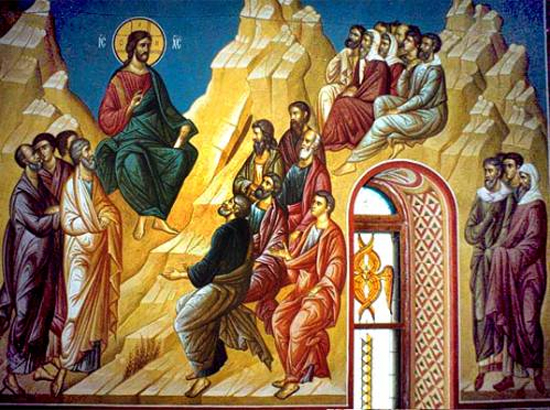
The Beatitudes form our gateway to the Sermon on the Mount, the first of the great five discourses which are recounted in Matthew’s Gospel, and a beautiful invitation to be with Jesus, a programme by which we may live a Christian life. Moses ascended a mountain to be with God and to bring the Law back to the people. Now Jesus ascends this mountain and draws the people with him, both his disciples and the multitude, and here he reforms and brings new life to the Law, teaching with authority as only he can [ … ]
Psalm 53 reflects on faith and consequences of disbelief. The psalm echoes themes found in Psalm 14, offering a compelling exploration of the nature of human folly and the importance of seeking God [ … ]
Psalm 138, a psalm of David, opens with a declaration of wholehearted praise. The psalmist commits to singing praises before the gods, a gesture of both defiance and faith. This act, set against a backdrop of a polytheistic world, underscores the psalmist’s devotion to the one true God [ … ]
