
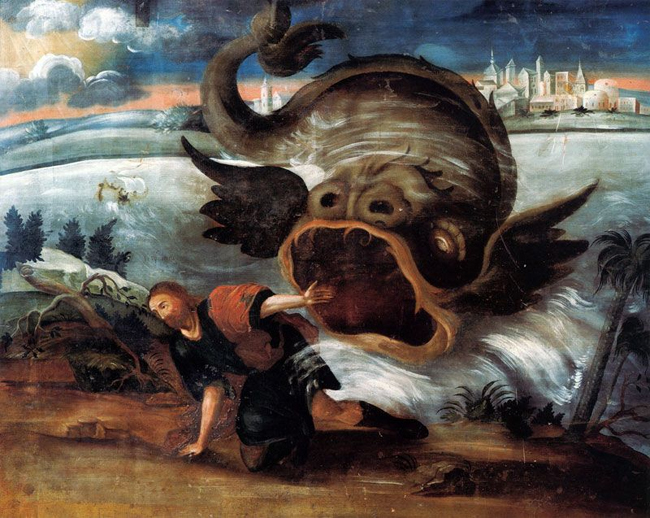
Christian Art | Sign Of Jonah | King James Audio Bible | Jonah And The Whale
Luke 11: 29-32 – Lent Week 1, Wednesday; Monday Week 28, Ordinary Time (King James Audio Bible)
29 ¶ And when the people were gathered thick together, he began to say, This is an evil generation: they seek a sign; and there shall no sign be given it, but the sign of Jonas the prophet.
30 For as Jonas was a sign unto the Ninevites, so shall also the Son of man be to this generation.
31 The queen of the south shall rise up in the judgment with the men of this generation, and condemn them: for she came from the utmost parts of the earth to hear the wisdom of Solomon; and, behold, a greater than Solomon is here.
32 The men of Nineveh shall rise up in the judgment with this generation, and shall condemn it: for they repented at the preaching of Jonas; and, behold, a greater than Jonas is here.
The crowds gather to see and to hear Jesus. Among them, as Matthew relates in his Gospel (Matthew 12: 38-42), are the scribes and Pharisees, who ask for a sign from Jesus to prove his divinity. Jesus refuses to confirm his preaching with dramatic signs. It is his teaching Jesus wishes the people to hear. Through seeking to taunt Jesus, and through their unbelief, the scribes and the Pharisees express the hardness of their hearts. Christ is present to them and they refuse to see. Christ is speaking to them and they refuse to hear. Through the Gospel, we have witnessed Christ’s miracles. And we are called to hear his word. ‘An evil and adulterous generation seeketh after a sign.’
Christ throws the taunts of the scribes and the Pharisees back at them: ‘This is an evil generation: they seek a sign; and there shall no sign be given it, but the sign of Jonas the prophet.’ Jesus replies, in other words, by announcing the mystery of his death and resurrection, using the parallel of the case of Jonah. Matthew tells us of Christ’s explanation of what he has said: ‘For as Jonas was three days and three nights in the whale’s belly; so shall the Son of man be three days and three nights in the heart of the earth.’
Jonah was sent by God to Nineveh, in Mesopotamia. He was a sign to them. Through his preaching, the people of Nineveh were converted and did penance, accepting his message. It is a striking contrast with the response of the people to Jesus, one infinitely greater than he who prefigured him.
The crowds are also reminded of the great journey of the Queen of Sheba to hear the wisdom of Solomon. Jesus is prefigured also in Solomon, whom Jewish tradition saw as the epitome of the wise man. The pagan Queen makes such effort to hear Solomon’s wisdom, and yet the Jews, the people of God, cannot recognise Christ, who is infinitely greater than Solomon.
It is the converts who will rise to condemn this generation who reject Christ when the day of judgement is here. Christ’s message, the Gospel, will spread through the world to the Gentiles, and as St Paul teaches, Christ does not require circumcision of us. We are called to a deep conversion through our hearing of Christ’s word. We are called to hear the word of God and keep it.
‘When Jesus the son of Nun passed over the Jordan with his people, he circumcised them a second time with a stone knife. Jesus our Saviour circumcises a second time, with circumcision of the heart, those who believe in him and are washed in baptism. They are circumcised with a sword which is his word, sharper than any two-edged sword… Blessed are those who are circumcised in their hearts and are born again of water in this second circumcision. They will share in the inheritance of Abraham.’ Aphraates

King James Audio Bible | Endnotes
How Does Jesus Teach That He Is God The Son?
In the Gospel of John, Jesus identifies himself as the Son of God, saying: ‘I and my Father are one.’ (John 10:30, KJV) This statement is often interpreted as a claim to equality with God. In John 8:58, Jesus tells the Jews: ‘Before Abraham was, I am.’ Jesus uses the same divine name that God revealed to Moses in Exodus 3:14. This statement also implies that Jesus existed before Abraham and is therefore eternal.
The Gospels can be understood to constitute a progressive revelation on the part of Jesus of his divinity. Jesus teaches that the Kingdom of Heaven is at hand, and that he is the gateway. The parables all point this way. Jesus’ forgiveness of sin in healing miracles establishes an equality with God the Father. Perhaps in Saint John’s Gospel, the great Priestly Prayer of Jesus becomes the definitive statement.
Jesus’ Prayer In The Garden Of Gethsemane
In the Garden of Gethsemane, Jesus reveals his divinity through his deep anguish and willingness to fulfill God’s plan for salvation. As he prays, ‘O my Father, if it be possible, let this cup pass from me: nevertheless not as I will, but as thou wilt,’ (Matthew 26:39 KJV) Jesus demonstrates his submission to the will of the Father and his willingness to endure the suffering and death that await him.
Jesus’ prayer in the Garden of Gethsemane also reveals his intimate relationship with God, and highlights his unique role as the Son of God. As he prays, ‘Abba, Father, all things are possible unto thee; take away this cup from me: nevertheless not what I will, but what thou wilt,’ (Mark 14:36 KJV) Jesus uses the Aramaic word ‘Abba’ to address God, a term that conveys a sense of intimacy and trust. This prayer shows Jesus’ complete trust in the Father, even in the face of unimaginable suffering.
The Parable Of The Prodigal Son
In the Parable of the Prodigal Son, Jesus tells the story of a wayward son who squanders his inheritance but is welcomed back by his loving father. This parable emphasizes the themes of forgiveness and redemption, and highlights God’s boundless mercy toward those who turn back to him.
Through the character of the father in the parable, Jesus teaches with authority. It is a radical renewal and a turning around of the old Law. The identity of Jesus as of Christian faith – of all Christians – becomes transformed to a way of forgiveness – free gift freely offered of salvation.
Like the father in the parable, Jesus is willing to welcome back those who have strayed and to extend mercy to those who seek it. God is love. Jesus is love. We are asked by Jesus to transcend our petty squabbles and our clinging to inconsequential and such trivial nonsense.
Jesus as a person offers himself as the vehicle to carry us from ‘the devil made me do it’ world to selfless joy in heaven:
‘Then spake Jesus again unto them, saying, I am the light of the world: he that followeth me shall not walk in darkness, but shall have the light of life.’ (John 8:12)




This passage from Saint Irenaeus’ Against the Heresies provides a foundational second-century witness to the Church’s understanding of Pentecost, the role of the Holy Spirit, and the renewal of humanity through divine grace. Writing in a time when the Church faced doctrinal challenges—particularly from Gnostic sects that denied the goodness of creation—Irenaeus offers a vision of salvation that is incarnational, communal, and cosmic in scope [ … ]
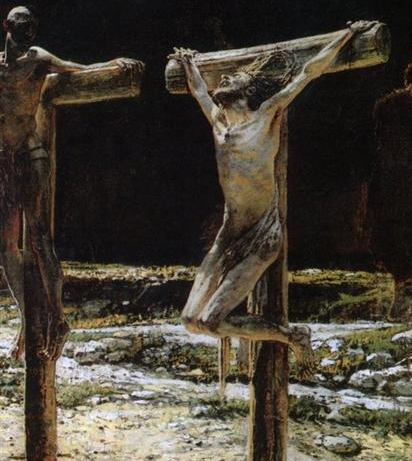
Jesus orders his disciples to keep his true identity, as the Messiah, a secret. We might wonder why this should be. One answer to this is that many of the people of whom we read in the Bible were hoping for and expecting the coming of the Messiah, who would lead the Jewish people to freedom, and yet their expectation – of a new judge or great warrior king – was not in accord with Christ’s true purpose, namely to serve and to suffer and so to save [ … ]

John the Baptist was sent to prepare the way of Jesus, to call the people to repentance of their sins, such that their souls could be readied to receive the grace of our Lord. He was the precursor, the last of a long line of prophets awaiting Christ. As he baptized, he told the people that one greater than he was to come [ … ]