
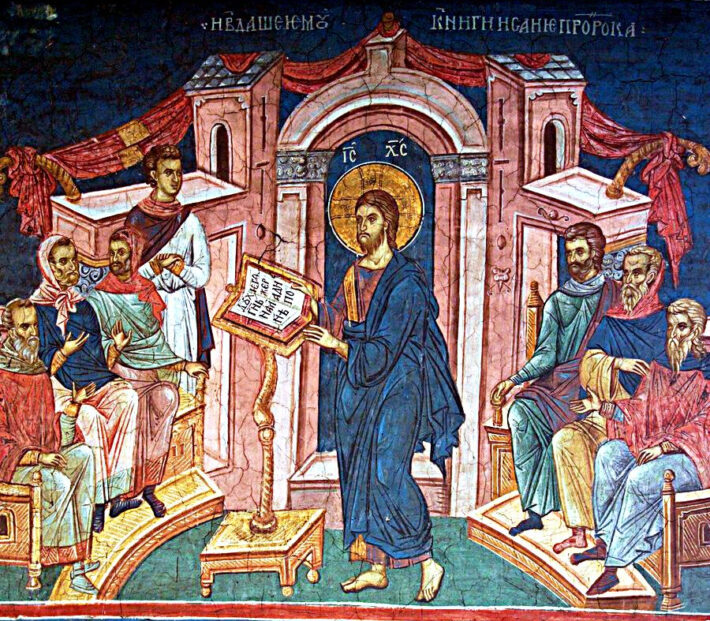
Christian Art | Jesus Teaches In The Synagogue | To Preach The Acceptable Year Of The Lord
Luke 4: 14-22 – Thursday after Epiphany – also 10 January. (Audio Bible, Spoken Word)
14 ¶ And Jesus returned in the power of the Spirit into Galilee: and there went out a fame of him through all the region round about.
15 And he taught in their synagogues, being glorified of all.
16 ¶ And he came to Nazareth, where he had been brought up: and, as his custom was, he went into the synagogue on the sabbath day, and stood up for to read.
17 And there was delivered unto him the book of the prophet Esaias. And when he had opened the book, he found the place where it was written,
18 The Spirit of the Lord is upon me, because he hath anointed me to preach the gospel to the poor; he hath sent me to heal the brokenhearted, to preach deliverance to the captives, and recovering of sight to the blind, to set at liberty them that are bruised,
19 To preach the acceptable year of the Lord.
20 And he closed the book, and he gave it again to the minister, and sat down. And the eyes of all them that were in the synagogue were fastened on him.
21 And he began to say unto them, This day is this scripture fulfilled in your ears.
22 And all bare him witness, and wondered at the gracious words which proceeded out of his mouth. And they said, Is not this Joseph’s son?
On the Sabbath, the day of rest and prayer, the Jews would gather in synagogues to recite the Shema and the eighteen blessings, which would be followed by readings from the Book of the Law, the Pentateuch, and from the Prophets. In today’s Gospel verses, Jesus has returned home to Nazareth, where, in the synagogue, he volunteers to read.
The passage Jesus reads, or begins to read, is from Isaiah 61 – Jesus reads the first verse and part of the second, before he abruptly halts the reading. The verses become Jesus’ first messianic declaration, according to Luke, in which Jesus tells the people that he has been anointed by the Holy Spirit for the mission the Father has entrusted to him, to bring redemption.
The reading of Isaiah captures much that we know of Jesus’ teaching. It is the poor who will hear the good news, those who have an attitude of humility toward God, and frankly acknowledge their spiritual need and dependency, trusting in God’s love and mercy, rather than relying on any possessions or merits so as to deserve salvation, trusting in grace alone. It is in this manner that those who are captives of sin, and so blinded by sin, may be freed by Jesus. We will be liberated by Jesus from slavery to the devil and from eternal death.
Isaiah’s words proclaim a jubilee year, ‘the acceptable year of the Lord’, which the Law laid down as occurring every fifty years, and which symbolized the era of redemption and liberation which the Messiah would bring. This era is now inaugurated by Christ. This is the time of mercy and redemption, which culminates in heaven. It is the time of the New Law. In the person of Jesus, the Scripture has been fulfilled.
Jesus, though, is doing more in these Bible verses than marking the fulfilment of the prophecies of Isaiah. By stopping the reading abruptly, Jesus is also commentating on and changing the import of the reading. In Isaiah, the verse continues: ‘and the day of vengeance of our God.’ Those listening to Jesus read in the synagogue would expect the verse to continue, but vengeance is not why Jesus is here. There should instead be forgiveness between enemies, a general healing of society. There has been conflict between people for too long – liberty, forgiveness, mercy should be preached to all.
3 And many people shall go and say, Come ye, and let us go up to the mountain of the Lord, to the house of the God of Jacob; and he will teach us of his ways, and we will walk in his paths: for out of Zion shall go forth the law, and the word of the Lord from Jerusalem.
4 And he shall judge among the nations, and shall rebuke many people: and they shall beat their swords into plowshares, and their spears into pruninghooks: nation shall not lift up sword against nation, neither shall they learn war any more. (Isaiah 2: 3-4.)
Through your Son, Lord God,
you shed your eternal light on all mankind.
Give us grace to acknowledge the full splendour of our Redeemer,
so that, going from glory to glory,
we may come at length to your everlasting light.
Through Christ our Lord.




Dear Jesus, Thank you for the blessing of family. Help me to appreciate and cherish my family members, both biological and spiritual. Guide me to be a source of love, support, and encouragement to them. Grant us the strength to overcome challenges together and to celebrate our joys with gratitude. May our family be a reflection of your love and grace. Help us to forgive one another, to be patient, and to build each other up. Let your peace reign in our home, and may we always seek to do your will. Amen [ … ]

This reading explains why the true humanity of Jesus Christ is essential for salvation. Saint Leo insists that it is not enough to say that Jesus was human in a general sense. Jesus must be recognised as truly belonging to human history, descended from the line traced in the Gospels [ … ]

Saint Cyprian begins by marvelling at the concise and powerful form of the Lord’s Prayer, a summary of all Christian petitions. He references Isaiah to underscore how God’s message is brief yet filled with justice and truth. This is a significant theological point: God’s wisdom is not obscure or elitist. The Lord’s Prayer, taught by Christ himself, is accessible to all – young and old, educated and uneducated. It reflects a democratic grace in Christian spirituality [ … ]
