

Christian Art | Martyrdom Of John The Baptist
Mark 6: 14-29 – Week 4 Ordinary Time, Friday (Audio Bible KJV, Spoken Word)
14 And king Herod heard of him; (for his name was spread abroad:) and he said, That John the Baptist was risen from the dead, and therefore mighty works do shew forth themselves in him.
15 Others said, That it is Elias. And others said, That it is a prophet, or as one of the prophets.
16 But when Herod heard thereof, he said, It is John, whom I beheaded: he is risen from the dead.
17 For Herod himself had sent forth and laid hold upon John, and bound him in prison for Herodias’ sake, his brother Philip’s wife: for he had married her.
18 For John had said unto Herod, It is not lawful for thee to have thy brother’s wife.
19 Therefore Herodias had a quarrel against him, and would have killed him; but she could not:
20 For Herod feared John, knowing that he was a just man and an holy, and observed him; and when he heard him, he did many things, and heard him gladly.
21 And when a convenient day was come, that Herod on his birthday made a supper to his lords, high captains, and chief estates of Galilee;
22 And when the daughter of the said Herodias came in, and danced, and pleased Herod and them that sat with him, the king said unto the damsel, Ask of me whatsoever thou wilt, and I will give it thee.
23 And he sware unto her, Whatsoever thou shalt ask of me, I will give it thee, unto the half of my kingdom.
24 And she went forth, and said unto her mother, What shall I ask? And she said, The head of John the Baptist.
25 And she came in straightway with haste unto the king, and asked, saying, I will that thou give me by and by in a charger the head of John the Baptist.
26 And the king was exceeding sorry; yet for his oath’s sake, and for their sakes which sat with him, he would not reject her.
27 And immediately the king sent an executioner, and commanded his head to be brought: and he went and beheaded him in the prison,
28 And brought his head in a charger, and gave it to the damsel: and the damsel gave it to her mother.
29 And when his disciples heard of it, they came and took up his corpse, and laid it in a tomb.
Herod the tetrarch, Herod Antipas, the son of Herod the Great, was a client ‘king’ of the Romans. He is highly alert to the in/stability of his region and to his own position within the Roman authority. We may imagine that the fear of a popular leader amassing a following and potentially threatening authority contributed to the arrest of John the Baptist, this in addition to the reason we are given in the Gospel, which is that John had told Herod how immoral he was being in marrying his brother’s wife Herodias.
We become aware in our reading of these verses that Herod seems very much not his own man and conflicted. Despite his position as a client king, caught between the people and the Roman power, and despite his marriage to Herodias, Herod responds to John the Baptist’s conversation and seems to know what is good. When he is so foolish as to kill John the Baptist because of his silly vow, made when he is overcome with sexual impulses, he knows that he is in the wrong and feels terrible regret as he orders the killing.
Herod is so caught up in the trap of his false and immoral position that, even when he could have renounced the falsity and turned to the good, converted, he sticks with the evil, commits to it, resisting conversion, and the death of John the Baptist is ordered and made so. We may find ourselves repelled as we look on this situation by how far a person can sink consciously into evil and then further evil, first beguiled by strange pleasures and then committing to that choice to do evil. Herod has given himself to evil. He is haunted and he is lost.
John the Baptist was the precursor. He came to pave the way for Jesus. When Jesus was ready to begin his ministry, John the Baptist gave way. It is fitting that at this point in Jesus’ ministry John the Baptist’s fate should be revealed. Jesus has taken up the torch – it is his time, to complete what he was made incarnate to accomplish. This is the environment he works in: it is dangerous and it is full of sin; the expectation of self-sacrifice for preaching the good, the truth, hangs in the air, as if people can only bear so much love, so much reality. Nonetheless, Jesus goes forward.
6 There was a man sent from God, whose name was John.
7 The same came for a witness, to bear witness of the Light, that all men through him might believe.
8 He was not that Light, but was sent to bear witness of that Light.
9 That was the true Light, which lighteth every man that cometh into the world.
10 He was in the world, and the world was made by him, and the world knew him not.
11 He came unto his own, and his own received him not.
12 But as many as received him, to them gave he power to become the sons of God, even to them that believe on his name:
13 Which were born, not of blood, nor of the will of the flesh, nor of the will of man, but of God. (John 1: 6-13)
Concluding Prayer
Lord God,
bestow a full measure of your grace on us
who gather in prayer.
As you work within us
to keep us in the path of your commandments,
may we receive consolation in this present life
and eternal joy in the next.
We make our prayer through our Lord.



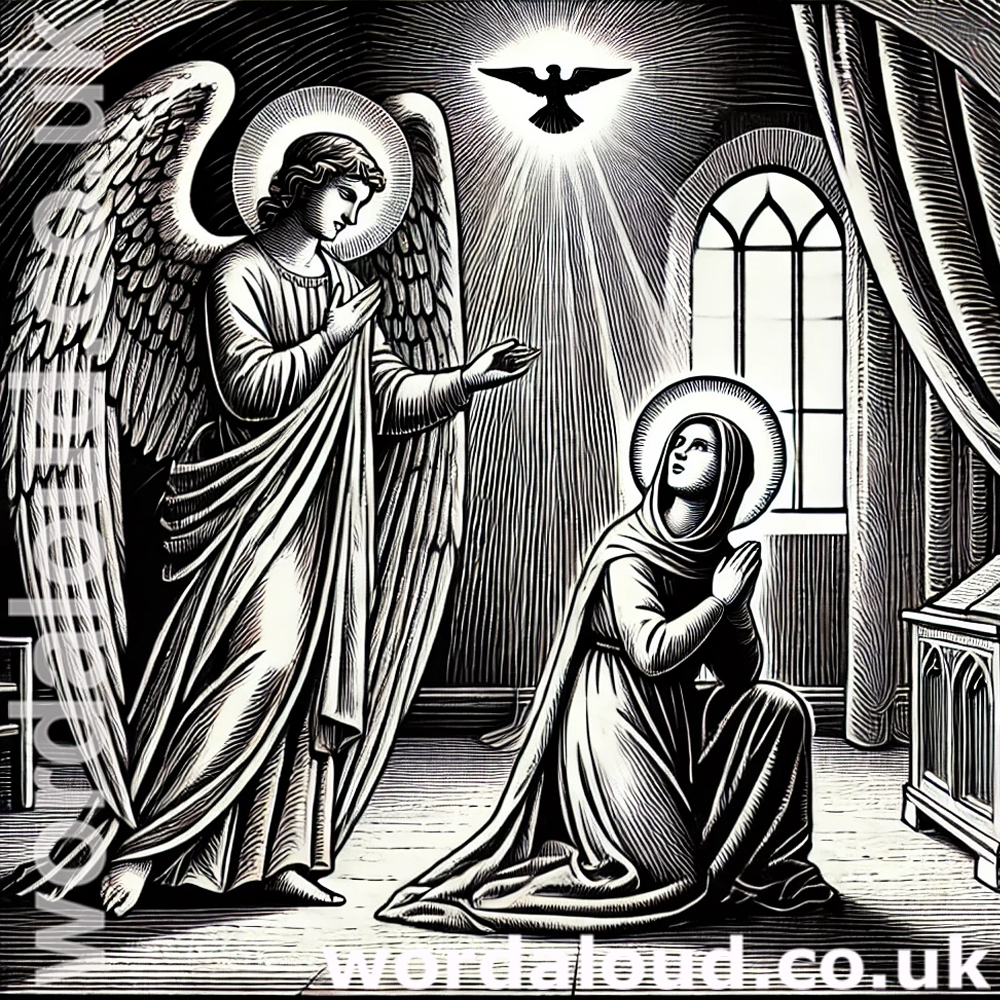
Saint Bernard begins with the claim that ‘there was only one mode of birth that was worthy of God, and that was to be born of a virgin’. With this statement he places the Incarnation within a framework of fittingness (convenientia), a theological mode of reasoning that asks what befits the majesty and holiness of God. The divine birth, he argues, required a vessel untouched by stain, a mother who would embody in her body and soul the purity and humility of the Son whom she would bear [ … ]
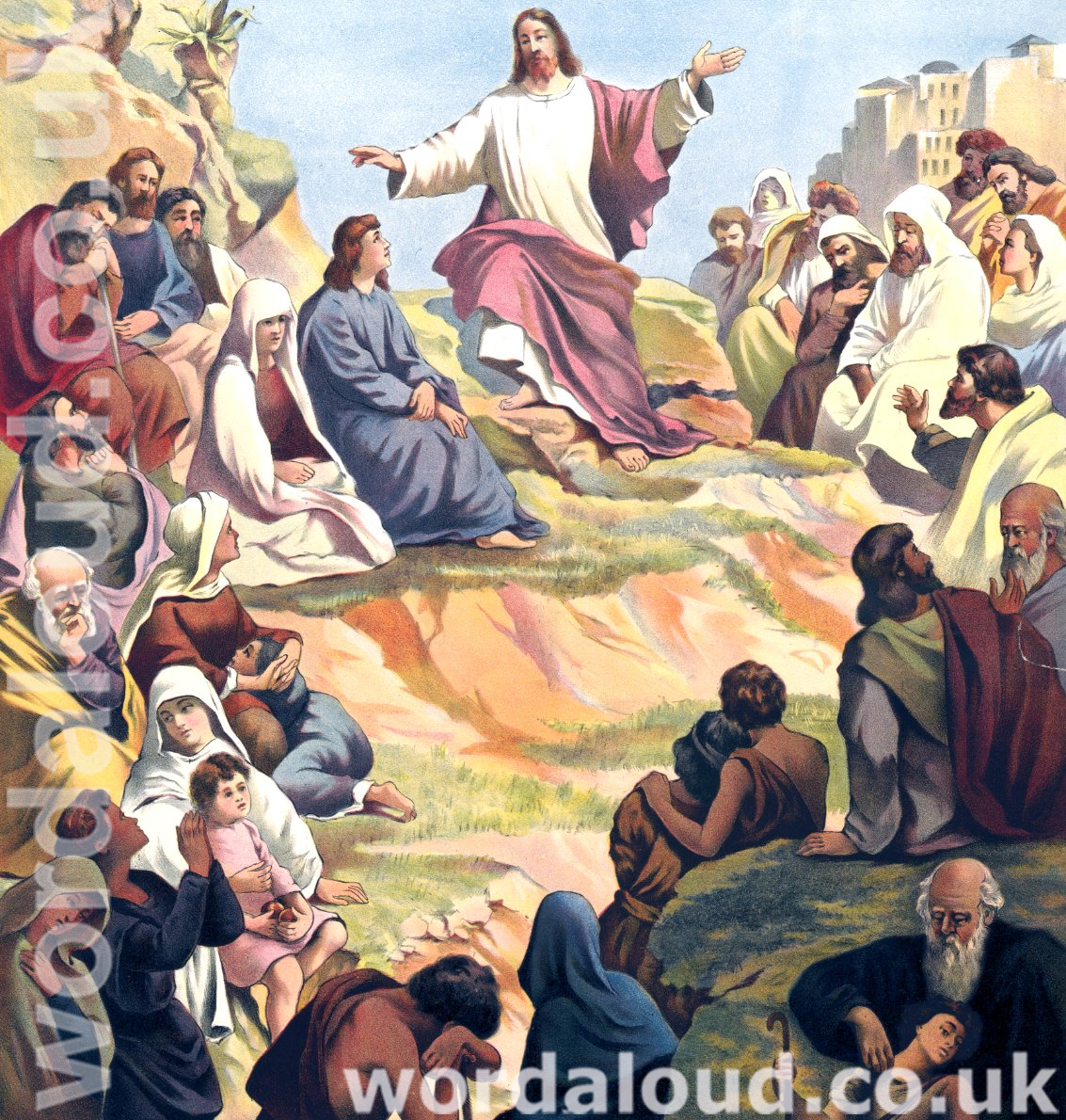
Pope Saint Leo the Great’s exposition of the first Beatitude, ‘Blessed are the poor in spirit, for theirs is the kingdom of heaven,’ (Matthew 5:3) sets poverty of spirit in relation to both material poverty and spiritual detachment. His reflection is situated within the wider Christian tradition that viewed the Beatitudes as the programme of the Christian life, and particularly as an introduction to the Sermon on the Mount [ … ]

Christian Art | George Herbert | The Temple | The Church | The Sinner George Herbert | The Temple | The Church | The Sinner Lord, how I am all ague, when I seek What I have treasur’d in my memorie! Since, if my soul make even with the week, Each seventh note by right is due to thee. I finde there quarries of pil’d vanities, But shreds of holinesse, that dare not venture To shew their face, since crosse to thy decrees. There the circumference earth is, heav’n the centre. In so much dregs the quintessence is small: The spirit and good extract of my heart Comes to about the many hundredth part. Yet Lord restore thine image, heare my call: And though my hard heart scarce to thee can grone, Remember that thou once didst write in stone. George Herbert | The Temple | The Church | The Sinner The poet reflects on his spiritual state, describing a struggle with weakness, sin, and the desire for divine alignment. The poem opens with the poet addressing God, expressing discomfort, likened to an ‘ague’ (fever or chill), when he searches his memory for spiritual treasures. This ‘ague’ suggests both a physical and spiritual unease, revealing the tension the poet feels in self-examination. The second line conveys a sense of regret as the poet searches for ‘treasur’d’ holiness in his memory. He recognizes that, although he might strive to keep his soul ‘even with the week’, dedicating every seventh day to God, he falls short. This phrase reflects the expectation to honour the Sabbath, but the poet’s efforts are met with disappointment in their perceived spiritual emptiness. The poet goes on to examine his inner self, describing ‘quarries of pil’d vanities’ that dominate his mind. Here, ‘quarries’ implies an overwhelming quantity of earthly or superficial concerns, while ‘vanities’ suggests that these concerns are meaningless in the context of divine expectation. In contrast, he finds only ‘shreds of holinesse’, fragmented attempts at righteousness, which he hesitates to bring forward as these elements are ‘crosse to thy decrees’, or in opposition to God’s laws. This imagery underscores the poet’s internal conflict and recognition of shortcomings. Further, the poet contrasts earth and heaven, saying that ‘the circumference earth is, heav’n the centre.’ This phrase symbolizes the poet’s focus on worldly concerns (the circumference) that orbit around a neglected spiritual core (the heavenly center). The poet reflects that his life is filled with ‘dregs’, the lesser, unrefined aspects of his being, while ‘quintessence’, or the purest part of himself, is scarce. This ‘quintessence’ is described as the ‘spirit and good extract’ of the poet’s heart, amounting to a ‘many hundredth part’ — a small fraction of life’s essence. The poet realizes that, despite attempts to cultivate holiness, his internal state largely lacks spiritual substance. The final lines shift to a plea for restoration. The poet calls on God to ‘restore thine image’, asking for renewal and transformation. This restoration request implies a yearning to reflect God’s nature more fully, as humanity is believed to be made in God’s image. The poet acknowledges that his heart ‘scarce… can grone’ to God, reflecting the difficulty he feels in truly connecting with or petitioning the divine. The poem ends with reference to the biblical account of the Ten Commandments, when God ‘didst write in stone’. This allusion serves as both a reminder of God’s past willingness to communicate directly and a plea for a similar intervention to etch divine law into the poet’s heart. The poem examines themes of introspection, human fallibility, and a longing for divine transformation. The poet’s self-examination reveals struggle to balance earthly concerns with spiritual commitments, culminating in a plea for God’s direct action to restore spiritual integrity.
