

Office Of Readings | Eastertide Week 2, Friday | A Reading From The Addresses Of Saint Theodore The Studite | Precious And Life-Giving Cross Of Jesus Christ
‘The precious and life-giving Cross of Jesus Christ.’
Saint Theodore the Studite (c. 759–826) was a Byzantine monk, abbot, theologian, and one of the most influential figures in Eastern monasticism. Born in Constantinople into a devout and aristocratic family, he entered monastic life at the Sakkudion Monastery and later became abbot of the renowned Studion Monastery, from which he takes his name. Theodore is best known for his defense of icons during the second phase of the Iconoclast Controversy, passionately upholding the Orthodox teaching that the veneration of icons affirms the reality of the Incarnation. A prolific writer, his sermons, letters, and rules for monastic life have had a lasting influence, particularly in shaping the spiritual and liturgical life of Eastern Christianity. He suffered imprisonment and exile for his staunch convictions and was eventually canonized as a saint. His feast day is celebrated on November 11 in the Eastern Church and November 12 in the West.
‘The Precious And Life-Giving Cross Of Christ’ By Saint Theodore The Studite
Saint Theodore the Studite’s homily on the Cross is a rich and theologically layered reflection that blends deep scriptural insight with liturgical devotion, patristic tradition, and the historical experience of Christian suffering. His words emerge not only as theological instruction but as a proclamation of Christian hope and glory through the paradox of the Cross.
Beauty And Paradox Of The Cross
The homily begins with a striking contrast: the Cross, once a symbol of shame and death, is now revealed as wholly beautiful and life-giving. Unlike the tree in the Garden of Eden, which was the occasion for humanity’s fall, the Cross becomes the tree through which paradise is reopened. Here Theodore draws on the deep Christian tradition of recapitulation, the idea famously developed by Saint Irenaeus, that in Christ all the failings of the first Adam are reversed. As Adam’s sin through the tree of the knowledge of good and evil cast humanity out of paradise, Christ’s obedience on the tree of the Cross brings humanity back into communion with God.
The Cross is thus not a symbol of defeat, but of divine victory. Theodore envisions Christ upon the Cross as a king riding a chariot into battle, a clear evocation of Christus Victor, the early Christian theme of Christ triumphing over the powers of sin and death. Wounded in hands, feet, and side, Christ paradoxically brings healing. What was once an instrument of torture has become the throne of the victorious Lord. This is a recurring image in Byzantine theology and iconography, where the Cross is never simply a mark of suffering but always a gateway to glory.
Typology And Scriptural Fulfilment
Theodore’s theology is deeply typological, drawing heavily on the Old Testament to reveal how the Cross was always part of God’s redemptive plan. He invites the listener to ‘meditate on these’ types and figures if they wish to learn. Here he follows the patristic tradition of interpreting the Old Testament as prefiguring Christ, with emphasis on God’s consistent saving action across history.
- Noah’s ark, constructed of wood and saving humanity from destruction, prefigures the Cross as the vessel of salvation.
- Moses’ rod, which turns water into blood, defeats the false serpents, and parts the sea, is presented as a sign of divine authority and deliverance—fulfilled in the Cross.
- Aaron’s rod, which blossoms miraculously to signal divine choice, becomes a sign of Christ’s priesthood and life-giving death.
- Isaac’s sacrifice on a pile of wood is one of the clearest prefigurations of Christ’s own willing sacrifice.
Theodore’s selection of these figures reflects a coherent theology of the Cross as the culmination of salvation history, not a tragic anomaly. He reads the entire Old Testament through the lens of the Cross, showing that it is not simply a historical event, but the central mystery around which all of salvation turns.
The Cross As Source Of Ecclesial Identity
The homily turns from biblical types to the life of the Church. Theodore declares that by the Cross, Adam is restored to life, and the Church is given her identity. The Cross is:
- The glory of the apostles – for they preached nothing else.
- The crown of martyrs – who willingly suffered out of love for Christ.
- The sanctification of the saints – who were transformed by it.
By the Cross, the Church becomes what she is. The Cross gathers Christ’s sheep into ‘one flock’, emphasizing unity and communion. This echoes John 10:16 (‘There shall be one flock and one shepherd’), and places the Cross at the centre of ecclesial identity. In a time of theological conflict (especially the Iconoclast controversy of Theodore’s era), this unity was not theoretical—it was a call to faithful witness, even to suffering.
Theodore’s own monastic community at the Studion Monastery experienced persecution for their defense of icons and the materiality of the faith. His words carry the force of personal conviction: he knew that faithfulness to the crucified Lord meant both joy and hardship.
The Cross As The Christian’s Transformation
In the final portion, Theodore articulates how the Cross transforms each believer. By it, ‘we put on Christ and cast aside our former self.’ This language recalls Romans 6: through baptism, we are united to Christ’s death and resurrection. The Christian life is a continual ‘dying and rising’ with Christ. For Theodore, this is not metaphorical. He means it existentially: through sacramental life, ascetic struggle, and obedience, the Christian is truly conformed to Christ crucified.
To ‘put on Christ’ is also to put on his humility, patience, and obedience. In the monastic context, this is the very definition of the virtuous life. But it applies universally. All Christians are called to ‘bear about in our bodies the dying of Jesus’, as Paul writes (2 Cor. 4:10). The Cross is not only something we contemplate—it is something we carry.
Theodore writes with a sense of Eucharistic realism: the Cross is not just an historical moment or a theological symbol. It is present in the sacraments, in the life of the Church, in the obedience of believers. This is the same mystical realism found in the Divine Liturgy of the East, where every Eucharist is both a remembrance and a real participation in the one sacrifice of Christ.

A Reading From The Addresses Of Saint Theodore The Studite
How precious the gift of the Cross, how splendid to contemplate! In the Cross there is no mingling of good and evil, as in the tree of paradise: it is wholly beautiful to behold and good to taste. The fruit of this tree is not death but life, not darkness but light. This tree does not cast us out of paradise, but opens the way for our return.
This was the tree on which Christ, like a king on a chariot, destroyed the devil, the Lord of death, and freed the human race from his tyranny. This was the tree upon which the Lord, like a brave warrior wounded in his hands, feet and side, healed the wounds of sin that the evil serpent had inflicted on our nature. A tree once caused our death, but now a tree brings life. Once deceived by a tree, we have now repelled the cunning serpent by a tree. What an astonishing transformation! That death should become life, that decay should become immortality, that shame should become glory! Well might the holy Apostle exclaim: Far be it from me to glory except in the Cross of our Lord Jesus Christ, by which the world has been crucified to me, and I to the world! The supreme wisdom that flowered on the Cross has shown the folly of worldly wisdom’s pride. The knowledge of all good, which is the fruit of the Cross, has cut away the shoots of wickedness.
The wonders accomplished through this tree were foreshadowed clearly even by the mere types and figures that existed in the past. Meditate on these, if you are eager to learn. Was it not the wood of a tree that enabled Noah, at God’s command, to escape the destruction of the flood together with his sons, his wife, his sons’ wives and every kind of animal? And surely the rod of Moses prefigured the Cross when it changed water into blood, swallowed up the false serpents of Pharaoh’s magicians, divided the sea at one stroke and then restored the waters to their normal course, drowning the enemy and saving God’s own people? Aaron’s rod, which blossomed in one day in proof of his true priesthood, was another figure of the Cross, and did not Abraham foreshadow the Cross when he bound his son Isaac and placed him on the pile of wood?
By the Cross death was slain and Adam was restored to life. The Cross is the glory of all the apostles, the crown of the martyrs, the sanctification of the saints. By the Cross we put on Christ and cast aside our former self. By the Cross we, the sheep of Christ, have been gathered into one flock, destined for the sheepfolds of heaven.



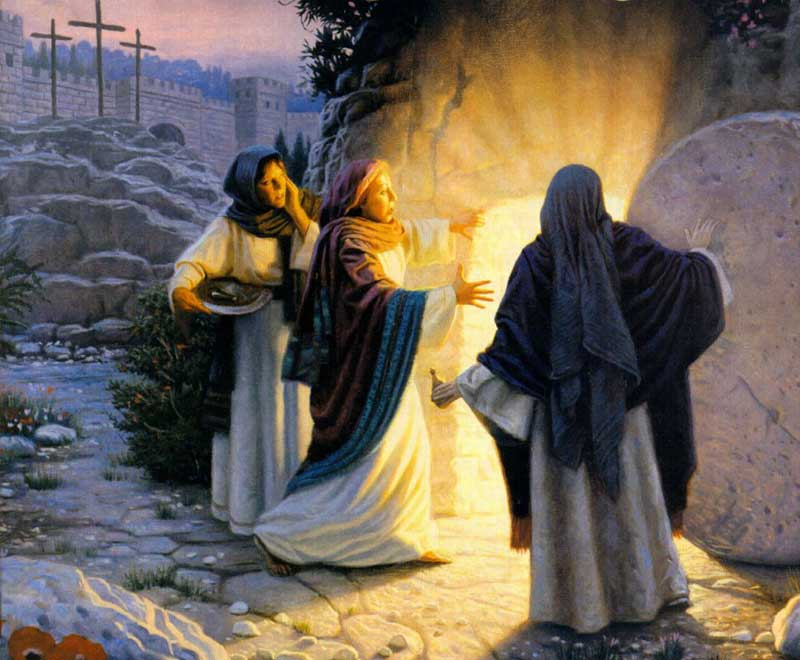
It is a time of vigil while Jesus rests and we await his resurrection on Easter Sunday. Jesus has died to free us from our sins. While he rests, the church is a quiet and sombre place. We think of Jesus’ first followers and of what they must have felt and thought through this time. They must have felt very alone and abandoned, and indeed at risk of losing their own lives [ … ]
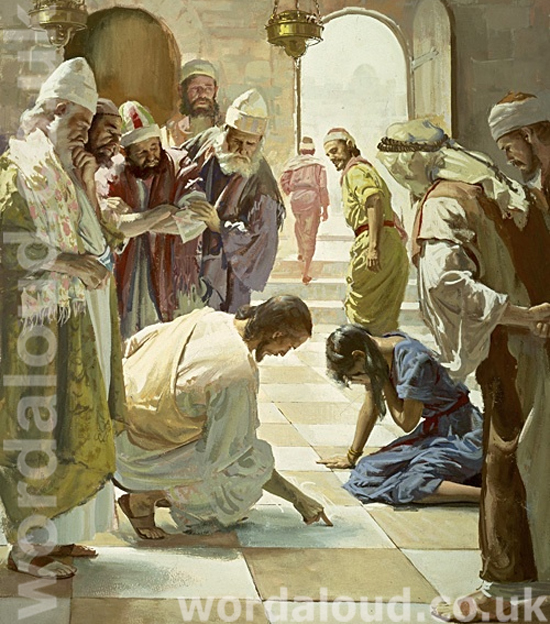
In this passage, Saint John Chrysostom sets out five distinct ‘paths’ by which Christians may repent of sin. His approach is notable for its simplicity and accessibility. He does not treat repentance as a single act confined to sacramental confession or to extraordinary ascetical practice, but as a set of daily habits open to every believer, regardless of wealth or circumstance [ … ]

Saint Augustine reflects on the joy of the just, a joy rooted not in worldly circumstances but in God himself. He takes as his starting point the psalm’s declaration that ‘the just man will rejoice in the Lord’, and he invites the Christian to recognise this as both a present reality and a future promise. Joy in God is, for Augustine, a mark of the just because it springs from faith and hope—virtues that draw the soul beyond what it sees to what it awaits [ … ]
