
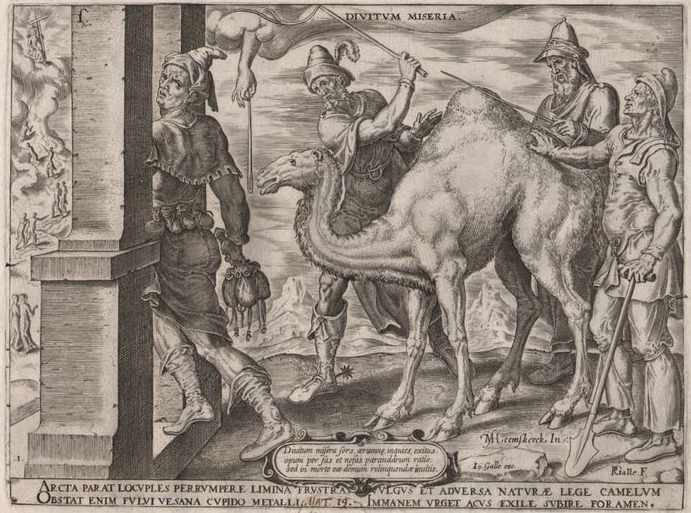
Christian Art | A Camel Through The Eye Of The Needle
Mark 10: 17-27 – Week 8 Ordinary Time, Monday (Audio Bible KJV Spoken Word)
17 ¶ And when he was gone forth into the way, there came one running, and kneeled to him, and asked him, Good Master, what shall I do that I may inherit eternal life?
18 And Jesus said unto him, Why callest thou me good? there is none good but one, that is, God.
19 Thou knowest the commandments, Do not commit adultery, Do not kill, Do not steal, Do not bear false witness, Defraud not, Honour thy father and mother.
20 And he answered and said unto him, Master, all these have I observed from my youth.
21 Then Jesus beholding him loved him, and said unto him, One thing thou lackest: go thy way, sell whatsoever thou hast, and give to the poor, and thou shalt have treasure in heaven: and come, take up the cross, and follow me.
22 And he was sad at that saying, and went away grieved: for he had great possessions.
23 ¶ And Jesus looked round about, and saith unto his disciples, How hardly shall they that have riches enter into the kingdom of God!
24 And the disciples were astonished at his words. But Jesus answereth again, and saith unto them, Children, how hard is it for them that trust in riches to enter into the kingdom of God!
25 It is easier for a camel to go through the eye of a needle, than for a rich man to enter into the kingdom of God.
26 And they were astonished out of measure, saying among themselves, Who then can be saved?
27 And Jesus looking upon them saith, With men it is impossible, but not with God: for with God all things are possible.
The rich young man has recognized what Jesus has to offer him. Moved with great enthusiasm, he runs to Jesus to ask him what he must do. To this, Jesus reminds the young man of the Ten Commandments.
These Bible verses affirm that Jesus is not come to replace the commandments, but rather to fulfil them. Indeed, we may consider the commandments now and find that no part of them has become obsolete. As Christians, we are called to obey the commandments.
This could seem strange. After all, Jesus came to forgive us our sins, and he does much in his ministry to counteract the excessive, and excessively detailed, elaborations of the Jewish observances. The commandments, however, are not an excess, a burden placed upon people to keep them in line; they are at the core of God’s rule for living. In effect, all the sins we commit can be considered a violation of one or more of the Ten Commandments.
Thou shalt not kill. There are few of us who will ever actually kill another human being, but the commandment reaches beyond this bald interpretation. All too often, a person might injure another person through a cruel word or through the omission of a kind word, or we might carelessly withhold much needed deeds of affection, failing to treat every other human being as our neighbour, our brother in Christ.
Thou shalt not commit adultery. Well, when we are married, to cheat on a husband or wife must be almost unthinkable, and yet we see that many people squander their gift of sexuality through promiscuous living and through a way of life which is directed to sexual display and transient gratification, in effect making themselves and other people objects of a sexually oriented idolatry.
Thou shalt not steal. Yet so much that we buy and sell has come at high environmental cost, or a cost in terms of human misery, which is not factored through to the price we pay. Perhaps, then, the rules of the marketplace have led many to pay those who work for them, whether indirectly or directly, the least they could get away with, rather than what would be truly a living wage. There are many who work each day and yet live in poverty, their lives being stolen from them.
Above all, there is the primary, positive commandment: ‘And thou shalt love the Lord thy God with all thy heart, and with all thy soul, and with all thy mind, and with all thy strength.’ This is one commandment Jesus most notably asks of us, concerning his Father and also himself. We are not to regard Jesus as only a great teacher or prophet or healer. We are to love him with all our being. We are to be part of his body. We are to drink his blood and eat his flesh. We are to know that he is the air we breathe, that without him we can do nothing, that our lives are lived through Jesus. We are to know that there is no other good but God’s, and from this all good in our lives flows. This was the commandment of Yahweh to Moses and to the people of Israel. It is now our commandment, as Christians.
The rich young man knows the commandments. Moreover, he has obeyed the commandments from his youth. Surely, then, salvation must be his? Jesus now looks at this young man with love and also pity. There is one thing this rich young man lacks, which is all that he has. To be perfect, he must give away everything that he has, and so follow Jesus.
The rich young man, then, is returned to the first commandment, to love God. His attachment to worldly possessions compromises this. If his mind, his desires, his love, are caught up in his material wealth, then he cannot wholly be with God. The young man has asked Jesus how to achieve everything. Rejecting what Jesus has to say to him, he goes away sorrowful. From now on, all that rich young man’s possessions will only mean this to him: sorrow.
‘It is easier for a camel to go through the eye of a needle, than for a rich man to enter into the kingdom of God.’ This is a difficult saying. Riches can work great wonders in the world. Riches build hospitals and schools, can keep people from dying of malaria, can feed and house people. But it is not money that is the root of all evil; it is the love of money. It is that false love that grasps onto the young man, and so leads him away from God.
‘Follow Christ! You who are single or preparing for marriage. Follow Christ! You who are young or old. Follow Christ! You who are sick or ageing; who are suffering or in pain. You who feel the need for healing, the need for love, the need for a friend – follow Christ!’ John Paul II
Concluding Prayer
Lord God,
who entrusted the earth to mankind
to till it and care for it,
and made the sun to serve people’s needs:
give us the grace this day to work faithfully for your glory
and for our neighbbours’ good.
We make our prayer through our Lord.




The homily reflects the concerns of an early Christian community navigating moral uncertainty, delayed fulfilment, and the practical demands of discipleship. Its tone is pastoral rather than speculative, grounding theological claims in concrete habits of life. The homilist’s central conviction is that the believer’s return to God is both possible and urgent, and that this return takes shape through self-control, repentance, charity, and mutual responsibility within the community [ … ]

Right at the start of Jesus’ ministry, Mark tells us of the fundamental difference between Jesus and other religious teachers. As we listen to these verses, we are struck by the presence of a Christ who is not, as so many in our modern age like to think, only a fine moral teacher, or a wise man with some fascinating spiritual insights to offer us. When Jesus talks about the Scriptures, when he teaches the people about God, he speaks not as the scribes but with authority, and he has that authority because he knows the Father intimately and he is the Son. As the Son, he doesn’t just explain Scripture; it is his right, he has this authority, to change, to add to, to subtract from, to reinterpret what was already received as the word of God [ … ]
Dear Jesus, Thank you for the blessing of family. Help me to appreciate and cherish my family members, both biological and spiritual. Guide me to be a source of love, support, and encouragement to them. Grant us the strength to overcome challenges together and to celebrate our joys with gratitude. May our family be a reflection of your love and grace. Help us to forgive one another, to be patient, and to build each other up. Let your peace reign in our home, and may we always seek to do your will. Amen [ … ]
