

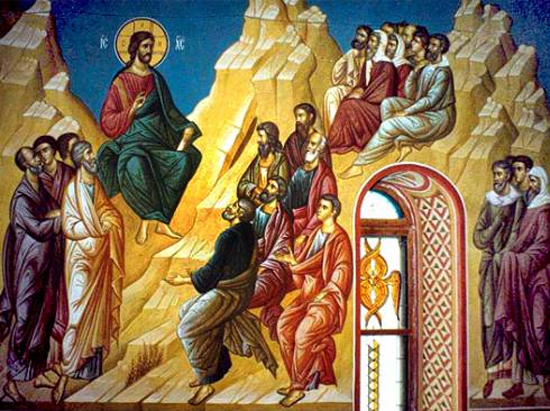
Christian Art | Jesus Teaches His Disciples | Prayer With Jesus
Office Of Readings | Week 11, Friday, Ordinary Time | A Reading From The Treatise Of Saint Cyprian On The Lord’s Prayer | The Peace Of God | We Are God’s Children
‘Let us remain in the peace of God – we who are God’s children.’
‘As God’s Children, Let Us Remain In The Peace Of God’
Saint Cyprian’s meditation on the Lord’s Prayer provides a vivid theological and pastoral reflection on the condition for receiving divine forgiveness: our own willingness to forgive others. This commentary weaves together profound scriptural insight, liturgical theology, and the early Church’s experience of persecution, showing that divine mercy and ecclesial unity are intimately bound together.
Historical And Ecclesial Context
Saint Cyprian, Bishop of Carthage in the third century, wrote during a turbulent time in the life of the Church. Christians were suffering under Roman persecution, particularly during the reign of Decius. One major pastoral challenge he faced was the controversy over the lapsi—those who had denied Christ under duress. Some clergy advocated leniency; others demanded strict exclusion. Cyprian advocated for a merciful middle path, guided by repentance and ecclesial unity.
This historical backdrop illuminates his insistence on forgiveness as a condition of reconciliation, not only with God but also within the Church. It also reveals the urgency behind his call to remain in God’s peace: a community fractured by grudge-bearing or factionalism could not withstand the pressures of persecution.
Theological And Scriptural Themes | The Mutual Condition Of Forgiveness
Cyprian reflects deeply on Jesus’ words: ‘Forgive us our trespasses, as we forgive those who trespass against us.’ This is not a pious phrase but a binding condition. We ask God to treat us by the same standard we apply to others. Cyprian echoes Matthew 7:2 and the parable of the unforgiving servant (Matthew 18:23–35), which he cites explicitly. The lesson is stark: to receive mercy, one must first extend it.
This is reinforced by Jesus’ own teaching: ‘If you do not forgive others, neither will your Father forgive your transgressions.’ (Mark 11:25–26) Forgiveness, then, is not optional; it is intrinsic to the Christian identity and a condition of entering the kingdom.
Liturgical Implications
Cyprian sees this ethic of forgiveness as essential not only morally but liturgically. Citing Matthew 5:23–24, he reminds readers that worship is unacceptable when offered with division or resentment in the heart. The unity of believers is the true sacrifice pleasing to God.
This sheds light on early Christian practice, such as the kiss of peace, which was traditionally exchanged before receiving the Eucharist. The early Church saw this moment not as a mere symbol but as a real enactment of the reconciliation necessary before communion. Only those truly at peace with one another could be at peace with God.
The Peace Of God And The Unity Of The Church
Cyprian describes God’s household as one where believers are of ‘one mind and one heart’. He is echoing Acts 4:32 and anticipating the Church’s eschatological unity in the kingdom. But he also makes this unity a present and necessary reality. Discord among Christians is not just unfortunate; it is a barrier to salvation.
Cyprian is emphatic: ‘Even if [a person] meets death for the sake of Christ’s name, he will still be held guilty of fraternal dissension.’ This echoes 1 John 3:15: ‘Whoever hates his brother is a murderer.’ The Church is not merely a collection of individual believers; it is one body. The health of the whole depends on the reconciliation of its parts.
Patristic Echoes
This vision is not unique to Cyprian. Saint John Chrysostom likewise insisted that the Eucharist must be approached in a spirit of peace: ‘You are preparing to receive the King of peace. And are you still enraged?’
Saint Augustine saw the Our Father as the perfect prayer of unity, and he, like Cyprian, warned against the dangers of saying the words while harbouring division. These Fathers recognised that the prayer’s power lay not just in its words, but in the disposition with which it was prayed.

A Reading From The Treatise Of Saint Cyprian On The Lord’s Prayer | The Peace Of God | We Are God’s Children
Christ has clearly added a law here, binding us to a definite condition, that we should ask for our debts to be forgiven us only as much as we ourselves forgive our debtors, knowing that we cannot obtain what we seek in respect of our own sins unless we ourselves have acted in exactly the same way to those who have sinned against us. This is why he says in another place: By whatever standard you measure, by that standard will you too be measured. And the servant who had all his debt forgiven him by his master but would not forgive his fellow-servant was cast into prison: because he would not forgive his fellow-servant, he lost the indulgence that his master had granted him.
And Christ makes this point even more strongly in his teaching: When you stand up to pray, he says, if you have anything against anyone, forgive it, so that your Father who is in heaven may forgive your sins. But if you do not forgive, nor will your Father in heaven forgive you. On the day of judgement there are no possible excuses: you will be judged according to your own sentence, and whatever you have inflicted, that is what you will suffer.
For God commands us to be peacemakers, and to agree, and to be of one mind in his house. What he has made us by the second birth he wishes us to continue during our infancy, that we who have begun to be children of God may abide in his peace, and that having one spirit we should also have one heart and one mind. Thus God does not accept the sacrifice of one who is in disagreement but commands him to go back from the altar and first be reconciled with his brother, so that God may be placated by the prayers of a peacemaker. Our peace and concord are the greatest possible sacrifice to God – a people united in the unity of the Father, and of the Son, and of the Holy Spirit.
Not even when Abel and Cain were making the first sacrifice – not even then did God pay attention to their gifts. He looked into their hearts, and the gift that was acceptable was the one offered by the one who was acceptable in his heart. Abel, peaceable and righteous in sacrificing in innocence to God, taught the rest of us that when we bring our gift to the altar we should come, like him, with the fear of God, with a heart free of deceit, with the law of righteousness, with the peace of concord. He sacrificed in such a way, and so he was worthy to become, afterwards, himself a sacrifice to God: he who bore witness through the first martyrdom, who initiated the Lord’s passion by the glory of his blood, had both the Lord’s righteousness and the Lord’s peace. Such are those who are crowned by the Lord at the end; such are those who will sit and judge with him on the day of judgement.
But he who quarrels and stirs up discord, he who is not at peace with his brethren – the Apostle and holy Scripture together testify that even if he meets death for the sake of Christ’s name, he will still be held guilty of fraternal dissension, for it is written, whoever hates his brother is a murderer, and the murderer cannot attain the kingdom of heaven or abide with God. No-one can be with Christ who preferred to imitate Judas rather than Christ.
Prayer With Jesus
Lord Jesus Christ, Prince of Peace, You taught us to pray as one people, not only for ourselves but for all your Church. You gave us your own prayer, and with it a commandment to forgive. Cleanse our hearts from resentment, nourish us with the bread of life, and unite us in the peace of your Spirit. Make us, like Abel, worthy to offer ourselves to you in righteousness and love. Let your Church be one, as you and the Father are one, that your name may be glorified in every heart, now and forever. Amen.
Glossary Of Christian Terms
- Lapsi: Christians who renounced their faith under persecution, later seeking to return to the Church.
- Kiss of Peace: An ancient liturgical gesture signifying reconciliation before Communion.
- Fraternal dissension: Division or enmity among fellow believers; Cyprian warns it endangers salvation.
- Patristic: Relating to the Church Fathers (early Christian theologians and writers).
- Eucharistic communion: Receiving the Body and Blood of Christ in the Eucharist, requiring unity and peace.
- Our Father / Lord’s Prayer: The prayer given by Jesus to his disciples, central to Christian communal worship.
- Sacrifice of the altar: The offering of the Eucharist; Cyprian insists it must be made in a spirit of reconciliation.
- Unanimity in prayer: A key theme for Cyprian; unity in heart and intention is essential for effective communal prayer.




Saint Augustine begins by naming the Passion of Christ as ‘the hope of glory and a lesson in patience’. In other words, it is both a promise and a pattern. The Cross, he tells us, is not only what saves us—it also teaches us how to live. It shows us how God loves, and how we are called to love in return: not with power or prestige, but with endurance, humility, and self-giving [ … ]

This remarkable homily from Origen, one of the most influential theologians of the early Church, invites the Christian to see biblical history not as distant or mythic, but as deeply personal and spiritually present. Drawing on the account of Israel’s miraculous crossing of the Jordan River in the book of Joshua, Origen constructs a rich allegory of Christian initiation, interpreting the Old Testament narrative as a prefiguration of the sacraments and the journey of the soul [ … ]
When we are offended or injured, Jesus teaches us not to demand pay-back, an eye for our eye, a tooth for our tooth, but rather to forgive, and where there was hatred, to bring instead to the situation the opposite of hatred, which is love [ … ]
