
Christian Art | Oh Jerusalem | Jesus In The Gospels | King James Audio Bible KJV
Luke 13: 31-35 – Week 30 Ordinary Time, Thursday (King James Audio Bible KJV, Spoken Word)
31 ¶ The same day there came certain of the Pharisees, saying unto him, Get thee out, and depart hence: for Herod will kill thee.
32 And he said unto them, Go ye, and tell that fox, Behold, I cast out devils, and I do cures to day and to morrow, and the third day I shall be perfected.
33 Nevertheless I must walk to day, and to morrow, and the day following: for it cannot be that a prophet perish out of Jerusalem.
34 O Jerusalem, Jerusalem, which killest the prophets, and stonest them that are sent unto thee; how often would I have gathered thy children together, as a hen doth gather her brood under her wings, and ye would not!
35 Behold, your house is left unto you desolate: and verily I say unto you, Ye shall not see me, until the time come when ye shall say, Blessed is he that cometh in the name of the Lord.
Some few of the Pharisees now show solidarity with Jesus, warning him that Herod Antipas means to kill him. Herod has previously expressed a wish to meet Jesus (Luke 9: 9), about whom he was perplexed, wondering if John the Baptist had risen again. We do not know whether the Pharisees simply want to get Jesus to go away or if there is danger.
In calling Herod a fox, Jesus rejects Herod for his duplicity, and affirms his independent authority to perform his healing work, with the symbolic suggestion that such work tends toward the cross, and to perfection on the third day. Nevertheless, he must leave and continue to travel to Jerusalem: the hour of Jesus’ death is not to be determined by Herod.
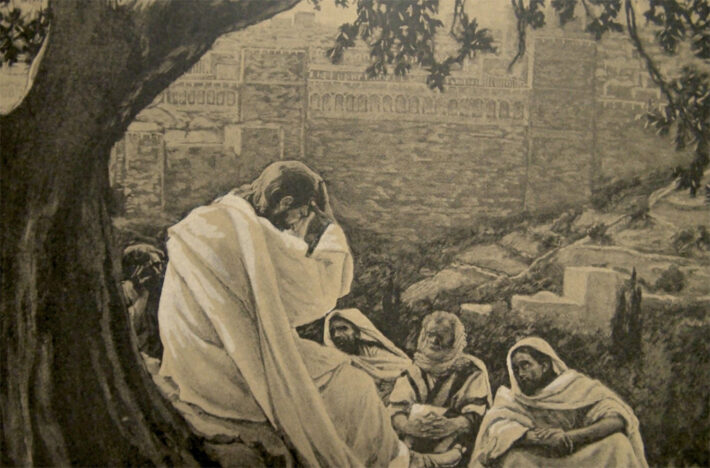
Christ’s lament for Jerusalem shows such loving tenderness. There is such pity as he considers the fate of the prophets and the recalcitrance of the city. So much could have been done had the city authorities especially not hardened their hearts against God’s word, had they opened themselves to allow the grace of God to come to them. As it is, history is set to take a different course. The house will be left desolate.
Concluding Prayer | Love Revealed By Jesus Christ
Be merciful unto me, O God, be merciful unto me:
for my soul trusteth in thee:
yea, in the shadow of thy wings will I make my refuge,
until these calamities be overpast. (Psalm 57/56)


King James Audio Bible | Endnotes
O Jerusalem, Jerusalem, Which Killest The Prophets
Luke 13:31-35 is a poignant passage that reveals the heart of Jesus towards Jerusalem, a city that had rejected and killed the prophets sent to her by God. In this passage, Jesus laments over the city, expressing his deep sorrow and love for its people, even as Jesus foretells its imminent destruction.
The passage begins with Pharisees warning Jesus that Herod, the ruler of Galilee, was seeking to kill Jesus. Jesus responds by telling them that he must continue his work of healing and casting out demons until he reaches Jerusalem, where he will meet his fate. Jesus then utters the heartbreaking words: ‘O Jerusalem, Jerusalem, which killest the prophets, and stonest them that are sent unto thee; how often would I have gathered thy children together, as a hen doth gather her brood under her wings, and ye would not!’ (Luke 13:34)
These words reveal the depth of Jesus’ love for Jerusalem, even in the face of its rejection of Jess and the prophets who came before him.
Let us consider Old Testament passages that Jesus may have had in mind when he spoke of Jerusalem killing the prophets.
In 2 Chronicles 24:19-21, we read of how the prophet Zechariah was stoned to death in the court of the temple by the orders of King Joash.
In 1 Kings 19:10, Elijah complained to God: ‘I have been very jealous for the Lord God of hosts: for the children of Israel have forsaken thy covenant, thrown down thine altars, and slain thy prophets with the sword; and I, even I only, am left; and they seek my life, to take it away.’
The killing of the prophets was not a new phenomenon in Jesus’ time but was a pattern that had repeated itself throughout Israel’s history.
Jesus’ reference to gathering Jerusalem’s children under his wings is an allusion to a metaphor used in the Old Testament to describe God’s protective care over His people. In Psalm 17:8, the psalmist prays: ‘Keep me as the apple of the eye, hide me under the shadow of thy wings.’
Similarly, in Psalm 91:4, it is written: ‘He shall cover thee with his feathers, and under his wings shalt thou trust: his truth shall be thy shield and buckler.’ This imagery highlights Jesus’ desire to shelter and protect Jerusalem, just as a mother hen gathers her chicks under her wings for safety.
In the New Testament, we find that the rejection of the prophets and the killing of Jesus are intimately linked. In Matthew 23:29-36, Jesus chastises the scribes and Pharisees for their hypocrisy and warns them that they are following in the footsteps of their forefathers, who killed the prophets. Jesus then declares: ‘Behold, I send unto you prophets, and wise men, and scribes: and some of them ye shall kill and crucify; and some of them shall ye scourge in your synagogues, and persecute them from city to city: That upon you may come all the righteous blood shed upon the earth, from the blood of righteous Abel unto the blood of Zacharias son of Barachias, whom ye slew between the temple and the altar.’ (Matthew 23:34-35) Here, Jesus prophesies His own death and connects it to the long history of Israel’s rejection of God’s messengers.
In Acts 7, we see the stoning of Saint Stephen, the first Christian martyr, by the Jewish authorities. Saint Stephen’s speech before his death echoes the words of Jesus, as Saint Stephen accuses the Jews of resisting the Holy Spirit and killing the prophets.
Saint Stephen proclaims: ‘Which of the prophets have not your fathers persecuted? and they have slain them which shewed before of the coming of the Just One; of whom ye have been now the betrayers and murderers’ (Acts 7:52). Saint Stephen’s death, like that of Zechariah and the other prophets, is a testament to the hardness of heart of the people of Jerusalem, who rejected the message of God’s messengers time and again.
However, despite this pattern of rejection and violence, Jesus still longs to gather the people of Jerusalem to himself. This is evident in Jesus’ words of lament in Luke 19:41-44, when Jesus weeps over the city and prophesies its destruction: ‘If thou hadst known, even thou, at least in this thy day, the things which belong unto thy peace! but now they are hid from thine eyes…because thou knewest not the time of thy visitation.’ (Luke 19:42-44) This sorrowful lament demonstrates Jesus’ love and compassion for the people of Jerusalem, even as he foretells their judgment.
The theme of rejection and of a welcoming back is most powerfully expressed in the parable of the prodigal son, in which a wayward son is welcomed back with open arms by his father, despite his rebellion and rejection. This parable demonstrates the radical nature of God’s love, which extends even to those who have turned away from Him.
Luke 13:31-35 is a powerful passage that reveals the heart of Jesus towards Jerusalem and His people. Despite their rejection of Jesus and the prophets who came before him, Jesus still longs to gather them to himself, as a mother hen gathers her chicks. A pattern of rejection and acceptance characterizes God’s relationship with His people.



The reading reflects on the baptism of Christ as a moment of revelation and renewal. The author begins by stressing the paradox of the event: Christ, who is the source of life, enters the waters of the Jordan. The language highlights the contrast between Christ’s divine identity and the humility of his action. The one who sustains creation submits freely to baptism, not out of need, but in obedience to the Father’s will [ … ]

Saint Augustine begins by asserting that our lives on earth should center on the praise of God because this is what we shall do eternally in heaven. His well-known anthropology, articulated in the Confessions (Book I), declares, ‘You have made us for yourself, O Lord, and our hearts are restless until they rest in you.’ In this restlessness, Augustine sees a divine gift: a yearning that trains us for heaven. The joy of praising God is not merely a future reward but a present discipline that forms the soul in divine love [ … ]

In this reading, Saint Basil the Great—a towering theological mind of the early Church—guides us into the heart of the Paschal Mystery. His meditation on Christ’s passion and our participation in it through baptism offers profound insight into the transformative meaning of Holy Week. Basil’s message is simple but immense: by one death and resurrection—Christ’s—the world was saved. And we, through baptism, are drawn into that saving mystery [ … ]
